There's little else to talk about in the NBA right this second other than team's negotiations with their own free agents. Until a bunch of teenagers in suits file into the green room next week, that's really about all that legally happen in the NBA, which is why it's been wall-to-wall Walker Kessler talk this week.
This article won't delve too deeply into the larger questions about Kessler's restricted free agency and reported offer process. SCH's Zarin Ficklin dug into Kessler's archetype and comps, and then Mark Pereira and Ken Clayton tackled rumors that Kessler wants more than the Jazz have offered.
So I won't wade into that any further, other than to say that everything that has gone on so far is pretty typical of RFA negotiations, and that's nobody's fault. Kessler wants to make the most he can make for being a very good starting NBA center, and the Jazz have leverage afforded to them by the current RFA rules that they will undoubtedly (and smartly) use. It's how this goes.
What I did want to do is briefly(?) talk about the idea of Kessler sign-and-trade deals. While that's technically one possible way the current stalemate could play out, sign-and-trade transactions are a lot harder to orchestrate than most people realize.
S&T salary matching
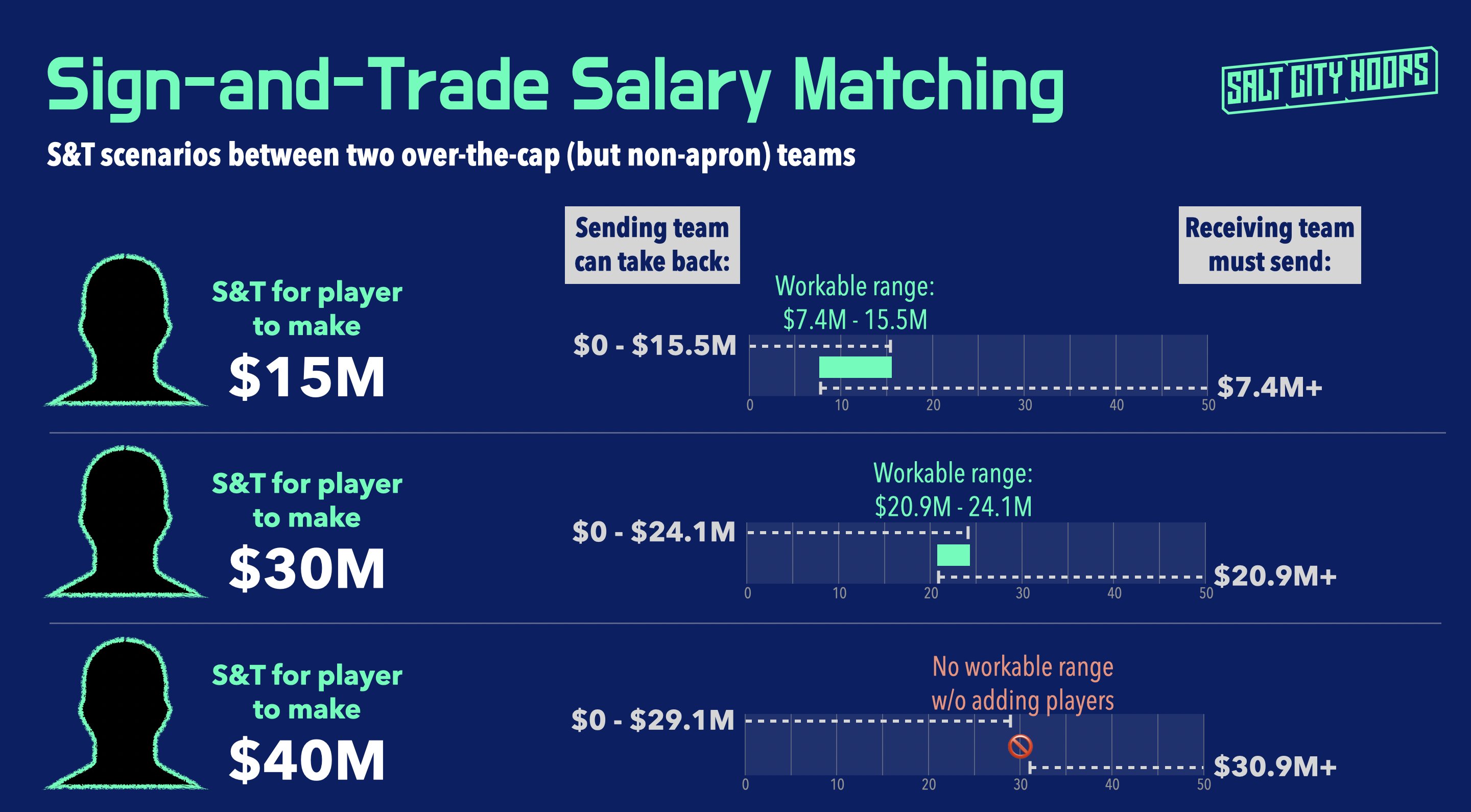
If an over-the-cap team uses a player's Bird (or Early Bird) rights to carry out a sign-and-trade to another team while the player gets a >20% raise, then the math gets weird. The team receiving the player has to send enough salary out to acquire his full new salary, but the sending team has to treat that outgoing salary as less than what it really is.
In that scenario, the sending team calculates their side of the trade based off the greater of:
- The player's salary in the last year before the S&T, *OR*
- 50% of the player's first-year salary on the new deal
The effect this has is that it narrows the workable range where the salary coming back actually works in both directions. The higher the salary, the narrower that window gets, up to the point where there's literally no overlap at all.
Kessler S&T?
In Kessler's case, that means if he agrees to a deal starting at $30 million via sign-and-trade, his outgoing salary on the Jazz's end is $15M. The Jazz could only trade him if they received a player (or players) making between $0 and $24.1M based on what are called "expanded" salary matching rules[fn]Expanded just means that they're available to over-the-cap teams but not to apron teams. If the Jazz go over the apron, it's a whole other level of complicated.[/fn]. But the team receiving Kessler would have to send $20.9M or more for Kessler's new salary to fit into their own trade exception.
That means the whole workable range for such a deal is just that tiny window: $20.9M to $24.1M. Only five players in the whole NBA could be traded straight-up in a Kessler S&T at that salary. Obviously they could stack 2+ smaller salaries to get in that range, but the point is that it just makes the path to a workable deal much more narrow.
So how to teams manage it? The most obvious option is to add salary to one side of the deal or the other by having someone send a small contract to a third team.
- If the Jazz send a $4M salary elsewhere in the same deal, they can now take back up to $28.1M, creating more options for who they could take back. Now the workable range is $20.9M to $28.1M.
- If the receiving teams sends a $4M salary elsewhere, then they don't need to send as much salary to the Jazz specifically. Now the workable range is $16.9M to $24.1M.
Both options widen the window, but also require a third able to take salary. They have to be willing to help out too, either because they like the player that salary is attached to or because they get to charge a facilitation fee.
This is why sign-and-trades are rare, but they do happen. Collin Sexton arrived in Utah via S&T when he agreed to be included in the 2022 Cavs-Jazz trade. Reigning Most Improved Player Nickeil Alexander-Walker was a sign-and-trade. Max Strus, Klay Thompson, DeMar DeRozan... technically the Jazz signed-and-traded Kris Dunn to the Clippers. It's doable... there's just a lot of maneuvering involved, especially for larger salaries.
Double S&Ts
Transactions involving multiple players getting signed-and-traded are even rarer. The math just gets so complicated when both teams have to ladder up to a big salary while only counting their outgoing guy at a fraction of his actual new salary.
Some Jazz fans have floated the idea of a Kessler-for-Austin-Reaves swap if the sides can't get to a number everybody's happy with. Let's tug that thread. The Lakers have expressed interest in Kessler before, and Reaves fills some Jazz needs.
But LA folks aren't looking to trade a guy who was trending toward an All-Star spot before he got injured last season. If you listen to Laker-focused analysts, their idea is not to replace their secondary star with Kessler, but have them join up. And even if the Lakers were willing to move Reaves in a Kessler deal[fn]They're almost surely not.[/fn], the math would be insanely difficult. Reaves probably has a case for a near-max deal, but even if he'd sign for the mid 30s, Utah would have to add millions to Kessler's artificially lowered salary, and the Lakers couldn't really take it.
The last double sign-and-trade in the NBA was when Kevin Durant and D'Angelo Russell swapped coasts in 2019, and that primarily worked because Durant's salary didn't change that much and because the Nets had some cap flexibility.
Tl;DR... don't bank on a double sign-and-trade.
Imagining packages
Let's assume Reaves-for-Kessler is not on table. How then would the Lakers and some other known Kessler suitors make a trade work?
LAL just about has to include Jarred Vanderbilt, plus one of Jake LaRavia or Dalton Knecht. Either guy gets them to a place where they could start Kessler in the mid 20s. The Jazz would surely want draft compensation there, especially because Vanderbilt has a player option after this year and didn't work out super great during his brief Utah stay four seasons ago.
Indiana was interested in Kessler previously, but landed Ivica Zubac instead. They're probably no longer in pursuit.
Chicago might be. They have the option of completing a hypothetical Kessler trade using cap space, meaning they wouldn't have to send players Utah's lukewarm about. That means their package would likely be asset-centric — essentially offering enough to gain the Jazz's cooperation so they don't have to gamble on an offer sheet.
---
The forecast from this scribe is still that this will most likely end with Kessler in a Jazz uniform, but it might take a while to get to that point. In each of the last couple of offseasons, the RFAs have been among the very last to sign, because the current system lends itself to protracted staring contests.
Non-max, high-quality starters might be the toughest negotiation in the NBA cap environment. Stars get the max, easy button. Role players haggle over exception money. But value gets really subjective when talking about guys in this type of tier: impactful, young enough to continue improving, but not quite star-level.
For now, the showdown continues.