
After Summer League, it’s difficult to contain the Darryn Peterson hype. After all, year after year we see players post gaudy stats in exhibition games, then fail to translate in regulation. Even looking at past Summer League MVPs, many are simply nice role players or out of the league completely. With Peterson, though, things feel different.
For one, Peterson emphatically made counterarguments to the ideas that he’s not a good rim attacker or passer. It appears the athleticism he showed in high school is back, as he drove to the basket at will, and then dished out 12 assists in his second game.
Peterson was the second pick in a loaded draft class. He posted historic shooting numbers in college despite health issues. And all stats aside, he simply looks the part. Watch these Summer League games, and you see a player who looks as smooth and controlled as a 5-year vet, unfazed by the defense. He can get to any spot on the court and makes the right reads. The eye test is screaming that this is a superstar.
For Jazz fans who have been starved of a “number one guy” to slot into a roster with complementary players, it’s natural to feel like we should temper excitement. We haven’t seen Peterson play in full NBA games yet. The league is loaded with talent, and ascending to the highest tiers of players is incredibly difficult.
But still, you can’t help but ask, what if Peterson can ultimately have an impact like Shai Gilgeous-Alexander's? Or even Kobe Bryant's? How good will Peterson be as a rookie, and what should we fairly expect?
I posted some polls on X.com to see how the Jazz community felt. This was before Summer League.
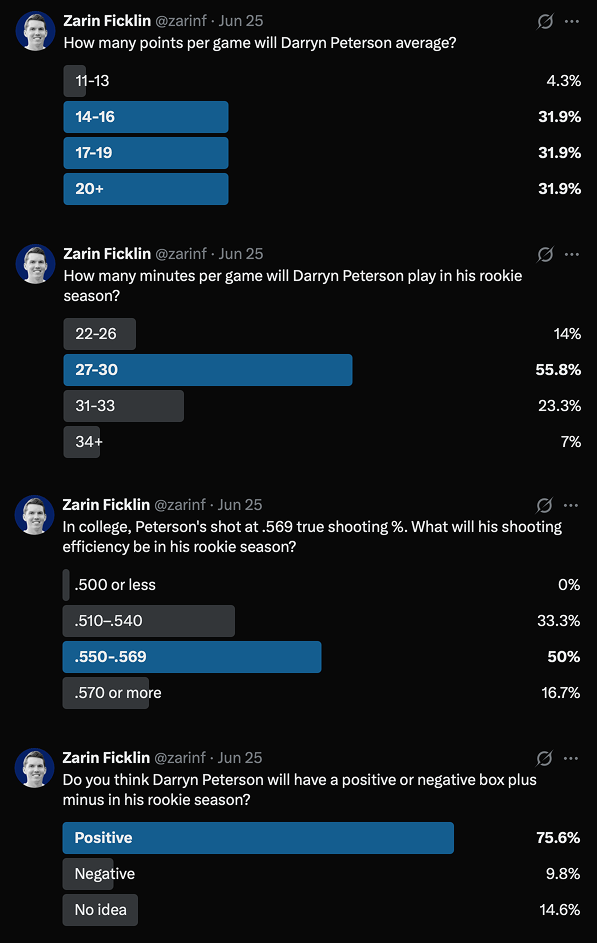
At face value, and especially after what we’ve seen from DP so far, these seem like reasonable predictions. Let’s say 18 PPG on slightly above-average efficiency in 28 MPG, with a positive impact on winning.
Let’s go back to SGA and Kobe, who have a combined three MVPs, three Finals MVPs, and six championships. In their rookie seasons:
- Kobe: 7.6 PPG, 15.5 MPG, .544 TS%, -0.1 BPM
- SGA: 10.8 PPG, 26.5 MPG, .554 TS%, -0.5 BPM
Kobe played off the bench for a playoff-competitive team as a teenager, while SGA mostly started on a scrappy No. 8 seed. Both became generational players, but if Darryn Peterson replicated their rookie production this season, it would likely be considered a disappointment. All of that is to say: DP may not reach our sky-high expectations in year one and could still have a path toward a Hall of Fame career.
To be fair, if you canvas the group of star guards similar to Peterson, Kobe and SGA are outliers of sorts. And I do expect that Peterson will have a better rookie season. Let’s dive into what his rookie season could reasonably look like if we believe in the current hype.
Points per game
Watch the high school tape, the college games, and now Summer League, and it’s clear that Peterson is a gifted scorer. After seeing how he picked apart Atlanta and Memphis defenses with ease, could he score 20+ in his first season? Even though the eye test says “definitely,” there is little historical precedent. Here’s how many points per game these star guards averaged in their rookie seasons:
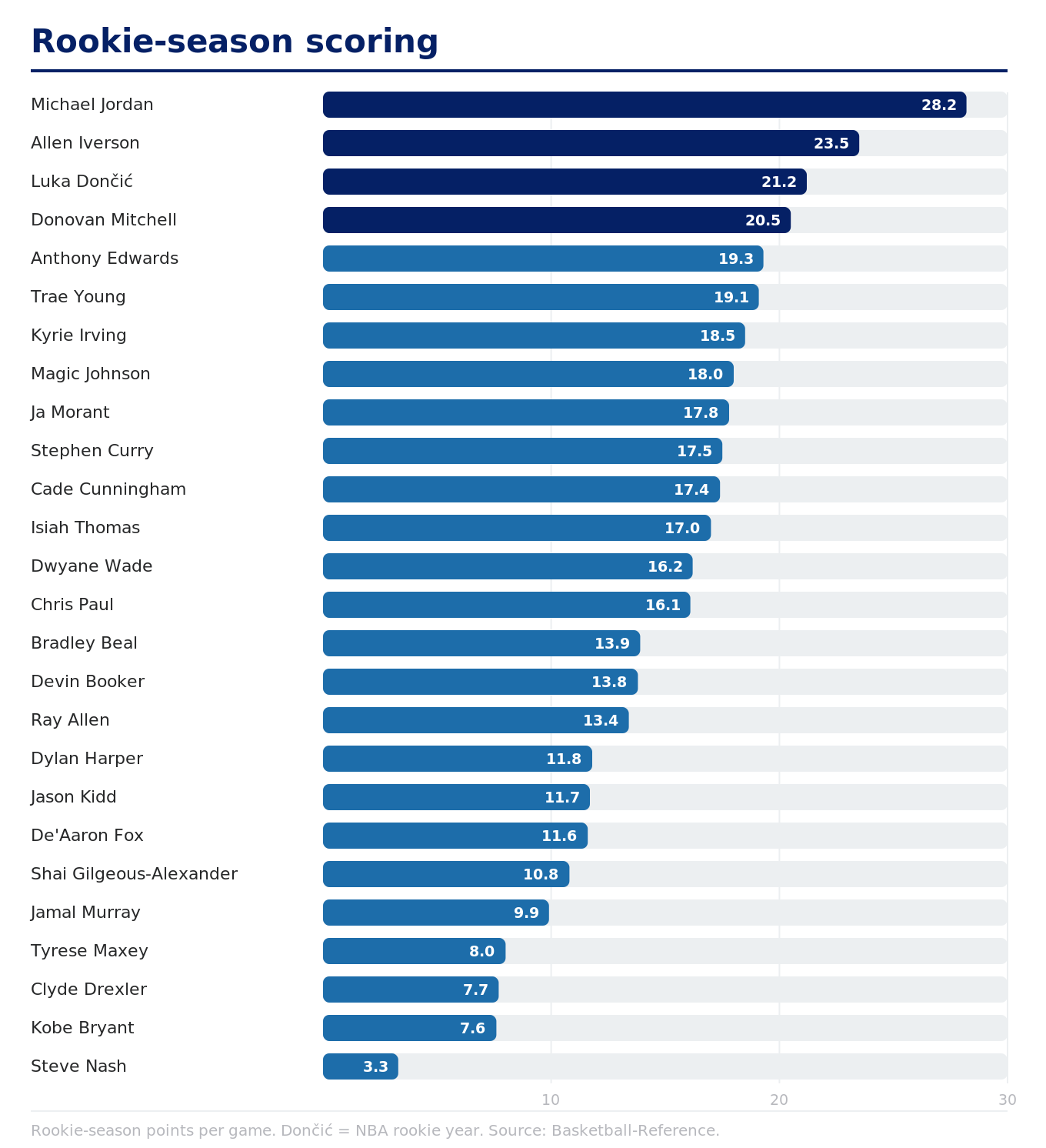
Michael Jordan is Michael Jordan. Iverson played 40 minutes per game. Injuries made Luka Doncic's the only 2018-19 Mav to cross 2,000 minutes. And Donovan Mitchell, as Jazz fans well know, joined a team devoid of a primary scorer after Gordon Hayward’s departure. No one else cracked 20+ PPG.
Now, Peterson could just be that gifted a scorer. And maybe if placed in a situation similar to Mitchell’s he would post similar numbers. But he’ll be joining a team of players who last season averaged:
- Lauri Markkanen: 26.7
- Keyonte George: 23.6
- Jaren Jackson Jr.: 19.2
Not to mention Ace Bailey, Jusuf Nurkic, Isaiah Collier, Brice Sensabaugh, and Kyle Filipowski, who all averaged double digits. The team has a lot of offensive firepower, and no player wants to give up touches. Some Jazz players will have to, and it will be interesting to see who reduces their field goal attempts. If Peterson does prove to be an efficient top option as a rookie, where will he rank in the pecking order?
If I had to predict, the 17-19 PPG range feels safest, but anything could happen. Let’s say 18.0 PPG.
Minutes per game
There has been much discourse about what Utah’s starting lineup will look like. Will Nurkic start at center, or will JJJ? Will Bailey or Peterson come off the bench? There is the notion that no rookie in Will Hardy’s system is entitled to a role despite their draft position -- after all, we saw Ace come off the bench at the beginning of his rookie season. It’s a good idea to squash rookie entitlement, but I don’t foresee that being an issue with Peterson. Despite possessing obvious confidence, his interview answers are team-centric. And Peterson’s play and work ethic could very well warrant a starting role day one. That said, there’s wisdom in bringing a rookie along at a controlled pace. This seemed to serve Ace well.
Honestly, I wouldn’t be surprised if DP starts or comes off the bench on opening night. Either way, he’ll start soon enough, and should have a prominent role on the team. I would confidently pencil him in for 30+ MPG. He looks that good already, and despite all the talent on Utah’s team, there is a wide-open gap at shooting guard. But even if that’s not the case, look at the star examples below. Plenty had sub-30 MPG seasons and turned out just fine.

Jazz Twitter voted for 27–30 MPG, but I’m going over, with 31.5 MPG as my choice.
Shooting efficiency (TS%)
For context, league-average true shooting percentage for guards in the NBA is around .570. In the NCAA, it’s a little lower. Peterson’s TS% at Kansas was .569. This was actually an exceptional figure considering the lack of spacing on his college team, the degree of difficulty on his shots, and the enormous 33 percent usage rate. If he were a lower-usage off-ball sniper on a better team, I would expect that efficiency to be much higher.
On the Jazz, he’ll likely play a mix of both on- and off-ball while paired with George. With Key, Lauri, and JJJ all capable scorers, DP shouldn’t shoulder such a high usage burden. And with such a gift for putting the ball in the basket, there’s reason to believe DP can be an efficient scorer, even as a rookie.
Half of the polled Jazz fans believed that DP would be slightly less or exactly as efficient as he was in college, somewhere between .550 and .569 TS%.
But again, look at our list of guards, and very few met even that benchmark.

For those who cleared .550 TS%, you have historically efficient players like MJ, Steph, and Kyrie. Or low-volume 3-point shooters like Morant, SGA, and Nash. Only Jordan, Magic, Curry, and last season’s Dylan Harper were above average in efficiency. If Peterson can join them, he’s in elite company.
As far as predictions go, I’ll join Jazz Twitter at .550 TS%, slightly below league average. Even that would be a huge achievement.
Winning impact (BPM)
In college, Peterson had an incredible box plus/minus rating of +9.3, arguably the best ever by a freshman guard (there are a few different college BPM models with slight variances).
Advanced metrics like BPM can be unwieldy, but whichever stat you choose, the truth is that rookies rarely help you win. Let’s look at our star cohort once more:
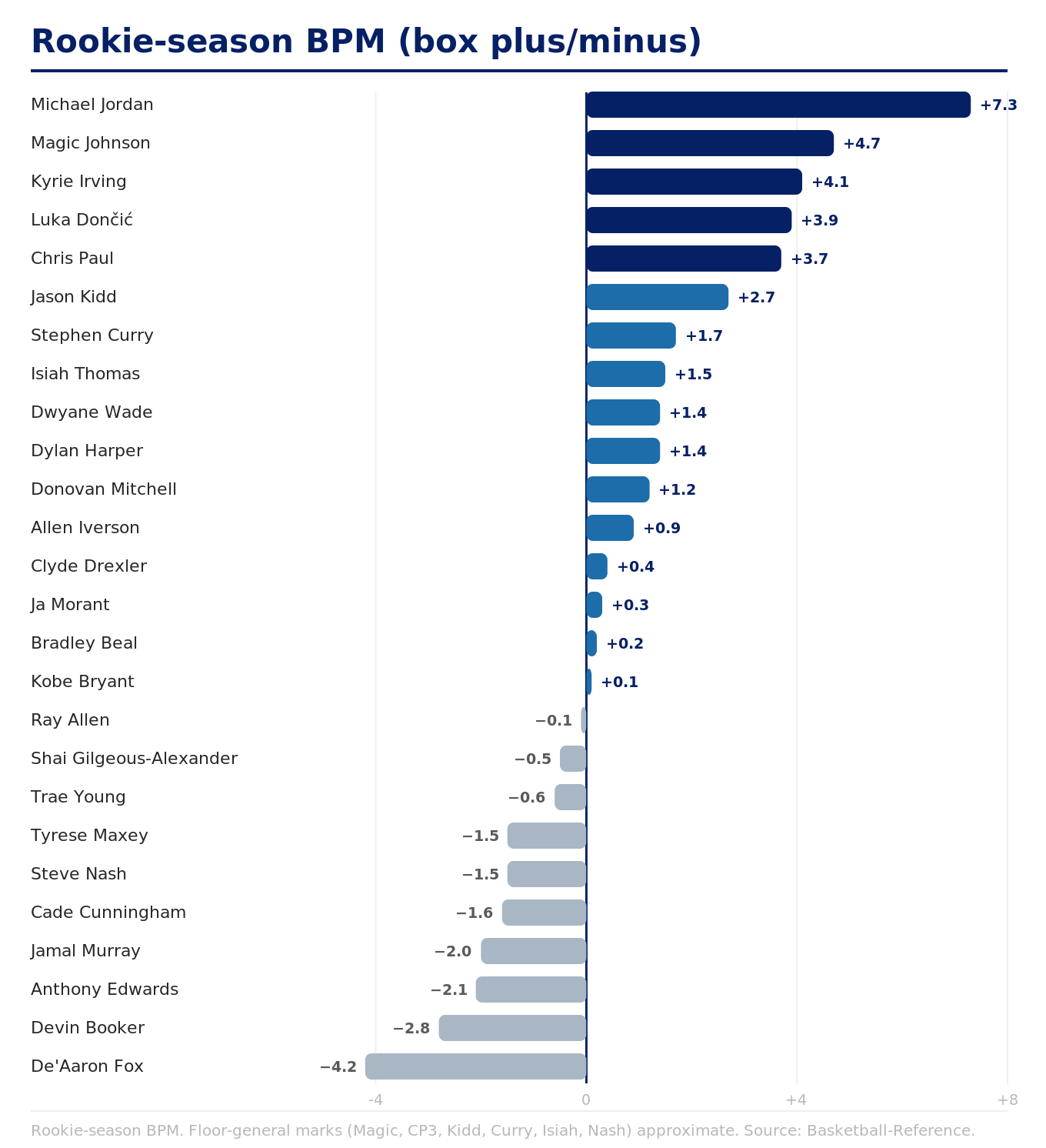
Among those with a positively impactful rookie season, most are enshrined Hall of Famers or locks to join them. The top eight are some of the best guards in NBA history.
It’s worth noting that while the BPM model does apply a team adjustment, playing on a winning team does modestly inflate a player’s rating. This should help Peterson.
But even if he is a positive BPM player, rating higher than +1.0 would be extremely difficult. I will cop out and agree with the poll results that Peterson will be positive, but just barely, at +0.5.
Stats aside for a moment, let’s look at playoff success. Most star guards are drafted to losing teams and don’t sniff the playoffs in their rookie seasons.
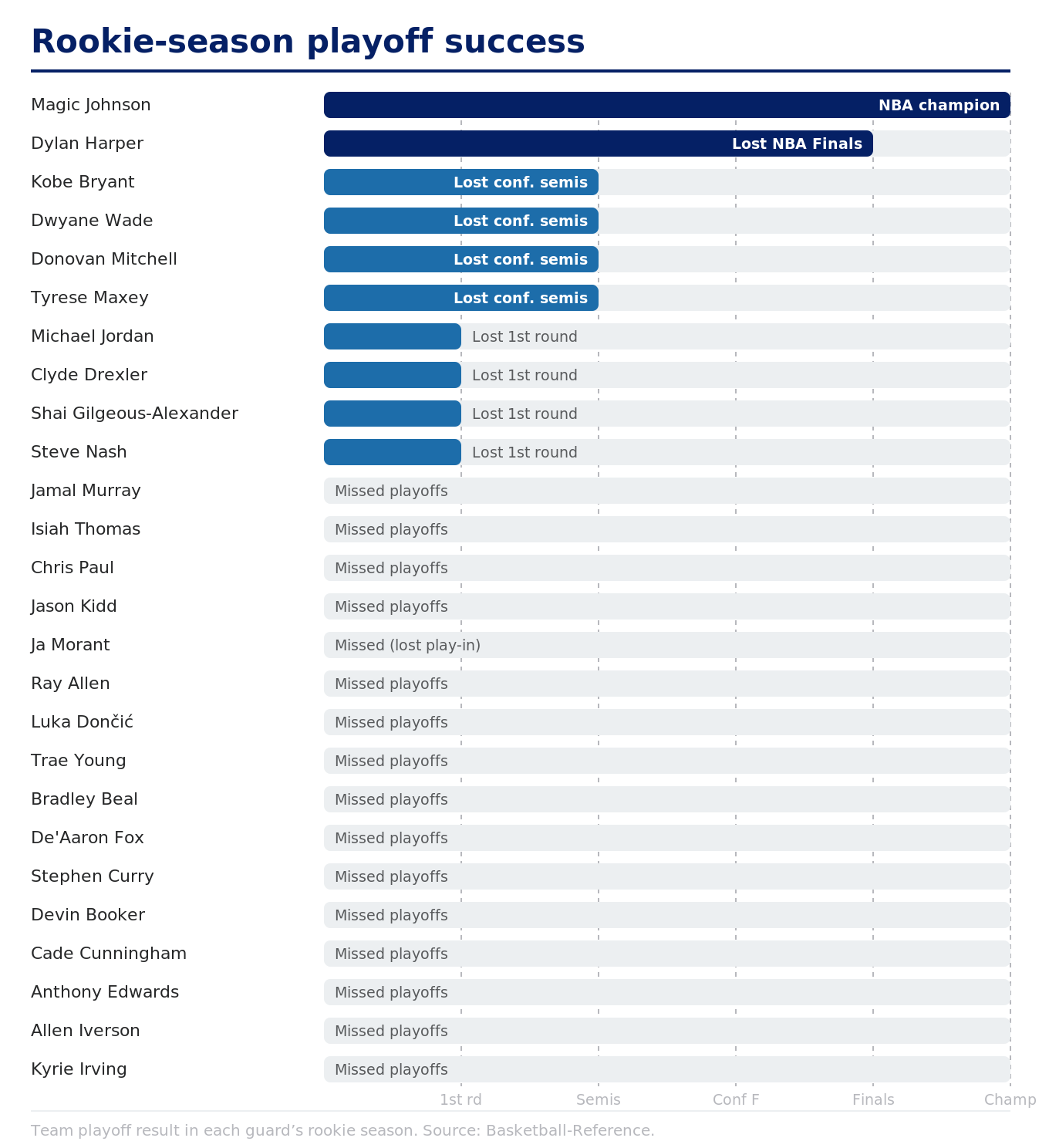
Magic is the true outlier, as the only star guard to lead his team to a championship. Kobe, Maxey, Clyde, Nash, and Harper played off the bench.
If Peterson starts in a playoff game, it’s already a big achievement. If he starts and makes it past round one, he joins the short list of Mitchell, Wade, and Magic.
I’ll predict that Peterson does indeed start in the playoffs, but not past the first series.
Defense (DBPM)
Lastly, let’s look at Peterson’s defense. In college, he posted a sublime 4.8 defensive box plus/minus. Since there are fewer tracked defensive statistics than offensive, so using advanced defensive catch-alls can sometimes be imprecise. But it’s one indicator to look at anyway. It’s also worth noting that DBPM wasn’t tracked among college players until 2011. But with all that in mind, signs are very positive for Peterson. Among the star guard cohort we’ve been measuring, only Donovan Mitchell (+5.5) and Kyrie Irving (+5.0 in only 11 games) bested DP’s rating.
And no player improved their college DBPM in their rookie season. Every player in the list below had a sharp drop, nearly all becoming negatively impactful defenders. It turns out that NBA defense is hard. From the full list, only CP3, Magic, MJ, Clyde, and Dylan Harper had a +1.0 DBPM or better.

In addition to the gaudy DBPM, Peterson also had a 2.3% block rate and 2.9% steal rate. Those combined numbers have been matched only by bona fide defenders like Cason Wallace, Kawhi Leonard, and Jalen Suggs. Depending on the offensive workload, Peterson could join the small group of players who translate into impactful defenders right away. But the historical data still points to a higher likelihood of negative impact in year one. Let’s predict he ends with a dead-even 0.0 DBPM.
Overall predictions
I may as well guess at some other raw stats, and present my final predictions as follows:
- 18.0 PPG
- 31.5 MPG
- .550 TS%
- +0.5 BPM
- 0.0 DBPM
- First round of the playoffs
- 3.5 APG
- 3.0 RPG
- 1.0 SPG
- 0.6 BPG
Whether or not those seem modest, they lean optimistic relative to historical precedent. If DP reaches these numbers I would mark that as a massive success[fn]Editor's note: only 83 rookies have ever averaged 18ppg-3rpg-3apg, without even accounting for the other stats...[/fn]. Whatever happens, it will be entertaining to watch, and I will revisit these next year to see how far off I am.