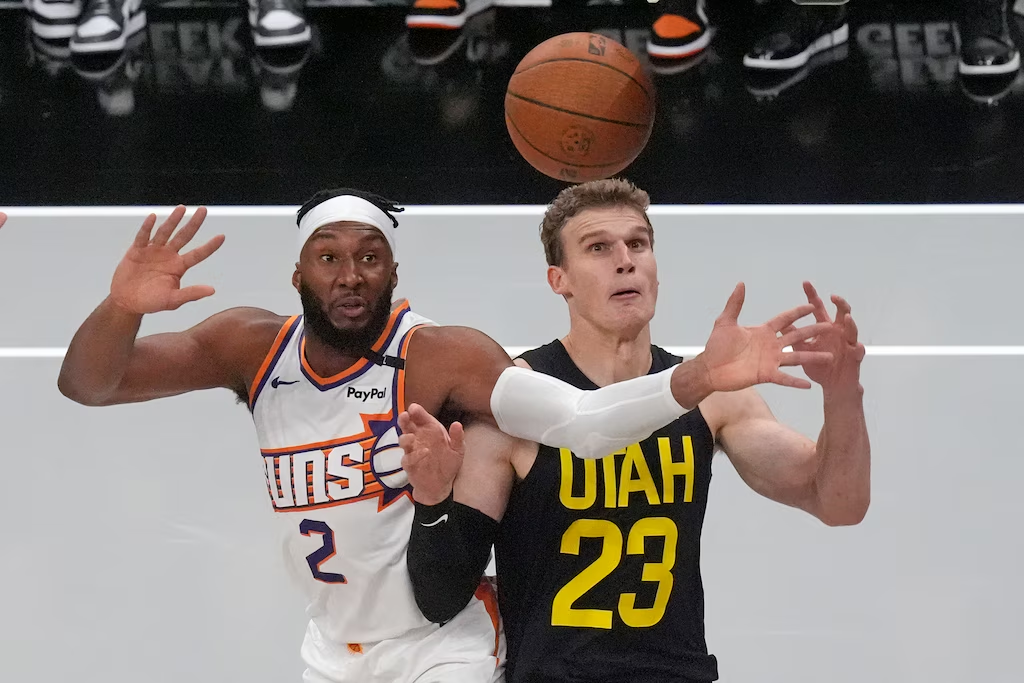
If the Jazz are truly mostly done with their roster-shaping for this transaction cycle, then 8-year veteran Josh Okogie represents their only significant external wing upgrade. They could, of course, be banking on some internal improvement from a young stable of wings, and they added other big men. But if you're trying to imagine what the rotation might look like on the perimeter, it's probably worth taking one of these slow summer days to break down Okogie's profile and strengths.
Okogie was a first-round pick by Minnesota back in 2018[fn]#20, taken just before Utah took Grayson Allen[/fn]. Oddly enough, he was selected with a pick that had passed through the Jazz's hands. They acquired the pick when they absorbed Kendrick Perkins' contract for the Thunder back in 2015, but then a couple of years later they'd use that same future draft pick to acquire Ricky Rubio from the Wolves.
Turns out that was probably a smart decision. Rubio helped legitimize the post-Gordon Hayward Jazz as a complement to rookie guard Donovan Mitchell. Okogie, selected a year after that trade, played significant minutes during his rookie scale contract but produced just 6.4 points per game and sub-30% outside shooting. Eventually the Wolves opted not to issue him a qualifying offer.
But since then, he's improved into a viable 3-and-D piece, albeit mostly in low-minute roles. Let's start on defense, because that's really Okogie's calling card.
He's best on the ball, using his 7-foot wingspan[fn]That's 8 inches longer than his listed height of 6'4"![/fn], big physique and good lateral movement to annoy ball handlers. He's consistently in the top 10% of isolation defenders (98.5 percentile this past season), and generally a plus defender when guarding the ball handler in pick-and-roll or dribble hand-off actions.
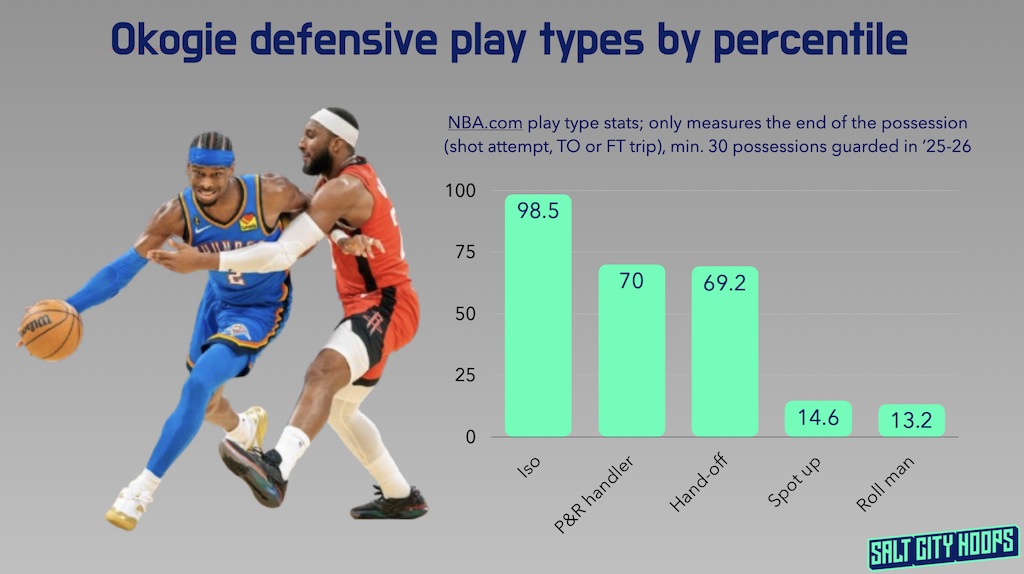
The spot-up numbers probably aren't worth worrying about, as those often say as much about the team-level schemes and how aggressively they choose to crash around drives. Okogie was in the 99th percentile in 2024-25, the 75th the season before that. At 6'4", he's probably not the guy Will Hardy wants guarding Nikola Jokic or Victor Wembanyama on rolls, but that's as close to a real Achilles' heal as he has on defense. (For what it's worth, he rated pretty well when a player tried to post him up, but that was just 16 total possessions, so I left it off this graph.)
He's just not an easy guy to get around in isolation:
Despite his big body, he does a good job squeezing through screens. He only needs a half second's worth of help from a hedging big to get back in front of his man so that the team defense can shift back into place.
Here, he deals well with the original screening action and gets back in front of Jamal Murray, but then realizes there's a breakdown elsewhere and rushes to the rescue. He guesses right on Nikola Jokic's drive and forces a mistake.
He guards 1 through 3 pretty credibly, but last season spent most of his time matched up on the opponents' lead creators. His top matchups by time spent guarding are Murray, Payton Pritchard, Cade Cunningham, Deni Avdija, Devin Booker... That's impressive when a coach trusts a 17-mpg player with the pivotal defensive assignment.
That said, he can guard bigger bodies. When he's at the 2 or 3, his team has a lot of options as it relates to switching. On this play, he calmly navigates multiple switches on a "weave" and stays connected so he can contest a good shooter:
Mostly what Jazz fans will like about him is simpler than all this tactical stuff: he just has a high motor, especially on defense. When he was shown on the Summer League broadcast on Sunday evening, Stan Van Gundy called Okogie "one of the league's great effort guys." One of his nicknames is Non-Stop for his constant tenacity.
Watch where he comes from on this play. He's standing at the angle of the 3-point arc when his team loses the ball, and then he makes it to the opposite corner on the far end in under five seconds to help challenge the play. That's about 95 feet of straight-line distance, to say nothing of the four teammates he sprints past to be the closest challenger on the shot attempt.
So why has Okogie, with all of the defensive intensity and skill outlined here, been just a 15 to 19 mpg player in each of the last four seasons? Mostly the answer lies at the other end of the floor. Okogie has improved his perimeter shooting since leaving Minnesota, but he's still pretty limited offensively.
The glass-half-full way of looking at it is that he knows exactly what he is and doesn't try to do too much. He has the precise shot chart you'd want from a guy who is primarily on the floor to be a defensive nuisance: 95% of his shot attempts last season were either catch-and-shoot threes or shots within 10 feet of the basket.
On top of that, he only takes open threes. He literally didn't have a single perimeter attempt all last season where a defender was closer than four feet. If a defender closes out to him at all, he's way more likely to put it on the deck and drive around the closeout than to take a contested jumper:
Essentially, his whole offensive game is made up wide open threes, show-and-go drives, tip-ins and fastbreak run-outs. And on one hand, that's probably a relief since the Jazz have enough mouths to feed on offense. But his limited participation in the offense does create some record-scratch moments and gives opponents a place to park a less stout defender.
That's why the hypothesis here is that Okogie isn't just stepping into a high-minute rotation role. Some have wondered if his arrival makes it harder for other winds like Brice Sensabaugh or Cody Williams to stay in the rotation — and it might, since NBA coaches tend to trust veterans who know how to execute what's on the clipboard. But my guess is that this is more of an insurance move. Okogie probably doesn't have the résumé to go into training camp penned in for 24+ minutes a night... but he has enough understanding and energy to make others really have to raise their level if they want to play over him.
In other words, he's here at least in part to ensure that Sensabaugh, WIlliams and others have to earn their burn.
If the way training camp shakes out is that Okogie heads into the season ahead of those guys on the wing depth chart, that's kind of disappointing for Sensabaugh in his fourth season or Williams with all of his length and tools. But that's the point of having quality depth: it should be hard to earn rotation minutes on a playoff team. Hardy has long had a "no free minutes" philosophy, and the bar is going to be even higher now that the Jazz's competitive ambitions have shifted.
The Jazz obviously liked Okogie enough to offer well above the minimum salary. But some of that was a concession in order to get the second year team option. As an 8-year vet, a minimum salary offer for Okogie would have been $3.5 million, and if it were a 1-year deal Utah would have only been on the hook for $2.45 million of that[fn]With the league picking up the difference, as they always do for vets with more than two years of experience.[/fn]. Utah had room under the tax to shell out more in exchange for the option to keep him next summer or move on. (Frankly, a $6M salary is also way more helpful if the Jazz need to stack salary for a trade, but Okogie can't be dealt until December 15.)
Okogie has playoff experience — just 310 total minutes, but compared to most of Utah's wings, that makes him a postseason savant.
Ultimately, let's be clear, we're talking about a role player here. But Okogie is very good at some specific stuff that the Jazz need to do better. And he seems to legitimately relish being a dirty work specialist who brings the energy and ball containment up when he checks into a game. Right now he does that for eight or nine minutes each half, on average. We'll see if he has more robust opportunities in Utah or if he stays at that level.
If he winds up being more essential than that, then the Jazz can keep him for another $6 million next season and then can retain him via "Early Bird" rights in 2028[fn]Which let a team go up to the average salary to keep someone who's been on their team for two seasons[/fn]. But regardless, the Jazz added a high-energy disruptor, an on-ball pest, and someone who is going to force guys around him to play harder.