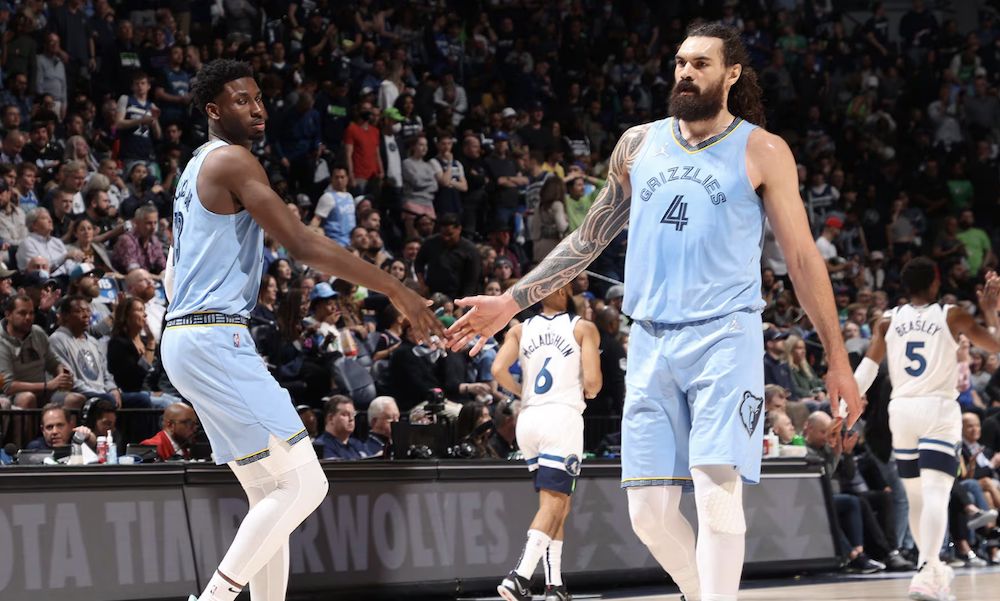

Adding Jaren Jackson Jr. clearly signaled the Utah Jazz's intent to shift gears competitively. The assumption at the time, though, was that Jackson would join Lauri Markkanen and Walker Kessler in a super-sized frontcourt... one that would ultimately log zero minutes together. Kessler, injured at the time of JJJ's Jazz debut, never played alongside the 2-time All-Star and now has been traded to Los Angeles for future draft capital.
To offset the loss of Kessler, the Jazz retained Jusuf Nurkic and then added centers Jaxson Hayes and Mo Bamba, moves that appear to indicate the Jazz are most comfortable imagining Jackson as a four alongside a more traditional big. None of those three is in Kessler's league as rim protectors[fn]Kessler has held opponents to 52.6% at the rim during his career. Last year, people shot 65.7% against Nurkic, 59.9% against Hayes. Bamba only appeared in four games.[/fn], but the thinking is that they can help Jackson with some traditional big man stuff like screening and rebounding.
It's worth investigating what type of big man pairings have really worked at unlocking the best version of Jackson. The 26-year-old[fn]He'll be 27 before the season starts.[/fn] has been an All-Star twice, won Defensive Player of the Year honors in 2023, and barely missed All-NBA in his last full Memphis season. Understanding what type of bigs he collaborated with in his best eras could be really instructive.
Let's dig into lineup data from his two best Grizzly seasons to see what type of frontcourt partners enable "Trip" to unleash his most impactful version.
2024-25: JJJ averages 22-6-2, makes All-Star, earns all-defense honors, and comes in 17th in All-NBA voting
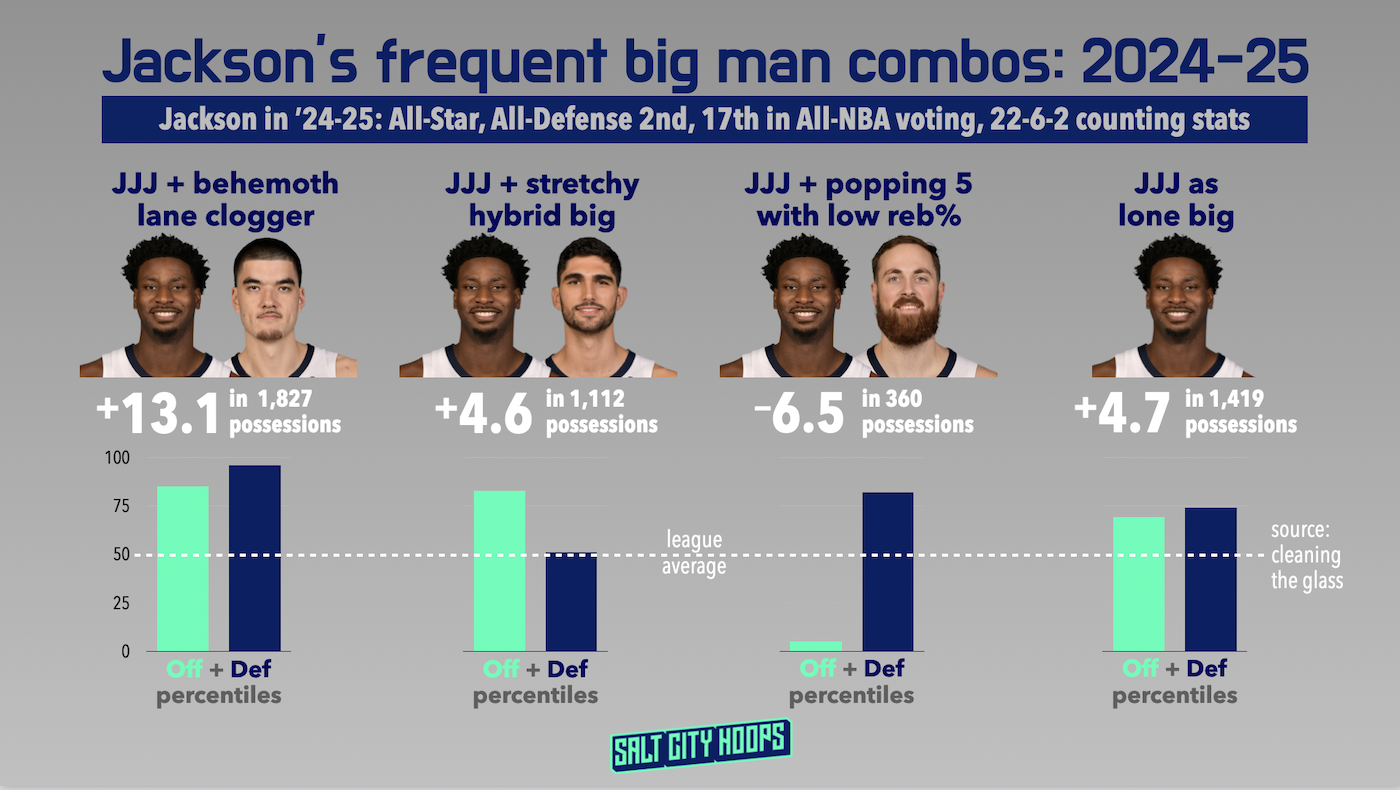
This was arguably Jackson's best all-around season, and his common collaborator was then-rookie Zach Edey, a behemoth big whose 7-foot-3 frame clogged the defensive paint. Edey isn't a Kessler-level rim protector, but he's a huge body and an elite rebounder, which helps since Jackson's rebound rate is just OK. The Jackson-Edey pairing played a ton of possessions together, per Cleaning the Glass. They were solid offensively (119.9) and elite defensively (106.8), leading to a +13.1 efficiency differential. That's juggernaut territory.
The takeaway for the Jazz is that putting JJJ next to a massive screening big who rebounds well is a pretty damn good formula. Nurkic isn't 7'3", but his rebounding rate is similar to Edey's and he's an effective screener who knows how to generate space for his teammates. The JJJ-Nurk pairing probably won't have defensive metrics as strong as JJJ-Edey given Nurk's limitations at the rim, but the offensive ceiling might be higher with Nurkic's vision, smarts and passing.
When '24-25 Jackson wasn't on the floor with Edey, he was most often alongside Santi Aldama. The Spaniard isn't really a center, either. Among current Jazzmen, he's probably most similar in style to Kyle Filipowski — a 7-footer, but who's more perimeter-oriented and not really a paint protector at all. When Jackson-Aldama were the only bigs, Memphis still managed a winning net rating at +4.6, but the defense was simply average at 115.0.
Jackson also played a little with Jay Huff, a pick-and-pop five with a mediocre rebound rate, and posted a -6.5 net rating in possessions. But most of his possessions with Edey and Aldama both off the floor were as the lone big. JJJ logged 1,419 possessions in such configurations, and Memphis was +4.7. Both the offense (116.9) and defense (112.2) were better than average, although not elite. Still, that's actually encouraging data for anyone curious to see what might happen when the Jazz utilize Trip as the de facto center. Most often, when JJJ was at center, it was next to the late Brandon Clarke at the four. Clarke was only 6'8", but had enough size and strength that he could keep some of the screening and banging off of Jackson's plate.
TL;DR: The JJJ-Edey pairing was massively successful and something the Jazz can attempt to approximate with Nurkic, but lineups with JJJ at center were also capable of playing winning basketball.
2022-23: JJJ averages 19-7-1, leads the league in blocks, makes first All-Star team and wins DPOY
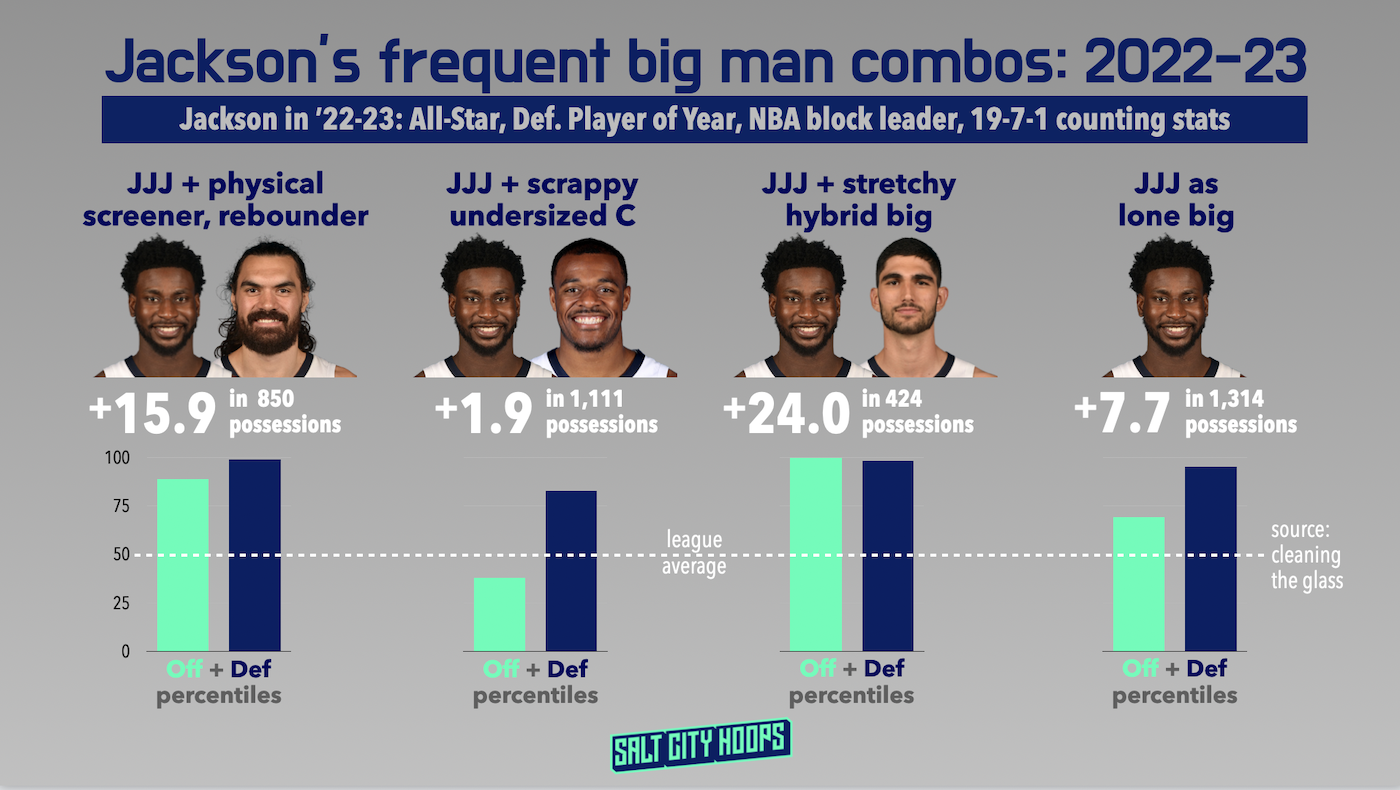
Aldama was also around for Jackson's DPOY season, but Edey wasn't. The plan that season was to use elite rebounder and meaty screener Steven Adams alongside Trip, and those two were devastatingly good together in 850 possessions before Adams got hurt. The offense was sharp (120.0) and the defense was in top 1% (104.1). The net rating of +15.9 was even better than JJJ-Edey.
Adams works hard, is a punishing screener, and rebounds well — particularly on the offensive end. So it's no surprise that playing alongside him freed Jackson up to be a second-side attacker on offense and a roaming/switching menace on D.
With Adams off, JJJ was mostly paired with Tillman (1,111 possessions) or Aldama (424). That particular season, the JJJ-Aldama duo was unstoppable in small doses at +24.0 (without Adams or Tillman on). The Grizz scored in bunches (129.8!) while also holding opposing teams to just 45.8% effective field goal percentage. That season was sort of Aldams'a coming-out party, and these two were great together — although again, they were someone interchangeable as the 4/5.
With JJJ-Tillman, the Grizz were slightly positive (+1.8), but scoring was a challenge. Tillman is only 6'8", so while he's a scrapper and an OK rebounder, he just didn't open the offense up as much with his screening. The team managed a sub-average 113.4 ORtg in those minutes, rarely got to the line, and struggled to O-board. The defense was still solid, though.
When Jackson played as the solo big, it was mostly again either alongside Clarke or in 4-guard configurations. The results were encouraging here, too! Again the Grizz played winning basketball with JJJ as the lone big: +7.6 with a strong offense and a 94th-percentile defense.
TL;DR: Once again the minutes alongside a big bodied screener and rebounder in Adams were dominant, but JJJ alongside a perimeter-minded hybrid big and JJJ at the five both worked well, too!
Jazz takeaways
The Jazz's situation is obviously different around those two positions. Jackson's new team has as its best player a guy who's essentially a 7-foot wing with constant gravity. The offensive engine in Memphis was Ja Morant, a dynamic downhill attacker when he's at his best, but not really a floor spacer. So the insights about what works and what doesn't might be situational given the new geometry.
Utah also has more size at the guard/wing spots than Memphis did: 6'0" Tyus Jones, 6'2" Morant, 6'6" Desmond Bane and 6'7" Dillon Brooks got most of the perimeter minutes, whereas Utah will field 6'4" Keyonte George, 6'6" Darryn Peterson, 6'9" Ace Bailey and 7'0" Markkanen. Having that size could change some of the questions about rebounding or interior defense.
But there is still plenty to learn by looking at these pairings.
For starters, these graphs should make Jazz fans feel pretty good about the defense in almost any configuration. Memphis could pair Jackson with just about any type of big and have the defensive results be at least adequate and in most cases very good to great. That's no surprise. The Grizzlies' defense was 5.5 points better per 100 possessions during his DPOY year, 6.3 points better in 2024-25.
On the whole, the biggest insight here comes from the double-digit net ratings of the JJJ-Adams and JJJ-Edey pairings. Those duos worked well on both ends in ways the Jazz can attempt to replicate. Offensively, when Jackson doesn't have to be the screener on every possession, he can slice through the back line of the defense or attack on second actions:
Playing alongside true bigs also means that sometimes the opposing center is occupied, often leaving Jackson with an opportunity to punish a defender who has no business checking someone with his size and agility. Jackson has really good ball skills for a 6'11" guy, and has a lot of ways he can finish over dudes who are 6'7" or whatever.
Stuff like that is why Jackson rated above-average on isolation plays and post-ups in both of the seasons in question. That year, the Grizzlies actually tried some funky offensive stuff where they eschewed pick-and-roll altogether, and Jackson's ability to create off the bounce was a big part of that experiment.
Defensively, pairing him with a traditional big gives his team the option of using him as a roamer or free safety. Imagine navigating the screen defense of an Adams/Edey type only to have Jackson's 7-foot-5 wingspan flying at you late in the play.
If the Jazz choose to maximize his time with Nurkic, it's because they're looking at clips like those and imagining how to unlock the +15.9 Adams number or the +13.1 with Edey. Putting him next to a five also saves him some banging and helps keep him fresh during a long season — and hopefully into a postseason run.
That said, there is evidence to support using him at the five, too.
Look at how much they're able to stretch out the defense when Jackson is the only true big on the floor:
And when he's at the 5 on defense, his versatility allows his team to scheme a number of different ways. Here he is guarding three different P&Rs during his DPOY season. On the first he plays a traditional "drop" defense, on the second he hedges high and then recovers, and on the third he switches onto the ball. In all three coverages, he suffocates the opponent with his length and mobility.
What all these clips and data show is that there's no one right answer with Trip. The Jazz were pretty smart to ensure they still have the option of putting a traditional big-bodied screener next to Jackson... but they don't have to be boxed into playing that way all the time.
The JJJ-Huff and JJJ-Tillman confirm the very intuitive take that Jackson is best served by collaborating with plus rebounders. But outside of that, there is no singular formula for success.
Jackson is a versatile, underrated weapon and the Jazz should have a lot of ways to play winning basketball with him, even after Kessler's departure.