The 2025-26 NBA season is officially over, and that opens the door for the Jazz to answer one of the biggest questions of their offseason.
The Finals ended on Saturday, and former Jazzman Jordan Clarkson is an NBA champion! If you’ve read Dan Clayton’s article about key offseason dates then you’ll know that the close of the NBA Finals means teams can officially start negotiating with their own free agents, including center Walker Kessler.
Everything about Kessler's offseason hinges on a single figure. The Jazz can keep him if they want to, thanks to the matching rights that come with his restricted free agency. The question is whether they should, depending on precisely where that price will come in. With the luxury tax looming over Utah's next few seasons, Kessler's asking number could turn an easy re-signing into a hard call. Finding the salary that works for both sides is one of the offseason's biggest decisions.
Kessler’s archetype
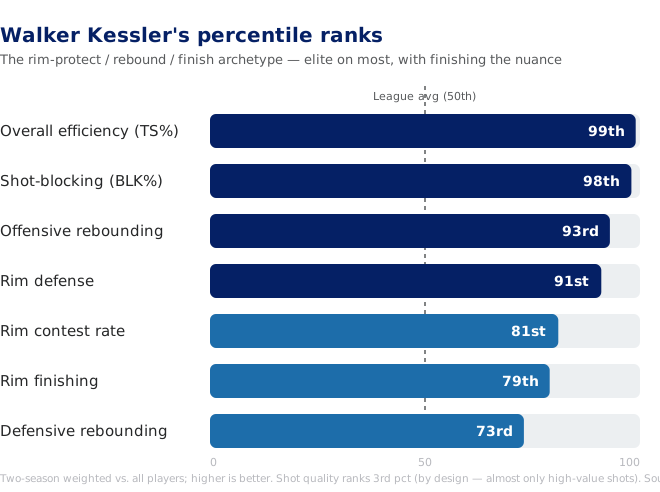
For the traditional center archetype, every team is looking for rim protection, rebounding, screen-setting, and rim pressure. Here's how Kessler scores in those areas:
- Rim protection: Kessler scores in the 91st percentile, with opponents scoring 9 points per 100 below expectation.[fn]per CraftedNBA, two-season weighted[/fn] His 7.1 BLK% is in the 98th percentile, and he contests a lot of attempts too, good for the 81st percentile in rim frequency. The bottom line is that Walker is a premier interior defender.
- Rebounding: His 16.6 ORB% in the 2024-25 season put him in the 93rd percentile, and he led the league in offensive boards per game. His defensive rebounding is a notch down, good for the 73rd percentile.
- Screen-setting: In his first two seasons, screen-setting was a marked criticism of his game, but this improved in his third season. Remember the screen assist discourse in the Rudy Gobert era? Well, Kessler ranked 23rd in the NBA in screen assists in the 2024-25 season with 2.9 per game[fn]per NBA hustle stats[/fn]. By the eye test, he’s made strides here, and this skill will become even more important if the Jazz draft Darryn Peterson, who is a genuinely lethal movement shooter.
- Rim pressure: Relative to other bigs in the league, Kessler’s rim shooting numbers ranked him in the 79th percentile[fn]in the 2024-25 season, per Cleaning the Glass[/fn]. Kessler largely restricts his shot diet to only rim shots, which skyrockets his efficiency numbers. His TS% ranked in the 99th percentile. He’s not an offensive maestro, but he plays within his role very well. Whether he can expand upon that is another matter.
The upside bet
Beyond the core abilities you want at the center position, Kessler is appealing in other ways. Just shy of turning 25 years old, Kessler should only improve throughout the life of his next contract. While Kessler only played five games last season before suffering a torn labrum, he briefly flashed increased playmaking and 3-point shooting. He was 6-for-8 from 3 and tallied 8 assists in a preseason game. I’m hesitant to put much stock in this small sample, but let’s speculate for a moment.
We saw Will Hardy put above-average passing centers in Jusuf Nurkic and Kevin Love to good use. The Jazz will need all the passing they can get in the starting lineup, and Kessler can earn his keep as an additional connector. Walker isn’t going to average 8 assists, but it’s not unreasonable for a fifth-year player to improve processing and make better reads as a passer, even at the center position.
I also don’t expect Kessler to become a knockdown shooter. We’ve seen centers try and fail to add a corner 3 many times. It’s not unheard of, though. The following big men added a 3-point shot later in their careers:
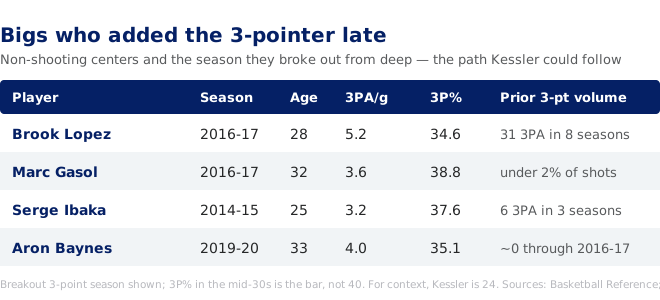
If Kessler can reliably shoot a corner 3 at around 33 percent in small doses, that gives the Jazz additional options and makes the opponent’s game plan a little more complicated. If he really can make the sort of leap made by the centers above, then things get interesting. But the Jazz shouldn’t give a massive contract based on this slim chance.
The Jaren Jackson Jr. fit
Another wrinkle in Kessler’s value is his hypothetical fit with Jaren Jackson Jr. We’ve yet to see them play together, which makes the negotiation trickier, but on paper Kessler is the ideal fit next to Jackson. While an elite shot-blocker himself, Jackson has always played better at the forward position, next to traditional big men like Marc Gasol, Jonas Valanciunas, Steven Adams, and Zach Edey. JJJ with Edey on the floor posted a 109.6 defensive rating, top-two-defense territory. Without Edey, that number slipped to 113.0, about 10th in the league. Jackson is also a minus rebounder at his position, which Kessler can cover for just fine. If Kessler anchors the middle, JJJ is free to roam and chase blocks on the help-side, which could be the best interior defensive duo in the league.
The case against huge money
Kessler does have his own weak points. His career free-throw shooting percentage is 54.5, which makes him a candidate for hack-a-Kessler treatment in close, late-game situations. It also adds skepticism to whether he’ll develop a long-range shot. He sits in the 4th percentile in creation-adjusted turnover rate (14.1 percent) despite a low offensive load (20th percentile). For a player who mostly catches and finishes, coughing it up that often is a genuine ball-security flaw, and the five-game 2025-26 sample made it louder at 3.2 per game. We talked about the passing flashes, but before last season he had an 11th percentile passer rating. He generally doesn’t punish defenses that ignore him away from the rim, which caps how much the offense can run through him.\v
Perhaps the biggest case against paying Kessler too much is the non-shooting center archetype itself. Without a doubt, rim protection, rebounding, screening, and rim pressure are super valuable. But in a playoff setting, any player with a limited enough offensive game can be punished. Gobert is one of my favorite players and had some amazing playoff moments this year, but his playing time dropped by 7.5 minutes per game from round of the playoffs to the conference semis against the San Antonio Spurs. And as the New York Knicks have demonstrated, the best game plan against Victor Wembanyama may require five-out lineups with shooting threats at every position.
The number
So, the big question is: how much should the Jazz pay Walker Kessler? Let’s look at a few recent comps:
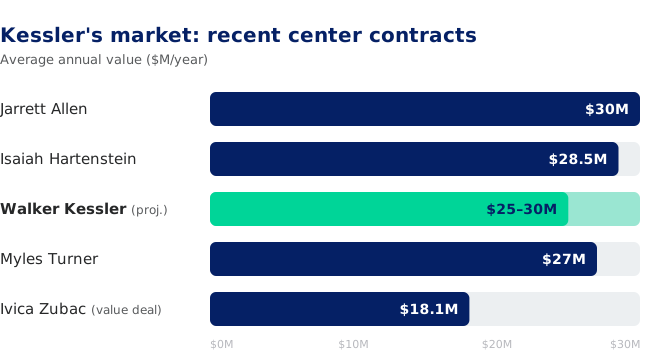
You could reasonably compare Kessler’s value to that of Jarrett Allen and Isaiah Hartenstein, both non-shooting rim protectors who are solid starters for playoff teams. Myles Turner has a more unusual profile, but earned similar money at his position. Ivica Zubac provides comparable performance, but is widely considered to have a bargain contract.
So somewhere between $25 million and $30 million annually feels reasonable. Given the market, restricted free agency, and injury last season, the Jazz will likely make a case for a lower figure. Kessler and his camp likely see his untapped potential and age as a reason to ask for something beyond the $30 million figure. If Kessler is unable to get a higher offer from the Jazz or outside teams, Utah could tighten the screws, but presumably they want a deal that leaves Kessler happy (or happy enough).
Since the Jazz need a center in Kessler’s mold, it makes little sense to let Walker leave for nothing. If Kessler does get an offer from, say, the Bulls or Lakers, the Jazz could still choose to match and figure out cap logistics down the road. But if a compromise can’t be reached, the Jazz could also explore sign-and-trade deals, so that Utah is at least getting assets in return. If the Jazz sign Kessler to a reasonable enough number, they can always see how he fits with the team now, and have a tradable contract attached to a young playerif they ever need to move it.
If the Jazz do retain Kessler, it will be interesting to see how the deal is structured. It makes a lot of sense for the Jazz to duck the luxury tax this season, as there’s a good chance they’re a tax team in future seasons if they extend Keyonte George. Each consecutive year in the tax is more punitive, so even if leadership is okay paying, it makes sense to avoid it this season if possible. With that in mind, if Utah wants to use the full mid-level exception, bring back Nurkic, and use their 15th roster spot, money gets tight. You can see this illustrated in Mark Pereira’s salary cap 101 video. If possible, it would be nice for the Jazz to give Kessler a deal that starts higher and descends to help with the future salary squeeze, but that may be difficult depending on what they want this season’s roster to look like.
The scenarios
So let’s look at what might happen:
A) Kessler’s market dries up and the Jazz sign him for $20-25 million. Kessler may be unhappy, but it’s enough to accept.
B) Kessler finds enough leverage to get a $26-30 million deal with the Jazz. Utah would prefer a cheaper deal, but this is palatable.
C) Kessler doesn’t find a middle ground with Utah, doesn’t sign an offer from another team, but works out a sign-and-trade deal.
D) Kessler signs an offer with another team in the $31-35 million range. Utah deliberates on whether they believe Walker can live up to this number and how this contract will affect future plans.
E) Utah does not re-sign Kessler and uses their cap space to find a cheaper center.
My read is that option B is most likely. If you want to pin me to a prediction, I'll say four years, $110 million. I want Walker Kessler back on the Jazz. He serves an important role and raises the floor of the team. Utah should pay him, structure it smart, and let Walker prove how he can help this Jazz team reach the next level.
(And just for fun, since it’s been a while since we’ve seen Walker play, enjoy this 2024-25 highlights mixtape to refresh your memory)