In the fantasy basketball league that I run, we have a rule: we don't draft until the last Saturday before the regular season. We draft late because even in preseason, in games that are glorified scrimmages, player health isn't guaranteed.
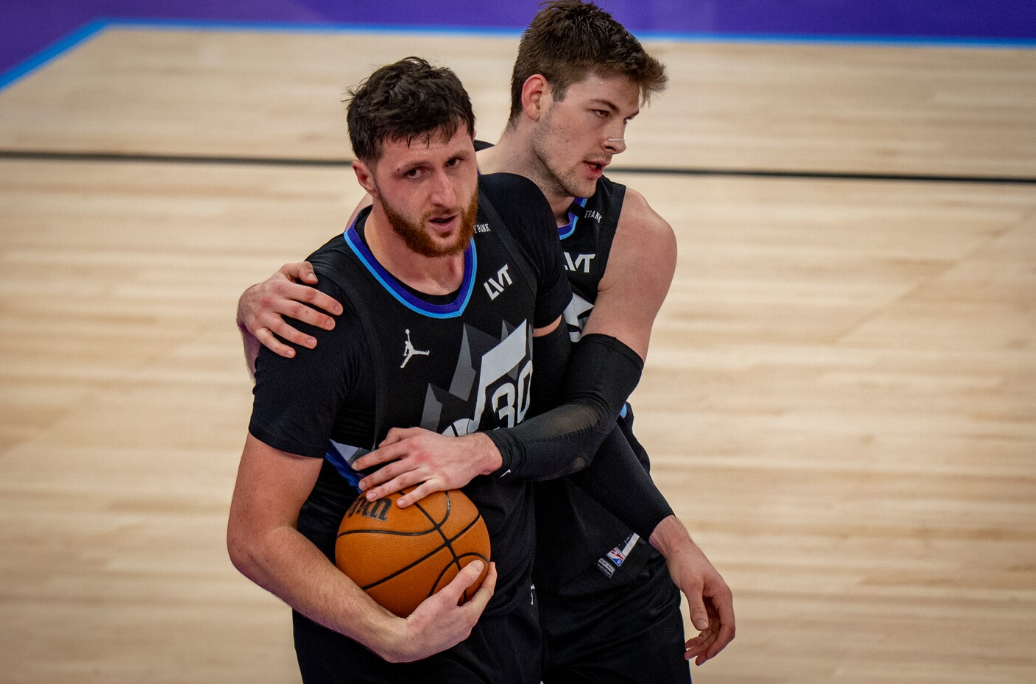
Jazz fans learned (or re-learned) that lesson on Wednesday when Chris Haynes reported that starting center Jusuf Nurkic will miss "at least four weeks after suffering a partial plantar plate tear of [the] second toe in [his] right foot." The Jazz say the injury occurred in the first half of Utah's preseason opener, and our Dan Clayton did identify a slight collision between Nurkic and Nuggets center Nikola Jokic just before the former checked out. The Jazz, already thin at center after trading Walker Kessler to the Lakers, head into what should be a promising season staring down a low-calorie diet at the five spot, at least for a while.
So what now?
With his massive frame (6’11”, 290 pounds!), Nurkic gives the Jazz traditional center things: boxouts, rebounds (particularly defensive rebounds), and punishing screens. The Jazz really don't have anyone else on their roster who does those things at the same level. It is highly likely that the team goes into its first 9-15 games without anyone who is top-tier or even second-tier in those areas. The Jazz will almost certainly be more susceptible to giving up offensive rebounds and second-chance points to opponents. Will Hardy will need to adjust his offense to be less reliant on center screening.
Realistically, Hardy (and president of basketball operations Austin Ainge) have a few options:
Option 1: The most straightforward, and (in my view) most likely, is simply to elevate the roles of the two other true centers on the roster: Jaxson Hayes and Mo Bamba. Hayes is slender and athletic, almost the polar opposite of the Nurkic archetype; his elite skill is rim-running. Bamba is also unique among the three Jazz centers as a big man with three-point touch—36% from distance in his career—who introduces five-out pick-and-pop space opportunities. Defensively, however, they are both too slender to drop deep into the paint and stall physical drivers, and will need defensive help, likely exposing the Jazz in the corners or elsewhere on the perimeter. Perhaps most frustratingly, this approach leaves the Jazz temporarily without any real defensive rebounding to speak of.
Option 2: Jaren Jackson Jr. has the size and length to play center, and has done it before in Memphis. The Jazz could play JJJ at center, which could even create room for Ace Bailey into the starting lineup. This is a very intriguing offensive option for the first unit. So much shooting and scoring at every level. It's tempting. However, as my colleague Zarin Ficklin pointed out on this site back in July, Jackson won his Defensive Player of the Year award as an elite, free-roaming weakside helper while a true center anchored the block. Forcing him to play the five instead anchors him to the primary screen-and-roll action, neutralizing his greatest gift as a roaming shot-blocker. He will certainly see some time at center, particularly in closing lineups, where having “your first best players” on the floor is, within reason, a must. The rest of the time, JJJ is enough of a force that letting him be him, even over having your five best players on the floor is the smarter move.
There are a variety of other combinations that people are throwing out there, some with more merit than others. In fact, there are too many to cover in a quick reaction post. Kyle Filipowski—remember him?—will almost certainly see some minutes at center now. He has offensive skills but hasn't proven remotely quick or strong enough defensively to occupy that particular role as more than a last resort. Bailey and Lauri Markkanen don't have the right physical profiles, and would take too much damage in that role.
Which brings us to. . .
Option 3: Ainge and his team could move to acquire another center. Sometimes the answer, particularly at center, is a free agent who simply hasn’t found a spot yet. That is how the Jazz landed Bamba on a 10-day contract last season, but the remaining pool is thin. Bismack Biyombo barely played last season. We all enjoyed Kevin Love’s vibes, but he doesn't solve defensive questions either. Kelly Olynyk just signed with a team in the Italian league. It’s hard to see a real solution in free agency. That leads us to trade ideas, and who doesn’t love trade ideas? We know the Jazz have assets, but it isn’t great to be forced to use them tactically instead of waiting to use them strategically. On the other hand, Nurkic isn’t the ideal long-term answer at center either, and trading for someone now could help provide that answer. Could Josh Green (for salary matching), a couple of first-round picks, and a young player or two get you Jarrett Allen from the Cavaliers? Steven Adams or Robert Williams III could probably also be had for less, but they, like Nurkic, bring significant injury risk with them.
That's why the answer for Hardy and the Jazz is pretty straightforward: hold your nose and weather the next four weeks. Elevate Hayes' and Bamba’s roles temporarily, play Filipowski at center when they can, and close with their top talent, meaning Jackson at center alongside Markkanen, Bailey, Darryn Peterson and Keyonte George. It’s a bit of a patchwork, as these things often are, and the Jazz will give up a lot of offensive rebounds. But if Nurkic only misses the currently prescribed four weeks, that accounts to somewhere between nine and 14 games of an 82-game season. We are prone to overreaction because this is happening before the season even starts, when we are at peak “unanswered questions,” and because for the first time in years, we are excited to be winning basketball games.
That said, it isn’t just “a small chunk of the season;” it is also the first chunk of the season. Will this injury set the Jazz back in figuring out who they are and how they play as a unit? Inevitably, yes, but I don’t think this injury is catastrophic in that way. Nurkic is both a known quantity and a very traditional center (rather than a player with a unique style whom others need to learn how to react to), which will ease his reintegration into the lineup.
Nurkic also is the focal point of neither the Jazz offense nor the Jazz defense. In the past, when teams have struggled to reintegrate key starters, it has typically been because the injured player occupied a unique role in the offense, and that offense shifted around them while they were out. Other players stepped into and hardened their presence in new roles. While not a midseason example, Kyrie Irving and the 2018-19 Boston Celtics come to mind. During Irving’s injury the previous season, an offense that was presumed to have featured him heavily became about Jayson Tatum and Jaylen Brown. By the 2018-19 season, their roles were solidified, and Irving was left on the outside; the team never came together as a unit and was bounced easily in the second round of the playoffs. But that required months without Irving on the floor, and for Irving to be the kind of player who is a featured part of a team’s strategy.
On the other hand, we have numerous examples of starters missing the first few weeks of a season, coming back, and quickly enabling the team to gel into something great. A particularly salient example is Utah's own Jackson, who missed the first 14 games of the 2022-23 season with Memphis while recovering from foot surgery. The Grizzlies went 9-5 without him, but the moment Jackson stepped back onto the floor on November 15, Memphis transformed into an absolute juggernaut. Jackson went on to win NBA Defensive Player of the Year, and the team comfortably secured the second seed in the Western Conference.
There is even, maybe, if we squint, some upside here in certain spots. Because Nurkic would likely use more possessions than Jaxson Hayes or Mo Bamba, this arrangement could lead to more early-season usage for players like Peterson, helping the rookie figure out his NBA game a little faster.
So breathe, Jazz fans; it’s going to be okay.