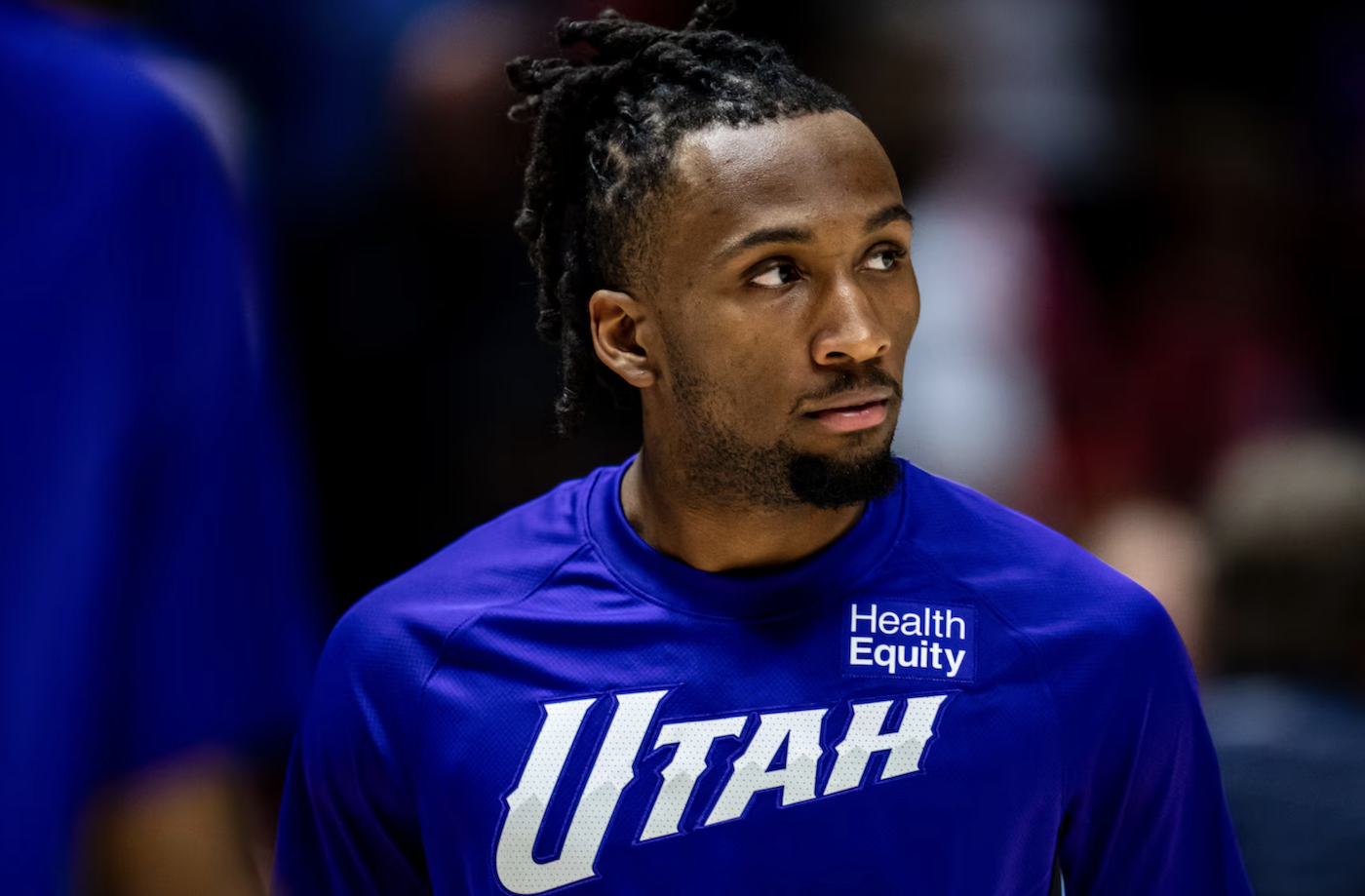
Three and a half seasons on the struggle bus finally paid off in June, bringing 6'5" combo guard Darryn Peterson to Utah with the #2 pick in the NBA Draft. While we didn't see a lot of Peterson at Kansas, his raw talent was plainly evident. The thought of him playing alongside what has subtly become a tantalizingly balanced lineup with five legitimate scoring options, shooters everywhere, and potentially intriguing defensive possibilities should have Utah thinking playoffs right out of the gate.
A full season of Lauri Markkanen, Jaren Jackson Jr., Ace Bailey, and Keyonte George (and a solid supporting cast) would likely have the Jazz playoff-competitive on their own, but Darryn Peterson is more than just the cherry on top; he's at least the whipped cream, and possibly some of the ice cream, too. In other words, as the player with the most unknowns, Peterson may be the key to figuring out how deep this Jazz team can go.
That's a lot to put on a rookie, even one as heralded as Peterson. To be fair, we could say the same about Bailey, or even George as floor-elevators and ceiling-reachers. But Peterson has the most unknowns, since we've only seen him in a handful of college and Summer League games. He also likely has the biggest superstar potential.
I'm comically terrible at predictions (you won't catch me on Polymarket), but I'm great at curiosity. Given the impact Will Hardy will be looking for Peterson to have, and as we embark on the 2026-27 Utah Jazz season, let's ask four big questions about the Jazz rookie that we should be hoping to answer by New Year's Day. This is what I'll be watching for during the preseason and the first 30 games or so of the Darryn Peterson Experience.
How fully realized is his offensive game right now?
Even in the lottery, some guys hit the league already on a superstar trajectory; others need time to develop. This was the line we got when Taylor Hendricks spent most of his rookie year with the SLC Stars, in sharp contrast to the Donovan Mitchells of the world. Don't worry; I'm not here to tell you that Peterson is a project. He absolutely appears to be "NBA-ready," as the #2 pick probably should be.
But does that mean instant playmaker who shoots 38% from three and makes the right reads on pick-and-roll? Or does it mean long stretches of cold shooting and hard-to-watch decision-making as he adjusts to NBA size and speed? How consistent will he be? There will be holes in his game, at least at first; where are they, and against what kinds of offensive and defensive schemes do they manifest? How quickly will he close them?
In other words: how up-and-to-the-right is his offensive trajectory between October and January?
This has as much do with Peterson's approach as it does with the result. We know he can shoot. What I will be looking for here, among other topics that we'll get into below, is whether he will continue to rely heavily on midrange pullups and floaters, as he often did at Kansas, or whether he gets downhill to the rim more frequently. Can he get to 35% of his shots at the rim and 35% from three? Or is he going to be north of 40-50% from midrange?
Did he have so few assists at Kansas because it was college basketball, and not a particularly talented Kansas team? Is the 12-assist, two-turnover Darryn Peterson that we saw against the Memphis Grizzlies in SLC Summer League the real Darryn Peterson?
Then again, Brice Sensabaugh told reporters at Jazz media day that Peterson "looks like a seventh-year guy," and I don't think he was referring to the rookie's hairline.
George also seemed impressed with his rookie teammate's toolkit: "He has everything in the book. Any move you think he has, he has. Any shot you think he has, he has.”
How does he fit next to George, and how different does he look if he is playing with Isaiah Collier?
Let's start by looking at how Peterson pairs with a couple of his backcourt teammates offensively (I'm no less interested in the defense; more on that shortly). Really, I'm interested in how Peterson fits next to perhaps half a dozen possible backcourt and wing mates, but let's focus on these two for now.
George took an all-star-level leap in 2025-26 and will be the Jazz's primary ball-handler in 2026-27. That immediately presents one of the biggest questions for Peterson's development with the Jazz this season: how will he operate without the ball, since this will be the first time that he has had to operate as much through cuts and off-ball movement as through drives and pull-ups? When Peterson did play off the ball at Kansas, it was usually in the service of the Jayhawks getting him the ball eventually (where he was deadly, hitting 43% of his catch-and-shoot threes). The Jazz led the NBA last season in off-ball screening actions, so presumably Peterson is going to be asked to screen for, say, Markkanen flaring out to the three-point line. Will he be fully engaged when his role is to do the little things that make Hardy's system work?
Then there is Isaiah Collier, the only traditional pass-first point guard on the roster. We saw in Summer League that Peterson struggled without Bailey on the floor to draw defensive pressure, allowing teams to double- and even triple-team him. A momentary blip, perhaps. Collier is proving himself to be a rotation-level player, but he isn't the scoring threat that George represents. Will Jazz backcourt lineups allow defenses to focus on Peterson when Keyonte isn't in the game?
How quickly will he adjust to NBA pick-and-roll?
Elite "processing speed" might be the thing I am most excited to see out of Peterson early this season. We know that, on paper, the Jazz have top-tier pick-and-roll optionality. However, that potential will only be as good as the players' real-time decision-making. Doing pick-and-roll well means making quick reads and reacting to defensive countermoves; I want to see how rapidly Peterson responds and how he manages to work through learning to read defenses at this level.
Peterson told reporters on media day that he's been watching film of guards who use their bodies well when they attack. That could give him some ideas on how to reach the rim.
More broadly, we should be interested to see the different kinds of looks Hardy and his staff are able to come up with for a Peterson-fueled Jazz offense. Partnering him with Markkanen and Jackson creates what should be a killer pick-and-pop action. If defenses drop to contain Peterson’s mid-range floater and downhill acceleration, it should leave Markkanen with open, in-rhythm looks from beyond the arc. On the other hand, if opposing defenses attempt to switch the screen to deny Markkanen's perimeter gravity, Peterson has the size and advanced hang-dribble package to comfortably isolate and manipulate slower big men on the perimeter.
When he drives off a high screen and the weak-side wing defender drops to help, does Peterson read it instantly and fire a pass to the opposite corner? Or does he get tunnel-visioned and force a contested runner over a collapsing big?
Again, there will be mistakes here at some point; how quickly does he adjust and adapt when he makes the wrong read?
How much can he raise the team's floor defensively?
I'm excited to add a 6'5" guard with a 6'10" wingspan known as a suffocating on-ball defender. Probably not as excited as Hardy is, but excited, nonetheless. As a high-risk, high-reward defensive player, I expect that we'll see Peterson create more steals and blocks than the Jazz are used to out of a guard. The wingspan alone makes that likely. My questions in this area have less to do with Peterson's on-ball defense and more with what he allows the Jazz to do defensively as a unit.
If all goes according to plan, the Jazz should be able to switch much more effectively than they have in recent seasons. Peterson gives Utah speed, size and, importantly, chest strength that allows him to cover guards and wings of all sizes anywhere on the floor without being outmuscled or outraced. This should take pressure off everyone else on the floor in a Jazz uniform, but especially George, Bailey, and Markkanen. In fact, that prospect is as exciting as what Peterson does for this team offensively My big question here is how readily we see that from day one, and how actively Peterson plays that role.
Consistent effort is one part of this question. There were times in college when Peterson took plays off defensively. Certainly understandable, to an extent; players who consume a ton of energy offensively need to catch their breath somewhere on the floor. (There's another column to be written at some point about how a lot of the small, high-usage guards that we think are terrible defenders are simply doing what they must, because going to the rim against bigger opponents takes more energy when you're 6'3" than it does when you're 6'6".)
That said, I will be looking for how engaged Peterson stays off the ball. In the NBA's rapid-fire offenses, will he consistently track cutters, execute crisp "stunt-and-recover" rotations, and stay alert during long possessions during which much of the action is 40 feet away from him? If he falls asleep off the ball, his individual length won't save the team from giving up open corner threes.
I don't expect that Peterson alone will single-handedly change the team's defensive identity—I look to Jackson more than anyone else in that regard—but Peterson could be the key to a new, upgraded defensive floor that will keep this team in games. How close are we to that point in October, and how close in December?
Conclusion
We asked a lot of questions here, and studiously avoided making predictions. At this point, it’s hard to separate what we want for Peterson and the 2026-27 Utah Jazz from what we might realistically think will happen. What we think we know is that Peterson has superstar talent and a very high floor. He also played a very limited college slate and is only 19 years old. It is likely that some of his 30-or-so 2026 games are going to be less than stellar. To round out this list of questions I’ll be looking for Peterson to answer, here is what I hope I remember as we watch these first few hundred minutes of his career:
- Rookie progress isn’t always linear,
- Rookies are particularly susceptible to variance based on who they’re playing with,
- The season is a marathon, not a sprint
And perhaps most importantly:
- Have fun with this, because talent like Darryn Peterson’s doesn’t come along every day.