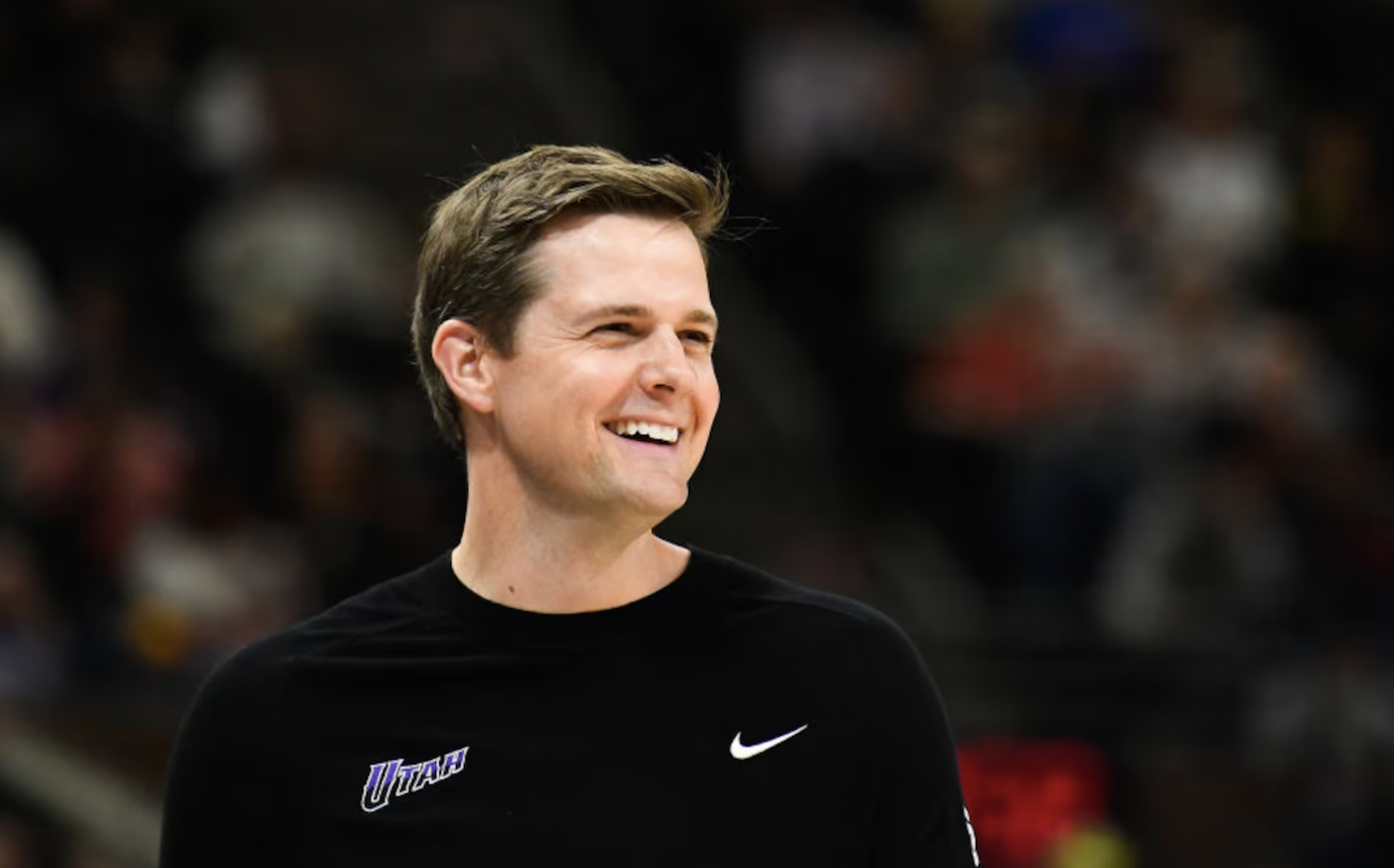
The basketball world is about to get a lot more familiar with Will Hardy.
Like his Utah Jazz, the fifth-year head coach has flown under the radar to a degree during a multi-year rebuild. Now that the Jazz aim to be more relevant in the 2026-27 NBA season, their talented roster will draw more attention. Their climb could also mean that the world will start to figure out what Jazz decision-makers have felt since Hardy was hired in 2022: that he's the real deal.
"Will is an extremely talented coach," said team president Austin Ainge. "He's a great communicator. He's really smart. He's really creative."
Franchise governor Ryan Smith shared similar thoughts at the press conference that followed Keyonte George's extension signing. "I've been around a lot of leaders. Will's got a special gift in his ability to communicate and his ability to teach. And it's unique."
NBA fans at large might not yet realize that Hardy is considered one of the league's up-and-coming basketball minds. Jazz brass, though, saw right away how he understands the game and connects with players. For starters, he immediately forged a strong relationship with Lauri Markkanen, helping the forward unlock his All-Star potential.
Their partnership fueled the Jazz in a surprising 2022-23 season, despite a somewhat random supporting cast of players thrown together through a half dozen different trades. Nine players from the Jazz's opening night roster in October 2022 are currently out of the league. It didn't matter. Hardy's Jazz won that opening night contest, stunning the title-contending Nuggets. They won the next night, too. And the next. By mid November they were 12-6, and they held a .500 record as late as February 25, after game 62.
Even with a roster not really built to churn out victories, Hardy was too clever a basketball tactician to avoid squeezing wins out of that delightfully weird squad. Imagine, then, what he might be capable of on a team that's aiming to be good.
Or... imagine how fun it will be to watch Hardy playing chess in a playoff series, should the Jazz make it.
Of course, even considering that auspicious start, Hardy has a 107-221 overall record as a coach. That's why evaluating him up to this point has mostly been an abstract exercise in Utah's situation. He is highly regarded by national media figures, at least partly because he shares insights that show both his emotional and basketball IQ. His peers also respect him, often pointing to his offensive creativity and player development successes. It just hasn't been fair to assess him based on outcomes while the Jazz were rebuilding, but that will change to a degree now.
A lot of the reason people across the NBA are high on Hardy come down to gravitas and coaching style. He can appear demanding and intense, but at the same time constantly seeks to put each guy's development arc into a very personal and nuanced context. That helps him connect with and unlock players.
"The way Will explains certain things, (he) just makes the game a lot easier for everybody on the team, honestly," said George.
Not every talent bet the Jazz have made has paid off, but George's growth is a good example of how right things can go when a player tunes into Hardy's coaching. His ability to communicate and connect is frequently mentioned among his virtues. Even players who have only been around the franchise for months or even weeks have picked up on this important Hardy trait.
"Will is a straight shooter but he has a kind of funny humor about him as well. It's a funny balance," offered newcomer Josh Okogie. "He's clear. You always want your head coach to be clear so there's no grey area... He can have a little bit of humor as well, makes it a good environment to grow and win."
We've seen the growing part. Now it's time to see the winning. Hardy's success in the win column has been limited by the Jazz's situation and priorities, and by the constant state of flux with the roster. During his tenure alone, the Jazz have made 26 trades. Individual player rights have been assigned to or from the Jazz 67 times in those trades. Counting only those who logged regular-season minutes, Hardy has coached 56 discrete Jazz players in four seasons.
Ostensibly now the Jazz have a more stable core in place, led by Markkanen, George and Jaren Jackson Jr. For the first time in Hardy's head coaching career, he isn't just presiding over a developmental laboratory in some interstitial version of the Jazz. He gets to regularly focus on engineering a winning outcome — and we get to evaluate how he does it.
"I'm excited with the diversity of tools he has this year," Ainge added. "In some ways that makes his job a lot harder... He's got a lot of figuring out to do, but there's no one I trust more to do that. It's going to take some time and some experimentation. I'm excited to see what he comes up with."
So what will a fully unleashed Hardy look like?
On offense, Utah's roster may allow Hardy to showcase his clipboard creativity in more ways.
"We have a group that has the ability to play a couple of different styles on the offensive side," the coach told media members on Monday. Utah ended more possessions with a shot resulting from an off-ball screen than any other team last year, partly to take pressure off of young guards. Hardy expects that to still be an offensive staple for the Jazz, but said the growth of George and Isaiah Collier as decision-makers — and the arrival of Darryn Peterson — might make them lean into more pick-and-roll play, too.
They can employ lineups that specialize in a certain style of play: big lineups, small lineups, hyper-athletic lineups, lineups with more shooting. Jackson can play the center spot but has also had success alongside a second big man throughout his career. Markkanen is multi-positional. Don't overlook Ace Bailey, who can unlock a ton of lineup wizardry because of the skills packed into his 6'9" frame.
"I think it's going to be a fun undertaking for us," Hardy said. "We're going to have to explore those things and see what works best."
That's on the offensive end. The other end is where the Jazz have a steeper climb, and where Hardy frankly has more to prove. And he sounds like he knows it.
"Defensively, we've got to take a jump."
According to stats site Cleaning the Glass, the Jazz have ranked 24th, 30th, 29th and 29th in defensive efficiency during Hardy's four years in Utah. They weren't really built to win those years, so Hardy got a bit of a pass on how the world viewed him as a defensive coach. Now, he's going to have to show he can construct a competent defense.
At media day, Hardy was back to preaching individual responsibility. The team defense can't improve, he insists, unless each individual takes more pride. That's true, but the Jazz are going to have to decide what their core defensive principles are from an X-and-O standpoint.
So far in his tenure, the philosophy has been to limit rim attempts. Hardy frequently evangelizes that the best shot in basketball — and therefore the worst shot a defense can allow — is a layup. The Jazz allowed the third fewest rim attempts last year, even at the expense of conceding threes (third most). Threes are loud, Hardy is fond of saying, but a team that can consistently create looks in the paint is going to be more efficient over time.
The problem is that while Jazz opponents shoot less often at the rim, they make a ton when they do get there. The 72.5% rim defense last year was 30th in the league. That's one of several numbers that just has to improve for Utah to be even decent on that end.
They certainly have more defensive talent to pursue those improvements. Jackson is a former Defensive Player of the Year who can alter games on that end in a number of different ways. But even he can't singlehandedly take the Jazz from bottom-two to defensively stout. The Jazz also added Okogie and Josh Green in part for their perimeter defense, although it's not clear exactly where they currently sit on Utah's depth chart, which is heavy on wings.
Hardy didn't seem especially interested in leaning into more zone defense to solve the quandary. When a reporter asked him about that on Monday, he explained that he and his staff are more focused now on building a foundation and that they may explore other concepts or structures later. ("I need to not do too much... take it bit by bit," he explained.)
Whatever the specifics are on both ends of the floor, it's obvious that we're about to see more of Hardy's playbook and ideas. He gets to imagine ways to deploy a pair of skilled 7-foot All-Stars. He gets to continue unlocking a young guard he helped shape into a secondary star. He gets to fashion a rotation, explore combinations, and create a development pathway for lottery talents Peterson and Bailey in the context of meaningful basketball.
It's too early to know for sure whether all of that will take the Jazz to their first playoff berth in the Hardy era. But 82 games from now, we're going to have a much better understanding of how good Will Hardy is at this coaching thing.
"I'm sure Will has some tricks up his sleeve," Markkanen said.