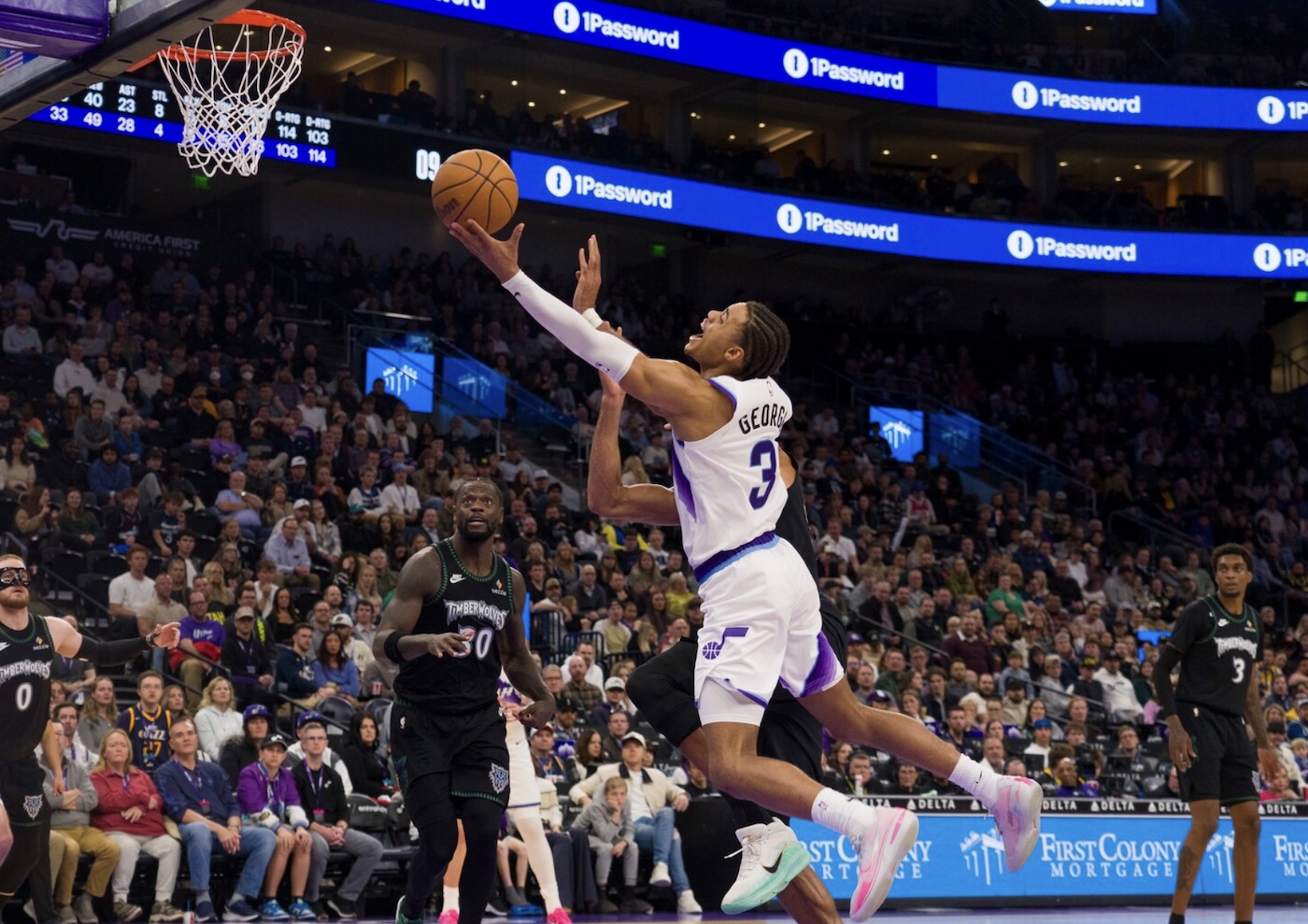
Late on a November night, the clock raced toward zero in the second overtime of a Jazz-Bulls contest. The Jazz had stayed close behind a 47-point night from Lauri Markkanen, but the Bulls switched his ball screen at the top of the key, and there wasn't a clean passing angle to get the ball to the Finnish forward. Instead, the Jazz flowed right into a dribble hand-off for Keyonte George, who probably didn't realize he was about to have maybe the most important before-and-after moment of his career.
It had been an uneven start to George's third NBA season up to that point. Sure, he had entered the game with a 21-ppg average, but he had struggled with his shot over the first month of the season. At the point when the Jazz triggered this play with 8.3 seconds left in 2OT, George was a 27% 3-point shooter for the year — including 2-for-9 that evening. His go-ahead attempt from 20 feet had airballed at the regulation buzzer, and he turned the ball over on the last possession of the first overtime, giving the fulls a chance to force a second extra session. Now, with the game deadlocked at 147-all, the ball hit George's hands with 3.1 seconds left. George found a seam in Chicago's switching defense and let fly. Swish.
It might not have felt like a seminal moment at the time, but something changed for Keyonte while that ball hung in the Delta Center air. Because from that game through the trade deadline, the 22-year-old guard averaged 25.2 points, 6.5 assists, and 40.8% outside shooting. It led to his best season ever, ultimately resulting in the lucrative contract extension he signed this month.
George became the third player from the 2023 draft class to extend his rookie scale contract. The new 5-year pact starts next season and could be worth up to $157.5 million, including reported incentives for individual and team performance benchmarks.
"I knew where I wanted to be," George said at a press conference. "This is my second family. Signing here, extending here was honestly a no-brainer."
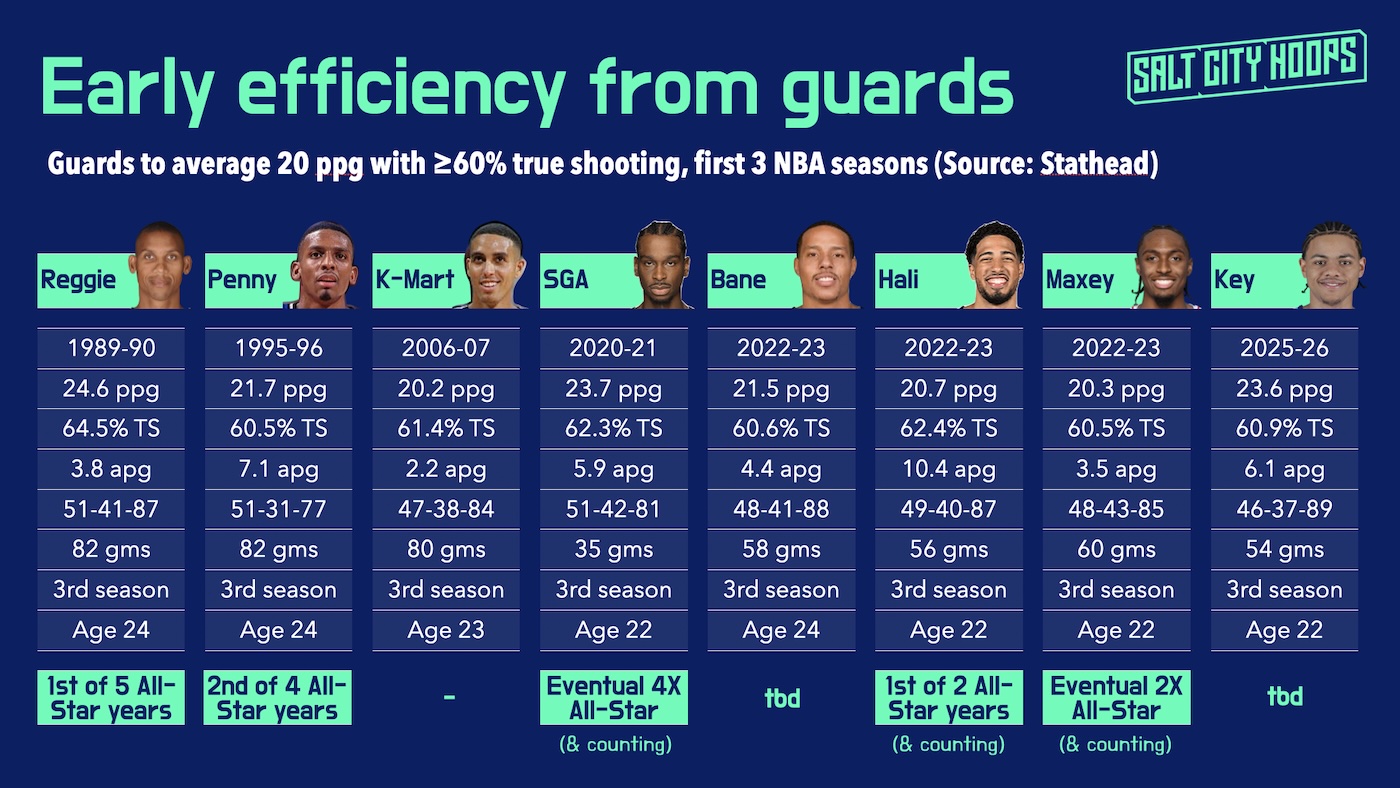
The extension comes in at a price point that is similar to other non-All-Star but high-producing guards, like Jalen Green ($35.3M annually), Immanuel Quickley ($32.5M) and Jalen Suggs ($30.1M). None of those three have equaled George's 23.6-point average from last season, or his 60.9% true shooting. In fact, precious few guards have scored that much and that efficiently in one of their first three seasons, and almost all those who did went on to enjoy All-Star careers.
Key did most of the heavy lifting on those stats in the 2.5-month span that started against Chicago, and the Jazz used him pretty sparingly thereafter. But those 11 weeks of basketball were enough to convince decision-makers that they had another piece. George's emergence emboldened Utah to make the February acquisition of two-way star, Jaren Jackson Jr., although their new win-now trio barely had time to test the waters. In the lone game in which Jackson, Markkanen and George appeared together, George left in the second quarter. By the time he returned to action three weeks later, Jackson and Markkanen had played their respective last games.
That trio will largely shape the Jazz's near-term basketball vision. It's no surprise, then, that Jazz coach Will Hardy went to great lengths to get the three of them together in a gym in Finland this summer to start to forge an identity.
"Those three are going to have to learn how they operate together best," Hardy said. "The thing that I've seen that has encouraged me the most is how the three of them interact as humans. They're all very driven, they're all tough and competitive, but each of them has enough humilty to be a part of the group in the correct way."
Hardy was quick to remind assembled media that the winning formula goes beyond those three guys — "It's not just about them," he added. But it's important to note that George occupies an important place on the Jazz's competitive timeline, because he can complement the late-20s All-Stars today, but still be part of a future that ostensibly will feature Darryn Peterson and Ace Bailey more centrally. Those five are now all under contract for 3-6 more seasons.
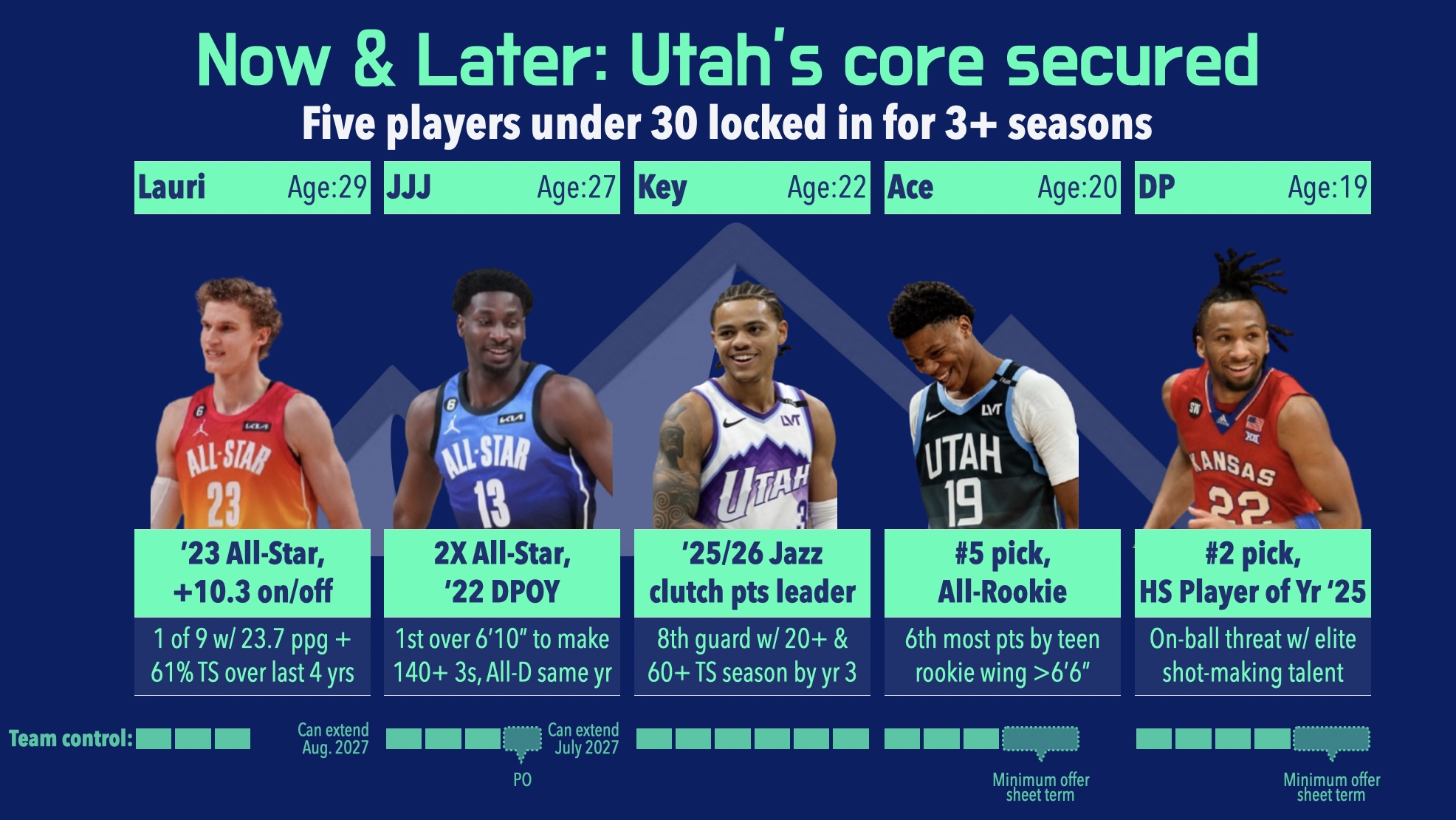
Markkanen and Jackson are win-now pieces, although both still under 30. Peterson and Bailey are intriguing talent bets who can't yet buy a beer. George — who will turn 23 in November — bridges those timelines in a way.
Those five, in some order, could represent the core of the next competitive version of the Jazz. George is likely the third best player today[fn]Austin Ainge says Lau & Trip are the two best... no arguments here.[/fn]. The question that matters more is where he will rank in that pecking order throughout this extension and as the Jazz get closer to real contention.
That's unclear for now. Jackson is just entering his prime, and this writer has long held the opinion that Markkanen's game will age well. DP and Bailey have sky-high ceilings, but aren't guaranteed to reach their best-case versions. And Key himself is still just 22 and likely not the final version of himself yet. Plus, there could still be external talent upgrades or development success stories that change the landscape.
But the $31M average annual base on George's deal is essentially a starter-level price point. So if he's still the third best guy on a 2030 contending Jazz team, it will feel like a steal. If he's the fifth best by then, it will still look appropriate.
Probably the only way the Jazz find themselves upside-down here is if he somehow winds up as a player contributing around the margins. Which is why the partnership to watch at this point is how he and Peterson complement each other.
In the immediate term, George takes some of the pressure off of DP needing to be transcendental from day one. And even as Peterson gets closer to the best-case version of himself, teams need more than one ball-in-hands creator. Eventually, if the rookie turns into what the Jazz hope he can be, then at some point on this contract George will no longer be a 23-point, 6-assist player. At this price point, that's fine. But how he fits into a hypothetically Peterson-led future does matter.
Based on his current level of play, this deal looks solid compared to his guard brethren from recent drafts.
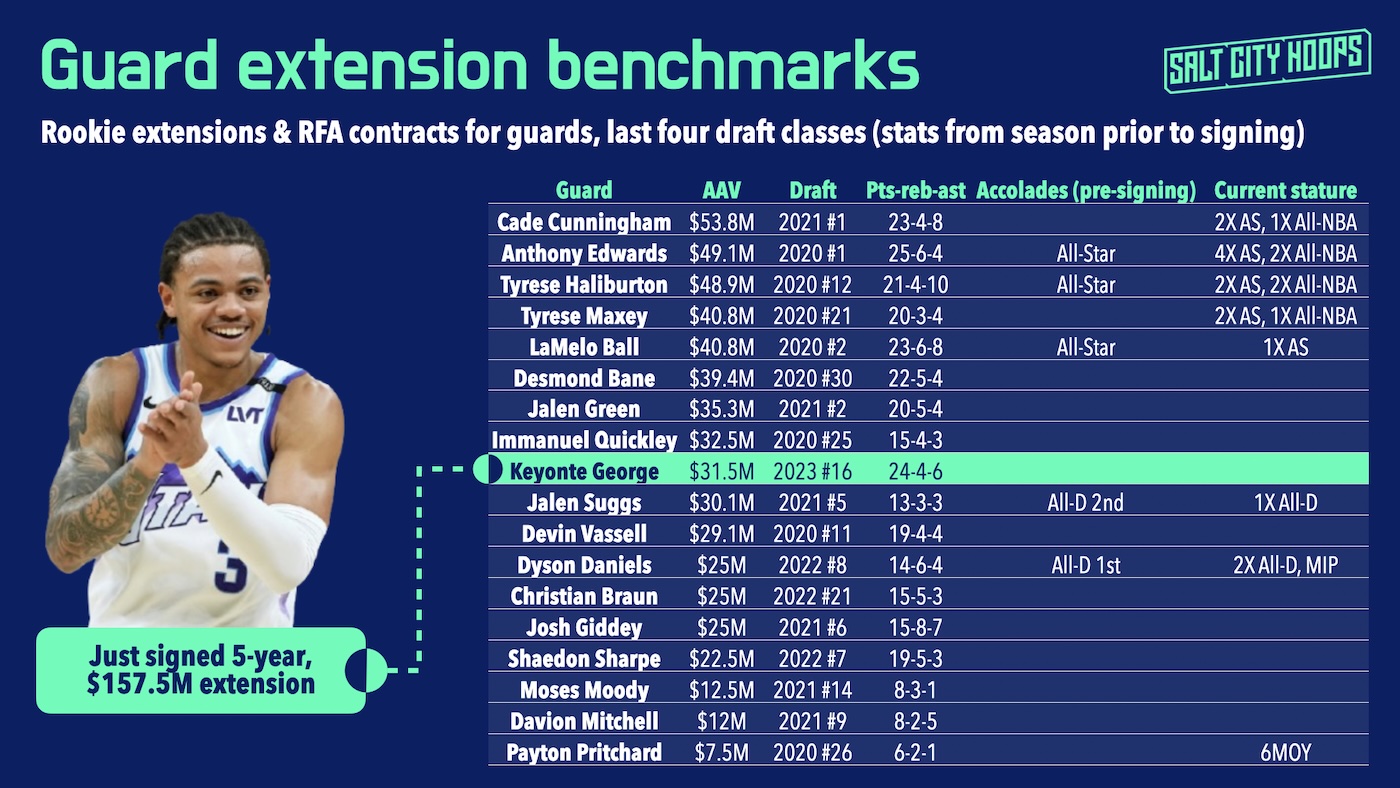
If anything, that list illustrates how challenging it can be to calibrate value on sub-max young players. Right this second, George is outperforming Jalen Green and Immanuel Quickley, who make slightly more. But at the same time, impact metrics would indicate that Jalen Suggs, Devin Vassell and Dyson Daniels may add more winning value.
But overall, that graphic more or less justifies the price point.
His defensive improvement will also be under a microscope as the contract takes George and the Jazz into a more competitive era. This is where the relationship between Hardy and George will matter. Hardy has already shown he can unlock improvements in the young guard. Both of them acknowledged again on Saturday the famously "brutal" dialogue that led to George's impressive leap. As much importance as has been assigned to that one exit interview, Hardy makes it clear that's just one moment in their partnership.
"There are more conversations to come," the coach promised. "We're not even close to finished."
That's certainly true. Keyonte's a very different player now than he was even 315 days ago when the ball found him on the right wing against Chicago. Whether because of some trajectory shift brought on magically by that moment or because his ascension was inevitable, the Jazz have another piece ready to aid in their climb.