
With the Walker Kessler trade, Utah’s biggest void is at the center position. For now, they can start Jusuf Nurkic and have Jaren Jackson Jr. chip in, but neither is an ideal option for a team with playoff aspirations.
Luckily they have a war chest of draft picks and increased cap flexibility that will allow them to explore many different options.
Further, the Jazz are in a unique position. Ace Bailey is on a rookie-scale contract for three years and Darryn Peterson for four. With Keyonte George, Lauri Markkanen, and JJJ also on the team, they have a three-year window where all five could share the floor together. If the Jazz want to make a push while Bailey and Peterson are on cheaper contracts, now is the time.
In the modern NBA, teams can change drastically year to year, and it can be a fool’s errand to forecast even a three-year window. But let’s try anyway, with the following assumptions:
- The Jazz focus on the core of Peterson, George, Bailey, Markkanen, and Jackson Jr.
- If changes to the core are made, Utah values them in this order: Peterson, Bailey, George, Jackson Jr., Markkanen
- Keyonte gets a five-year extension with an average annual value of $40 million. If he gets a larger number, the scenarios below should still be feasible.
- The Jazz are willing to go into the luxury tax, but want to stay under the first apron
- Roster slots 8-15 are filled with cheap contracts in the $2.5 million to $7 million range. Basically rookie-scale or exception-level contracts. With the core five, and while staying under the apron, the total salaries of these players should total around $32 million.
So the big question is: what kind of center do they target?
Average center
While Jusuf Nurkic is an excellent backup and capable of starting, the Jazz could look to sign another center of comparable or slightly better talent. For example (all salary figures here and below are 2026-27):
- Daniel Gafford: 9.5 PPG, 6.9 RPG, 1.3 BPG, .655 eFG% in 21.7 MPG - $17.3m
- Wendell Carter Jr.: 11.8 PPG, 7.4 RPG, 0.6 BPG, .568 eFG% in 29.3 MPG - $18.1m
- Onyeka Okongwu: 15.2 PPG, 7.6 RPG, 1.1 BPG, .564 eFG% in 31.0 MPG - $16.1m
Like Nurkic, each of these options has flaws, but also excels at particular big-man things. Combined, the Jazz would invest around $30 million in a solid center rotation. But in the playoffs, any of these options could be targeted and their minutes reduced.
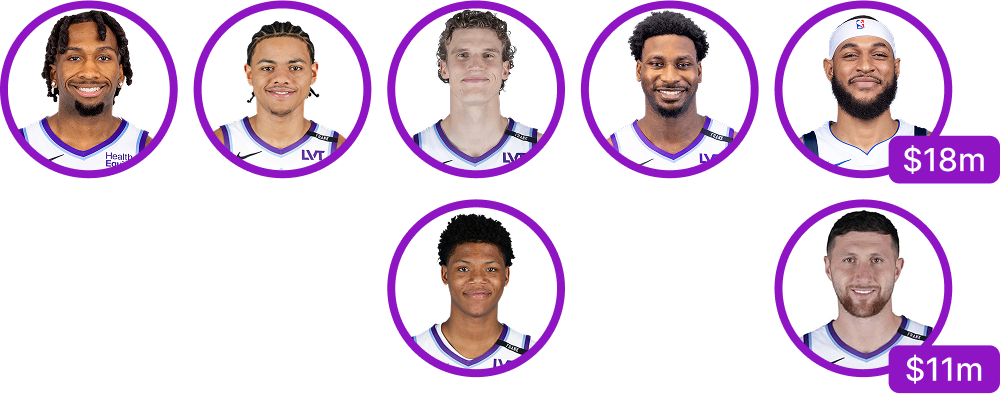
A team of Peterson, Key, Ace, Lauri, JJJ, Gafford, Nurkic, and eight cheap contracts should just fit under the apron for the next three seasons. This direction may have a lower overall ceiling than other options, but is also by far the easiest to build and would require very little draft capital. A young player and a few seconds or a single first-round pick may be enough to snag a center of this caliber. This is also a decent immediate path, as solid players on reasonable deals should be easy to fold into another deal later on.
Above-average center
If a player like Gafford doesn’t excite you, the Jazz could seek players in the next talent tier:
- Jarrett Allen: 15.4 PPG, 8.5 RPG, 0.8 BPG, .639 eFG% in 27.1 MPG - $28m
- Isaiah Hartenstein: 9.2 PPG, 9.4 RPG, 0.8 BPG, .622 eFG% in 24.2 MPG - $25m
In this scenario, the Jazz would either need to move on from Nurkic or tighten the belt on what they spend on their other cheap contracts. Instead of two solid centers, the Jazz would consolidate and spend roughly the same $30 million on a playoff-proven center like Allen, who would share center minutes with JJJ or one of the cheap contract players.
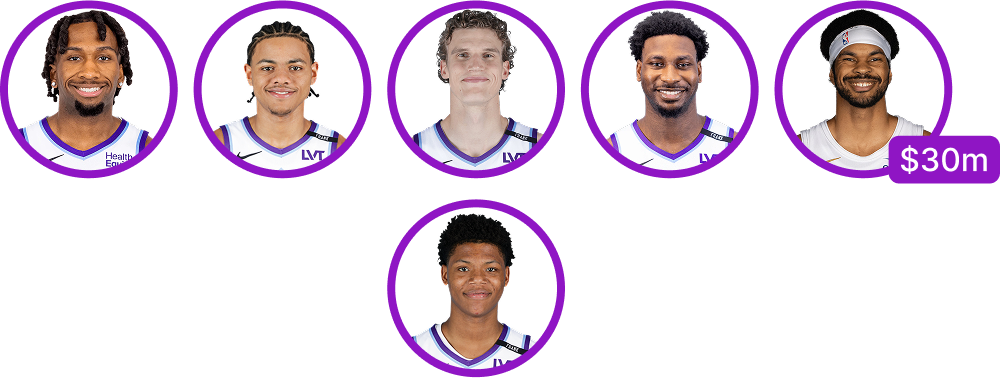
It would be more difficult to acquire a player like this, but it gives you a more dependable rotation in the postseason, where JJJ is more likely to spend minutes at center anyway. While it would require a higher asset price and the right opportunity, acquiring a player of this talent level would put the Jazz back in the position they were in when Kessler was assumed to be part of the future.
Star center
The issue with the core of Peterson, Key, Ace, Lauri, and JJJ is that since Jackson is best at power forward, one of these players needs to come off the bench -- likely Darryn or Ace as the younger players. One option is to trade Markkanen or Jackson for a star center, allowing everyone to start. To be clear, I’m a huge fan of Lauri, and was against the idea of trading him during the whole tanking experience. And with Kessler’s departure, it’s now possible to extend Keyonte while retaining him and Jackson for the next three years, at least.
That said, if the right star center becomes available, it’s worth considering all options. For example:
- Evan Mobley: 18.2 PPG, 9.0 RPG, 1.7 BPG, .582 eFG% in 31.9 MPG - $50.1m
- Chet Holmgren: 17.1 PPG, 8.9 RPG, 1.9 BPG, .614 eFG% in 28.9 MPG - $41.2m
Both are young players who have already made All-Star and All-Defense teams as well as deep playoff runs. Both players are comparable or slight upgrades in talent to both Lauri and JJJ, but have higher upsides with their youth. The chance such a player is available is slim, and the price could be high, but it raises the team’s ceiling.
The other advantage to such a move is that it gives the Jazz additional money to use on a bench upgrade. A team of Peterson, Key, Ace, JJJ, Mobley, and eight cheap contracts totaling $32 million would give the Jazz around $33 million they could use on one or two rotation players. More expensive options could be:
- Trey Murphy III: 21.5 PPG, 5.7 RPG, .379 3P%, .572 eFG% - $27m
- Devin Vassell: 13.9 PPG, 4.0 RPG, .384 3P%, .547 eFG% - $27m (I don’t think Vassell is at all available, but he’s another example of the type of player that could be targeted in this slot)
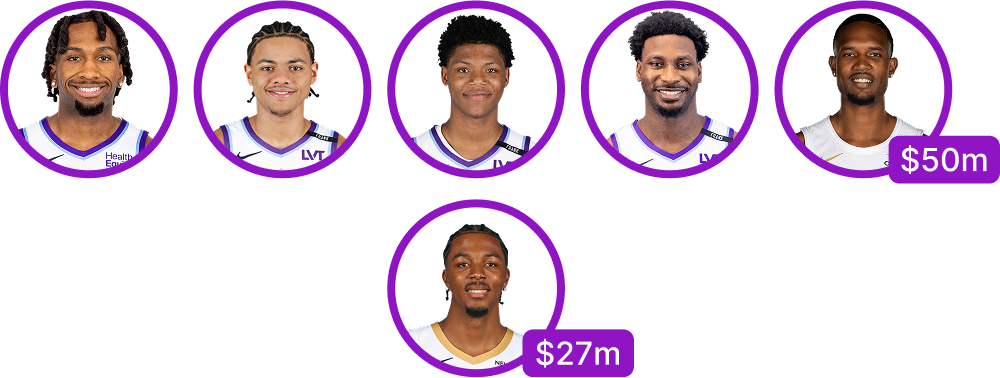
Again, these types of trades require both opportunity and assets. In the pipe-dream where the Jazz are able to trade for both Mobley and Murphy, they’re likely giving up Lauri, young players, and potentially four to six of their first-round picks. But consider the Knicks, who two years ago had a core of Jalen Brunson, OG Anunoby, Josh Hart, Mitchell Robinson, and 10 first-round draft picks. They cashed in a huge chunk of their pick stockpile in trades for Karl-Anthony Towns and Mikal Bridges. The Jazz are in a position to push in their chips when they feel ready.
Rookie-scale center
Rather than trade for the most expensive tier of center, the Jazz could target a rising player on a rookie-scale contract. A few such players:
- Donovan Clingan: 12.1 PPG, 11.6 RPG, 1.7 BPG, .582 eFG% in 27.2 MPG - $7.5m
- Kel'el Ware: 11.1 PPG, 9.0 RPG, 1.1 BPG, .601 eFG% in 22.1 MPG - $4.6m
- Moussa Diabaté: 7.9 PPG, 8.7 RPG, 1.0 BPG, .632 eFG% in 26.0 MPG - $2.4m
- Yves Missi: 5.7 PPG, 5.8 RPG, 1.5 BPG, .544 eFG% in 19.7 MPG - $3.5m
If the Jazz choose this route, they hope to replicate the production of an average center at a fraction of the price, with the potential to develop into a better player. The appeal is obvious, but it also is a bigger risk in the playoffs -- for example, Clingan was often played off the floor in a postseason matchup against Victor Wembanyama. Productive players on rookie-scale contracts are also valued across the league. Walker Kessler was coveted before he received his new deal with the Lakers. A player like Clingan may not be available except for a godfather offer (e.g. what L.A. eventually offered Utah for Walker).
The advantage of acquiring such a player is that they can use the saved salary for a stronger bench. Let’s say the Jazz pried away Clingan to join Peterson, Key, Ace, Lauri, and JJJ. They would have enough salary to retain Nurkic as a solid backup option, seven cheap contracts totaling around $24 million, and still have around $22 million to spend on another very good bench player. Again, these examples may not be on the trade market right now, but to give you an idea of playoff-ready players at this price point:
- Keldon Johnson: 13.2 PPG, 5.4 RPG, .363 3P%, .582 eFG% - $17.5m
- Dillon Brooks: 20.2 PPG, 3.6 RPG, .344 3P%, .501 eFG% - $20m
- Josh Hart: 12.0 PPG, 7.4 RPG, .413 3P%, .593 eFG% - $20.9m
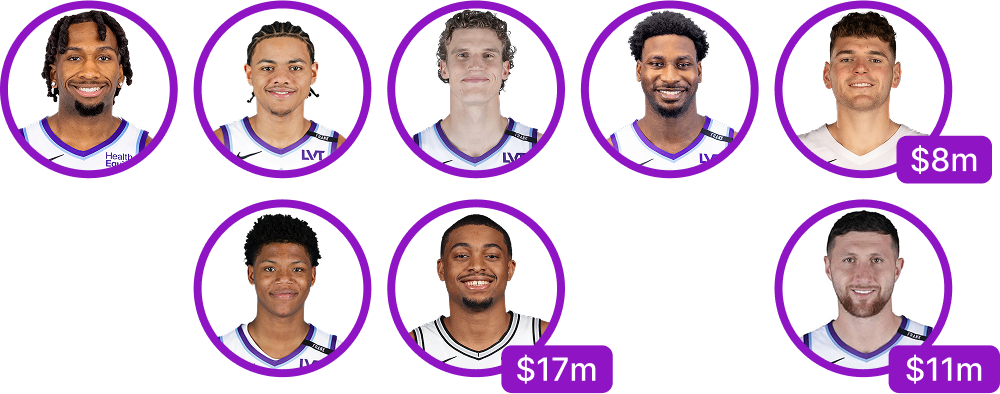
Adding another player that can start or be a sixth man would really solidify the rotation. Of course this money could be distributed among multiple players instead.
While targeting a rookie-scale center does have risk, the bolstered depth can offset inexperience that doesn’t translate in the playoffs. And if the player just isn’t working out, the Jazz aren’t stuck with a big contract that’s hard to move. The playoff floor is still probably lower compared to choosing a more proven center, but it’s still a tempting path.
Conclusion
Which choice is best? That will be dictated by what opportunities appear and at what price. While the Jazz do have a unique three-year window, they are not desperate and do not need to rush. Ace and Darryn will need time to develop no matter what path is chosen. Key and Lauri need to experience playoffs for the first time. The Jazz can roll with Nurkic and JJJ for now while they evaluate how the team gels and survey the market. The Jazz could start with a more modest upgrade around the trade deadline, and roll that into a bigger move next offseason. They could wait for a contender to hit a salary crunch or disappointing playoff run so that a previously unavailable star becomes available. The Jazz now have some of the most valuable draft pick assets on the market, and can be ready when the right moment strikes.
In the meantime, Utah still has an exciting and competitive team. Even without a center upgrade, making the playoffs is still a reasonable goal.