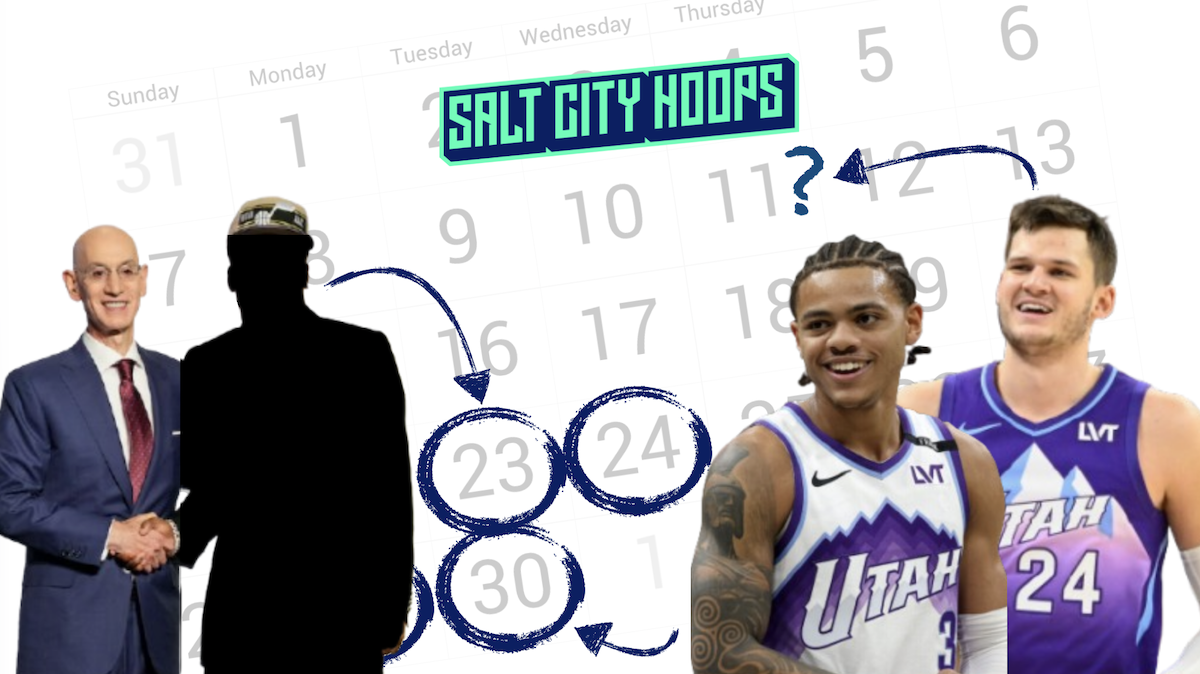

A huge percentage of the online dialogue about the Utah Jazz right understandably centers around draft outcomes. But that's just one of the many key decision days the Jazz have circled on their summer calendar.
The only Jazz players who don't have some kind of trigger date or contract decision looming are All-Stars Lauri Markkanen and Jaren Jackson Jr. Those two can calmly ride the summer out with no transactional drama. But the Jazz have to make some kind of decision on literally everybody else.
Some of those are largely ceremonial questions like whether to keep investing in a recent top-5 pick who averaged 14 a game as a teenager and looked good doing it. Easy call. Other decisions include how much to pay young starters about to graduate off of rookie deals, or (gulp) whose ceiling to bet hardest on with the second overall pick in the draft. Massively important stuff.
Any of these dates/decisions could be the subject of its own analysis -- and will be at some point. But let's start by just laying out the 11 dates Jazz fans should be aware of as the offseason chugs along.
Somewhere between June 11 and June 20: Jazz can negotiate with their own pending free agents
The Jazz get a head start at negotiating with their own incumbent free agents, starting the day after the NBA Finals. That could be as early as this coming Thursday if the Knicks complete a sweep on Wednesday evening; or, at the latest, Utah can officially open negotiations (and even agree to a deal) on June 20 with Walker Kessler, Jusuf Nurkic and Kevin Love.
Kessler's negotiation is the headliner. With the Jazz having spent their 2026 cap space in a "pre-agency" deal for Jackson, there's no longer a reason to make Kessler wait for his big raise. On his end, though, it might be advantageous to wait until 29 other teams could get involved and potentially help him set a market price. Unless Utah comes right out of the gate willing to meet every penny of his ask, there's little motivation to sign right away.
The Jazz would probably prefer to wait on veterans Nurkic and Love until they have a better idea how the draft and free agency might play out.
Nurkic technically could sign his new deal as an extension if it's within certain paramters, and that could happen as early as this instant... but it probably won't. The advantage of retaining him via an extension rather than a new contract is that depending on the amounts, he could be trade eligible immediately. Otherwise, the Jazz would have to wait until December 15 to include his new contract in a deal. (Love is coming off a 2-year deal and Kessler a rookie scale contract, so they are not eligible to re-up via extensions at this point.)
Utah has Bird rights to all three players, meaning they can retain them for any figure up to the max salary. Utah can also negotiate early with Elijah Harkless and Oscar Tshiebwe, for whom they have Early Bird rights.
June 23: The NBA Draft (round one)
It's likely the biggest day of their summer — and perhaps one of the biggest in franchise history — because Utah will have a chance to draft someone who could change the whole trajectory of the thing.
The Jazz have picked this high exactly one time in franchise history, and that was when Jimmy Carter was president and Han Solo had just been frozen in carbonite.
That pick turned out nicely, with 1980 draftee Darrell Griffith having a 10-year Jazz career averaging 16-plus points a game. But this draft class is headlined by four players widely heralded as potential stars. If the Jazz guess right on which one can change their future, June 23 will be a day we'll remember for a long time. Mark Pereira has already spent some time guessing at how draft day might unfold for the Utah Jazz with various guests on the SCH podcast feed, and there will be more discussion on that in the next two weeks and change. For the purposes of this article, we'll just leave it at this: this has the potential to be a BIG day in franchise history.
June 24: The NBA Draft (round two) & free agency for undrafted players
The Jazz don't currently have any second-round picks, but that can change quickly. Second-rounders change hands frequently over the course of draft night, and often for very little.
Then, as soon as the draft ends, undrafted players can agree to deals. Most commonly, players agree to two-way deals or to camp contracts with a partial guarantee. Expect a flurry of transactional reporting as soon as pick 60 is announced.
It does make some financial difference if the 15th man on the regular roster is a draftee or not. An undrafted free agent who signs a rookie minimum contract would only cost the Jazz $1.4M, but would count at nearly $2.5M toward the tax and aprons, whereas a second-round draftee signed to the minimum counts at the actual number he's signed to. That's one reason I wouldn't be surprised to see the Jazz — who suddenly have to worry about tax thresholds and salary aprons — try to scrounge up a second rounder.
Technically this is also the day when team option decisions must be made on Bez Mbeng and Hayden Gray. Since they could become restricted free agents if the option is not exercised, they have an earlier option deadline. But they are also both fully non-guaranteed even after their options are picked up, so functionally the June 24 date means fairly little for them in terms of job security. I expect both will be on the roster at least through summer league.
June 29: Decision day for Kyle Filipowski and Svi Mykhailiuk
These two forwards don't technically have option years, but their salaries guarantee fully if they're still on the roster after this date. Both played around 23 minutes per game when available in 2025-26, and both were net-positive players by EPM wins added[fn]2.2 for Svi, 2.1 for Flip.[/fn], so I'd expect them back. Mykhailiuk will make $3.85M if he's still on the roster when the sun rises on June 30, Filipowski will earn $3M.
June 29: Deadline for qualifying offers to potential restricted free agents
Kessler's is the big one. Utah will certainly tender him a one-year, $7.1M qualifying offer by that day in order to preserve his matching rights. Technically he could sign that contract and play out the year to become a 2027 UN-restricted free agent, but first-round draft picks almost never do. Unless he's already agreed to a new Jazz deal by then (see above), this "QO" will simply give the Jazz the right to match offers from other teams. That's incredible leverage to have in negotiations, and several RFAs have really felt the squeeze in recent years.
The Jazz can also make Harkless and Tshiebwe RFAs if they tender them a one-year minimum contract with around $109K guaranteed. The risk there is that either guy could accept the offer and then the Jazz would be forced to either keep them or cut them. So if they're not sure they want to allocate the roster spots to either guy, or if they're hopeful about keeping them in two-way slots, they could opt not to offer the QO. (Mbeng and Gray could also be RFAs if the Jazz decline the 2026-27 options, but as discussed above, there's little reason to do so before June 29. If they do, it probably signals that they're simply moving on.)
June 30: Free agency begins
Staring at 4:00 p.m. MDT, the Jazz can negotiate and/or enter into agreements with free agents from the other 29 teams. Because of where they're at salary-wise, they will likely only have some version of the mid-level exception[fn]The largest will be around $15M this year.[/fn] and minimum contracts to work with. There's some chance they could add a player via sign-and-trade, but doing so could put them close to a hard cap for their 2026-27 spending.
I'll have my usual all-FA list coming out soon, with a sentence or so on every guy the Jazz could target with their MLE or minimums.
June 30: Utah's 2023 draftees become extension eligible
Also on that Tuesday afternoon, the Jazz can officially offer extensions to Keyonte George and Brice Sensabaugh. Those deals can actually be signed starting July 6 as 10:01 a.m. MDT.
I've been talking a lot lately about how the George decision especially might sneakily be one of the biggest decisions the Jazz make this offseason. He's coming off leap to quasi-star status: 24-4-6 counting stats (rounded) and 60.9% true shooting, but as Zarin Ficklin points out, still has negative defensive metrics. He probably expects a significant dollar figure. Last year's guard extendees in the non All-Star tier were Shaedon Sharpe (4 years, $22.5M average), Dyson Daniels (4, $25M) and Christian Braun (5, $25M). George's camp will argue that he's better than those three; Utah will counter that we still don't know where he fits in the pecking order of a contending roster.
It's even trickier for Sensabaugh, a reserve whose exact place in the Jazz's new competitive reality is even less certain. Players in those types of roles rarely get extended at all. A few reasonable comps are Nikola Jovic, Moses Moody and Corey Kispert, all of whom signed for deals at or below MLE-level money.
If either guy doesn't sign an extension between July 6 and the last day of the offseason, they'll be restricted free agents next offseason.
July 2 & July 11: Mbeng & then Gray become trade eligible
This likely only matters if the Jazz need their salaries to ladder up to something.
July 4-7, 9-19: SLC Summer League & NBA Summer League in Las Vegas
Actual basketball!
The Jazz's 2026 draftee will likely headline the SLC event, with Memphis' choice at #3 also being a marquee attraction.
It's hard to know who else Utah will ask to make a summer league appearance. Mbeng, Gray and Blake Hinson will almost surely participate. Ace Bailey might have already shown enough to where Summer League isn't really super-duper for him, but they might have him play a little. Isaiah Collier and Cody Williams are the next youngest, but both have been rotation regulars. Harkless and Tshiebwe are technically free agents, so we'll see. Sensbaugh and 2025 Summer League MVP Filipowski have likely both graduated from the experience.
All 30 teams will participate in the Vegas action.
August 10 & 12: Mykhailiuk and then Filipowski become extension eligible
Both guys could theoretically extend for up to the estimated average salary, although that kind of jump could make them trade ineligible for next season[fn]Depending on exactly where the trade deadline falls.[/fn]. John Konchar is already extension eligible, but starting August 4 he wouldn't be subject to extend-and-trade limits. It's probably moot for all three guys, but this is the type of detail you get when a completist writes the article.
October 31: Deadline to exercise third-year (Bailey) and fourth-year (Williams, Collier) rookie contract options
To be clear, this is the deadline for team options on the 2027-28 season.
Bailey finished the season just shy of 1,000 points. The only teenage rookie wings around his size to have more were Carmelo Anthony, LeBron James, Luka Doncic, Cooper Flagg and Jayson Tatum. Sheesh. There's precisely zero chance the Jazz decline his option.
Williams just came off a 24.3-mpg season in which he finally started to look like more than a concept. Collier's ability to break the paint and pass became a staple of the bench offense. Neither guy can shoot well, but both have clear foundations in terms of NBA skills: defense for Williams, driving and passing for Collier. For a rebuilding team, these would be no-brainer option decisions, but Utah does have to start thinking about how the salary sheet fits together beyond this year. I'm still betting they exercise these options, but I'll reserve a final prediction until we know the full roster and get a sense for how camp goes.