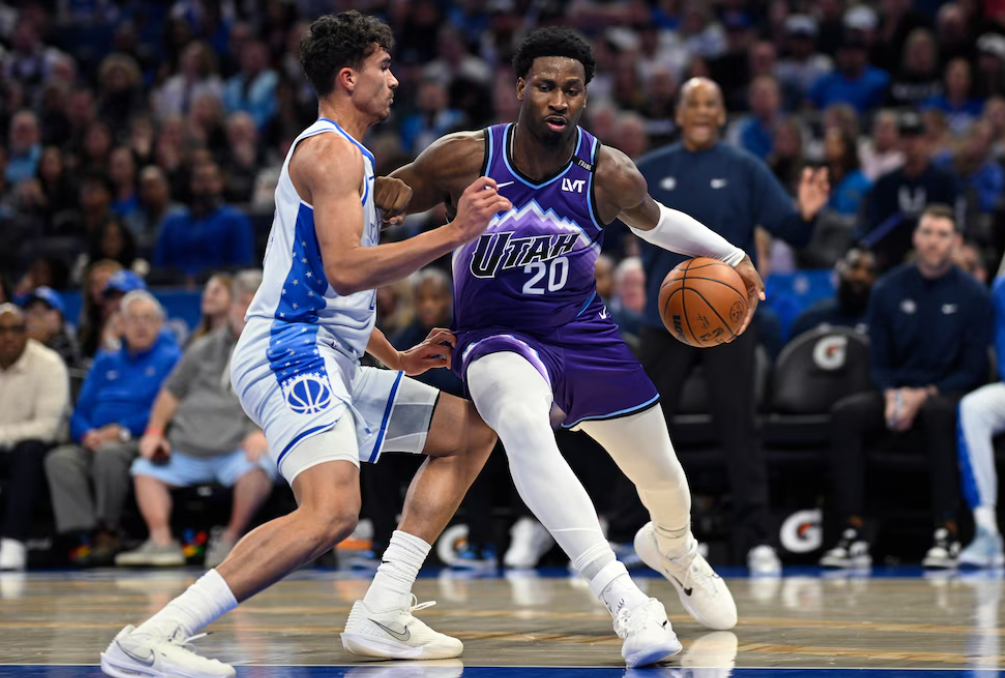

Every NBA team's year contains a minimum of 236,160 seconds just on the regular season clock. That doesn't count dead-ball drama, thousands of individual interviews, transaction cycles, strategic decisions, and everything else that accompanies the stuff that happens while the clock is running. It's not an exaggeration to say that an NBA team's season is a collection of a million moments.
But how many of them will have really mattered when you look back on that season years later?
Here are the seven canon events from this recent Utah Jazz season. A canon event is an occurence that's either vital to telling the story of that season or that has the potential to color everything that comes after. There are a thousand more moments that were interesting, or fun, or telling, or whatever... but only a few were "canon," meaning these are the things we'll be talking about five years from now when we reflect on the Jazz's 22-60 year.
And given where the Jazz were at in their competitive arc this year, it's also entirely that some fans' attention went elsewhere. So consider this a little Reader's Digest version of the season — if you were somewhat tuned out during the rebuild, here are the things you absolutely need to know about this past season to consider yourself up to speed.
In no particular order...
Trip trade
Whether it works out perfectly or not, the February acquisition of Jaren Jackson Jr. is a before-and-after moment for a franchise. If nothing else, it signaled a gear change nearly four years into the rebuild. For that reason alone, it will always be one of the most memorable and long-term relevant things that happened this year.
Plus, teams just don't often acquire 26-year-old All-Stars/DPOYs without giving away the store. Utah did send out three first-round picks, including one that could end up being valuable. Parting with Walter Clayton Jr. probably gave them some heartburn, but there weren't a lot of minutes for him anyway. Taylor Hendricks hadn't quite gotten back to looking like a lottery-level athlete after injury.
Jackson's defensive prowess will raise the floor for Utah going forward. The best defense in the league was OKC at 106.5 allowed per 100 possessions, and in the three games Jackson appeared, the Jazz produced D-ratings of 105.3, 106.7 and 92.1. Granted, that was against teams with average (Orlando, Miami) or bad (Sacramento) offenses, but still — you could catch the vision, and that was without Walker Kessler.
He's also a career 19-ppg scorer, but the biggest benefit he'll bring the now-competitive Jazz is on the other end, where he has earned three all-defense selections and one Defensive Player of the Year trophy.
All things Airious
We probably don't talk enough about how meaingful Ace Bailey's season as a teenage rookie turned out to be.
He ended the season just seven points shy of 1,000. The only players around his size who scored more as rookie teenagers are Carmelo Anthony, LeBron James, Luka Doncic, Cooper Flagg and Jayson Tatum. Read that list again. Yeah. And then how he did it was also pretty special.
I like to point out that even a bunch of even eventual star wings had relatively modest stat lines as teen rookies. Rashard Lewis averaged 2 points, 1 rebounds and less than half an assist in 20 games as a rookie, and became a 2-time All-Star. Gerald Wallace was an eventual All-Star and all-defense wing and averaged 3-2-1 as a rookie. Brandon Ingram's rookie year was 9-4-2, and he's an All-Star. Tracy McGrady averaged 7-4-2 and wound up in the Hall of Fame. Paul George (technically turned 20 before February 1 in his rookie year) had 8-4-1. Being a rookie wing suddenly playing among men before you can buy cigarettes is really hard!
Of all of these big wings who debuted before 20, Bailey's counting stats (14-4-2) were most similar to rookie Tatum's (14-5-2). Tatum shot better than Bailey did as a newbie, but also got to be part of a winning team from day one. That's an insane comparison; Tatum has finished top-6 in MVP voting four times.
The Jazz, umm, take care of business
By finishing the season 8-35, the Jazz sure looked like a team interested in guarding the pick they conditionally owe to the Thunder. After a tiebreaker drawing went the Jazz's way on Monday, they now have definitively kept the pick out of OKC's hands.
Importantly, they also have a 45.2% of picking in the top four of a loaded draft class. This could wind up being THE canon event of the 2025-26 Jazz, depending on how the lottery goes and how their draftee ultimately develops.
Few things will define the 2025-26 Jazz fan experience more than the collective anxiety about those odds, especially as Utah collected some unbudgeted (but fun!) wins along the way. In the end, the rotations got predictably more adventurous, with 10-day and two-way signees getting more of the minutes as the Jazz approached the finish line. They used a different starting lineup in every other game on average (42 quintets for 82 games), and got pretty creative with how they cobbled together lineups. They lost 11 of their last 12, 15 of their last 17, 23 of their last 27.
It's not awesome for their fans or for the league that the current reward system made this 100% the best thing for them to do. That's why the league will take a look at a bunch of potentially dumb and harmful "fixes" that might just complicate further the talent distribution conundrum in an already very stratified league.
Lauri goes for 51 (and is still awesome)
Only 14 players recorded 50-burgers this NBA season, and Lauri Markkanen's was the first regular season 50 by a Jazz player since 1998.
It punctuated another superb season for Markkanen, who averaged a career-best 26.7 points after hearing every national media pundit declare loudly that the Jazz had to trade him. Instead of trading him, they further engineered their offense around him. I wrote earlier this season about how Markkanen is absolutely the hub and primary decision-maker in Utah's system even though he doesn't necessarily start with the ball all the time. The first 40 or so games of this season were a proof of concept on how to build an offense around an elite off-ball weapon.
His 3-point percentage softened a bit, but he still maintained a true shooting mark over 60% because had his best season at the rim: 73.4% from 0-3 feet, per Basketball Reference. Only 10 other players achieved that same combination of scoring volume and efficiency, and they were all All-Stars except for injury-riddled Joel Embiid.
In fact, only one other player[fn]Devin Booker in '22-23, when Markkanen made it over him.[/fn] has ever missed the All-Star team in a season where he averaged 26+ on 60% or better true shooting while appearing in at least half the games. That's a long way of saying that Markkanen very well could have (and maybe even should have) repeated as an All-Star based on individual stats alone. It's somewhat understandable that it's harder to get in from a sub-.500 team, but historically guys with his stats get in anyway.
George's leap to stardom
Speaking of guys who played at star level, Keyonte George's counting stats (24-4-6 at season's end) compared pretty favorable to other guards who made All-Star. He certainly outpaced East reserve Norm Powell (22-4-3) and injury replacement De'Aaron Fox (19-4-6), although San Antonio getting a second guy in is understandable. Jamal Murray (25-4-7) was qualitatively much better, and Devin Booker (26-4-6) scored a bucket more per game while being part of one of league's biggest unexpected successes.
But the point here is he was not far from that level. Being a borderline All-Star means you're top 30-40ish in the NBA's power structure at a given point in time. Both Markkanen (in 2022-23) and Jackson (2024-25) have finished as high at 17th in voting for 15 All-NBA spots. So if you believe George's third season was pretty real, that means the Jazz will go into next season with three top-(X) players[fn]I'll let you figure out what X means, although I have some ideas and I'll be talking more about that soon.[/fn], all under 30, while they're in parallel going to be discovering how good Bailey and their 2026 draftee can be. That's a nice spot to be in.
George's growth also helped unlock a lot of the other things we're talking about here. Without his explosion, it's unclear if the Jazz would have felt ready to swing a big "buyer" trade for JJJ, and he certainly helped Markkanen get back to 2022-23 levels[fn]It's almost a separate topic, but Markkanen's best years have always been when he was playing next to a bona fide table-setter.[/fn].
His defense also improved, although that's the area he probably needs to continue to fortify. I'd also feel better about Utah's near-term competitiveness if the net rating in the George-without-Lauri minutes were better[fn]-14.4 per 100.[/fn], but there's a lot of context behind on-off stats in a season when the Jazz as an organization had some competing goals. Which brings us to...
One fine day
We already made reference above to Utah's competitive goals. But the NBA's decision to dock the Jazz a half million bucks in February became its own storyline that definitely belongs in the CliffsNotes[fn]Yes, this is apparently the correct style for the study guides that helped you cheat on your Dostoyevsky book report in high school... who knew??[/fn] version of the Jazz's season.
The most perplexing thing about this fine to me is not that the Jazz did stuff literally every tanking team does and got inconsistently penalized for it, although that's certainly true. The weirdest thing is that the punishment was expressly due to the fact that Trip and Markkanen did play in those two February games. If the Jazz had made up some bogus injury to hold them out, Ryan Smith would have an extra $500K right now. They were fined because Markkanen had 27 points in as many minutes, and Jackson added 22 points in 25 minutes, and then they sat down. HOW IS THAT WORSE FOR THE FANS?!
Would they have only been fined $300K if Markkanen played 30 minutes instead? What if Jackson had sat the entire second quarter instead of the fourth? Doesn't that set of questions fully illustrate how silly it is that the NBA gets to decide when a rotation decision is OK and when it's finable?
The Jazz had a ton of reasons to invest minutes in Kyle Filipowski, Brice Sensabaugh, Vince Williams, and others in those games, and had exactly zero reasons to pretend that they'd get some mythical value from winning a game they entered at 16-36. Even if they owned no draft pick at all, getting an extra win at that point in the season does less for the organization than collecting incremental information about players with upcoming option decisions, guarantee triggers, etc.
The pearl-clutching that preceded this fine might well become a seminal moment not just for the Jazz, but for the NBA as a whole. People around the league just couldn't fathom how a team could have the gall to — checks notes — play its good players part of a game instead of manufacturing a pretense to sit them. (/Exasperated shrug.) In the end, the NBA got what it wanted: they essentially punished the fans by making it clear that they'd actually prefer we all wink and grin through the injury report, instead of letting the fans enjoy good basketball players. But hey, whatever works for the league and its 14 official gambling app sponsors, right?
Triple-doubles galore
On many other franchises, this might not have been as notable an event. But the most triple-double-starved franchise in recent NBA history had a weird and random boom of them, all in about about a 2-month span and all from non-star players.
Jusuf Nurkic had three in a row. John Konchar had two straight. In the latter of his two, Bez Mbeng joined him, making the two the first pair of bench players in NBA history to record triple doubles in the same game.
Weird stat stuff happens late in NBA seasons, and every team has random-ass triple doubles that stick out. But this is a franchise that had precisely one in the 15 years (!!) prior to Nurkic's streak. Nurk, Jitty and Mbeng are going to be the answers to a lot of weird Jazz trivia questions.
Nurk's trio of triple doubles was perhaps the least accidental of the three. When Utah was down a couple of playmakers, they purposely reengineered their offense to focus more on Nurkic's passing and vision from the nail and the elbows. The result was 36 assists for the Bosnian Beast, who's already a solid rebounder and an opportunistic enough scorer to complete the trifecta. It was all unbelievably fun, and then Konchar and Mbeng added their own, making these perhaps the three most random triple double-getters you could imagine.
This is easily the most unserious of these canon events in that it likely won't alter any future trajectories, but it's still going to be a big part of how fans remember the weirdness of 2025-26.
Other considerations
- Kessler's injury might not have been a canon event since he was just five games into the season, but it had a number of different impacts. For one, it obviously tugged Utah's record downward by weakening the defense. It changed how the Jazz were forced to use Filipowski, whose growth was consequently more modest than the Jazz probably hoped. But also, it definitely impacted Nurkic's role and satisfaction with the Jazz. A major talking point right now is how much he and Kevin Love enjoyed their seasons, and who knows if he would have felt quite as engaged if he was mostly a 15-minute backup all season.
- Game 1 was fun. Utah had it's only wire-to-wire win of the last two seasons and led by as many as 37. If the Clippers had wound up being roughly as good as most people forecasted them at that point in time (instead of missing the playoffs) it would be easier to call this a scriptural part of the Jazz's season.
- If we're going with game outcomes, beating Detroit and San Antonio back-to-back in December was probably a much bigger deal. I just think that in a season where the wins didn't really matter, it's hard for any single night of basketball to be that canonical. (For that matter, the Jazz's 46-point win against Memphis was their biggest win since 2021, but that's more a story about ummm teams' competitive ambitions in April. Plus, we did sort of memorialize that win already by mentioning the triple doubles.)
- Lots of Jazz players had career outings in something during 2025-26, but few were as historic as Isaiah Collier's 22-assist night. Sensbaugh cross the 40 mark for the first and second times in his career. Cody Williams looks like an interesting project again. Svi Mykhailiuk probably earned a 2026-27 rotation spot, and Blake Hinson looks interesting as a microwave scorer with a big NBA body. None of these feel quite like "canon" yet, but any of those could ultimately prove pretty important in the medium term.