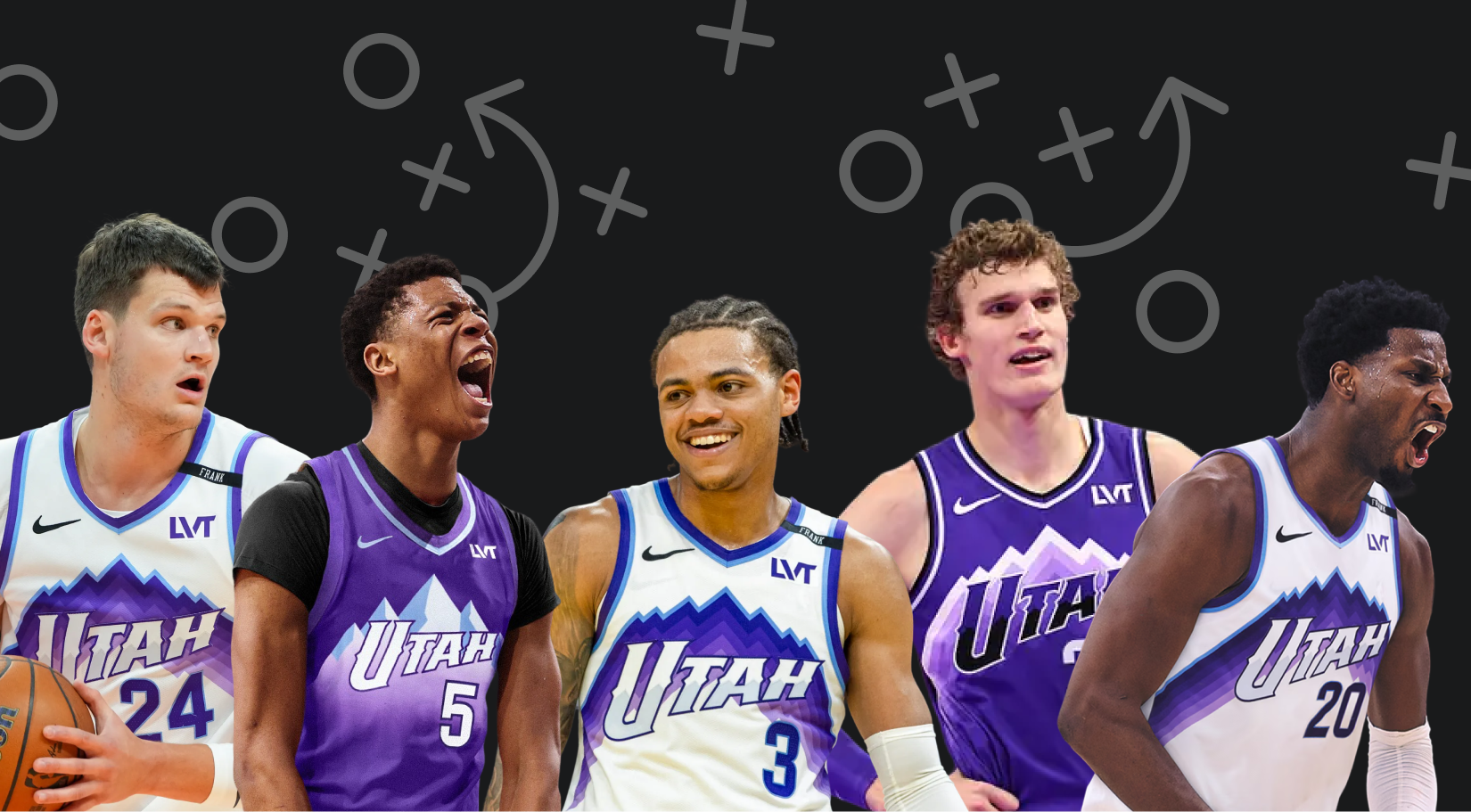
It’s an exciting time for Utah Jazz fans! They have have the No. 2 pick. They get a full season of Jaren Jackson Jr. And hopefully they re-sign a healthy Walker Kessler. Those three could join Lauri Markkanen, Keyonte George, and Ace Bailey as the core of the next Jazz era. There’s a lot of talent here. But what does this group look like on offense?
For the sake of this exercise, let's assume that Darryn Peterson lands with the Jazz via the second overall pick[fn]though AJ Dybantsa could fit into a similar exercise[/fn].
The resulting sextet doen't fit neatly into a familiar NBA template, but it's intriguing. It has shot-making at nearly every position, unusual size, and enough frontcourt variety to toggle between five-out spacing and vertical lob pressure. By offensive role, the team could look like:
- Keyonte George: three-level scoring guard and primary ballhandler
- Darryn Peterson: three-level scoring guard and secondary creator
- Lauri Markkanen: movement shooter, elite off-ball scorer, and mismatch finisher[fn]or rather, Finnisher[/fn]
- Jaren Jackson Jr.: stretch big, pick-and-pop threat, and face-up mismatch scorer
- Walker Kessler: vertical spacer, screen-setter, lob finisher, and short-roll connector
- Ace Bailey: big wing shot-maker and second-side scorer
As excited as I am to see how these players fit together, I’m just as interested in how Will Hardy decides to use this collection of talent. Hardy isn’t known for running the same five set plays over and over. His offense is more about connected actions, counters, and putting players in spots where the next read is already available. Still, we can make some educated guesses about what we might see.
Spain Pick and Roll
One of Hardy’s favorite actions is Spain pick-and-roll. Here’s one way it could play out: Peterson and Markkanen are in the corners. George brings the ball up. Kessler comes up to set the first screen. Behind him, Jackson back-screens Kessler’s defender.

From here, several things can happen. In this scenario, Keyonte dribbles off Kessler’s screen. Jackson pops above the three-point line. Keyonte now has options: drive to the rim, lob to Kessler, or if Peterson’s, Markkanen’s, or Jackson’s defender sags off, pass for the three.

This play attacks modern NBA defenses because it overloads the center’s responsibilities. The big has to contain the drive, protect against the lob, and recover to a shooter. That’s hard enough in a normal pick-and-roll. Add a vertical spacer like Kessler, movement shooters like Lauri, and a stretch big like JJJ, and the math gets nasty.
There are plenty of variations. Peterson or Keyonte can be the ballhandler. Lauri and JJJ can both serve as the back-screener who pops. Any of the bigs can set the first screen and roll. Anyone but Kessler can space in the corners, unless Kessler’s corner three becomes a thing.
Horns
Another set I expect to see a lot is Horns. In this example, Keyonte and Ace are in the corners. Peterson brings the ball up. Markkanen and JJJ are at the elbows, the so-called “horns,” both available as screeners.

Peterson chooses Lauri’s screen. Lauri screens and pops. From there, Peterson makes a read: drive, shoot, or pass. In college, Peterson shot 20% of his total shots from the top corner three, at a terrifying 47%. That threat requires a close coverage, making the Lauri screen likely to give him space to drive.
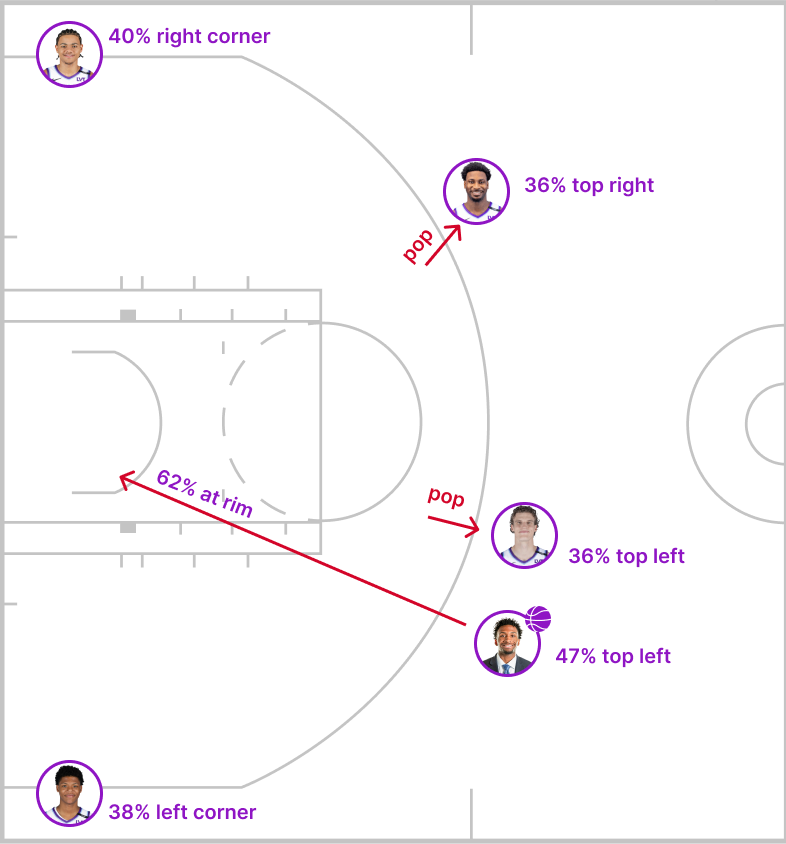
This set is extremely flexible. It creates passing angles and spacing, and it can flow into a handoff, pick-and-roll, pick-and-pop, cut, post-up, flare, or almost anything else. Instead of popping, for example, Lauri could move toward Ace for a pin-down, and Ace could receive the handoff into a Chicago action.
That kind of malleability seems especially useful for Hardy. It gives the Jazz structure without turning every possession into a rigid script.
Double Drag
This Jazz team would be young and athletic, but it may lack high-end passing. Double drag is a transition or semi-transition action that could fit the personnel well. Ideally, it happens before the defense is fully set.
Here, the Jazz are running. Jackson and Ace sprint to the corners. Markkanen and Kessler set a double screen above the break.

From here, Keyonte may be free for a pull-up three. Kessler dives to the rim, and Lauri pops to the three-point line. That combination is brutal because the defense has to process two different coverages while still matching up in transition.
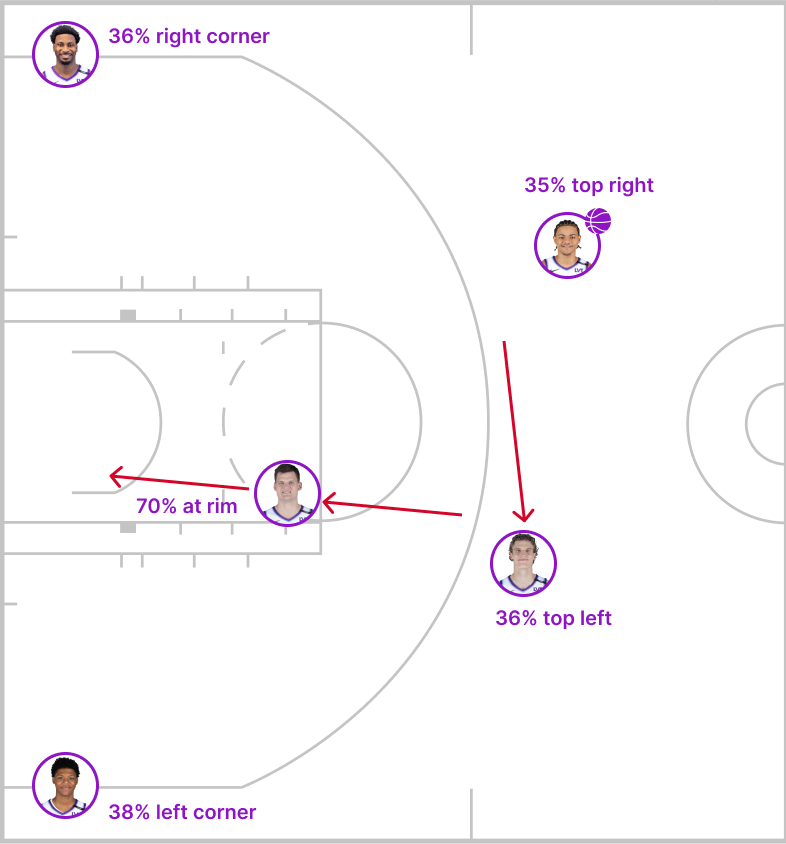
Like Spain pick-and-roll and Horns, double drag is full of actions that lead to other counters. It can flow into a ghost screen, flare action, empty-side attack, or a more traditional half-court set. That kind of connected offense suits a team with a deep group of starters more than a single heliocentric star.
How it all fits
At this point, it’s all conjecture. But on paper, the Jazz could have six players who fit together in fascinating ways. They would have size at almost every position, real spacing, and enough athleticism to play before the defense gets organized.
The real questions are whether the theoretical fit translates to the court and whether there is enough collective passing vision to maximize all those tools.
The Jazz will also play more than six players. Isaiah Collier’s ballhandling and passing could help grease the wheels. If Jusuf Nurkic is back, his big-man passing could give Hardy another connective piece. Maybe the Jazz use the mid-level exception or trade a young player for a veteran point guard. Whatever the case, figuring out the seventh and eighth rotation players is a good problem to have when the top six look this promising.