
Fourteen, two, six, nine. Thanks to those four numbers, the Utah Jazz are set up unbelievably well to start competing right away while simultaneously envisioning a long contention window.
That combination of numbered ping pong balls surfaced on Sunday, giving Utah the right to select second in a draft headlined by 3-4 prospects widely considered potential future stars. The Jazz are now guaranteed to be selecting from among three of AJ Dybantsa, Darryn Peterson, Cam Boozer and Caleb Wilson.
What makes the outcome even more noteworthy[fn]Ahem.[/fn] is that even before the NBA plugged in their fancy machine on Sunday, the Jazz were already looking like a team headed for a massive leap in 2026-27 wins. They united a tandem of All-Star forwards with a February trade, and saw Keyonte George ascend to near-star status.
Their veteran difference-makers can initiate Utah's return to competitiveness while they simultaneously manage the development of potential ceiling-raisers in Ace Bailey and now a second top-5 talent. It's a rare luxury to have multiple players like that and multiple win-now All-Stars, but that's where the Jazz sit after their lucky lotto.

Lauri Markkanen has just one All-Star selection on his résumé, but has averaged 23.7 points and 61.7% true shooting during his Utah era alone. The only players to match those levels over that 4-year span are all-world megastars[fn]SGA, Giannis, Jokic, KD, Steph, Kawhi, Embiid and Dame... eight players with 59 combined All-NBA nods.[/fn]. Jaren Jackson Jr.'s bona fides include two All-Star selections, three all-defense teams, and a Defensive Player of the Year trophy. Markkanen will be 29 when next year's playoffs start. JJJ will be 27.
At the other end of the age spectrum are Bailey and whoever the Jazz select next month. Stardom isn't a guarantee for either one, but if one or both achieve something close to their respective best-case versions, Utah might be the NBA's new "Two Timelines" franchise.
"Two Timelines"
Just four games into the post-Kevin Durant era in Golden State, Stephen Curry collided with a defender and fell awkwardly. He broke his hand, and the Warriors had suddenly gone from two MVP-caliber stars to none. They had little choice but to treat 2019-20 like a gap year.
Ultimately, Curry's misfortune yielded the Warriors three lottery picks in the next two drafts. Their 15-50 record without him got them the No. 2 overall pick, plus they flipped veterans for another good selection and landed 14th themselves in the 2020 draft after losing in the Play-In Tournament. Eventually Curry would return to his all-league level and the Warriors won their fourth title in eight years. Along the way, team principals could hardly conceal their excitement around the age diversity on their competitive team.
“I don’t think you can be all old. And you certainly can’t be all young to win in this league," team governor Joe Lacob told The Athletic back then. "I love the fact that we have these different kinds of players on the team." Thus was born the notion of Two Timelines. It's unclear if Lacob or roster architect Bob Myers ever actually used the term themselves. Either way, the idea became the identity of the Warriors circa 2020-2023.
The problem, of course, is that those youngsters were James Wiseman, Jonathan Kuminga and Moses Moody. Moody eventually turned into a valuable rotation piece, and Kuminga had a nice resurgence in Atlanta this spring. But it turns out they weren't a second title core in waiting. Balancing multiple priorities is always tricky with finite roster spots, but ultimately what led the Warriors to scrap the Two Timelines experiment wasn't that Steph was 34 and Wiseman was 21 — it's that Wiseman wasn't good enough to contribute on a contender.
We don't know yet which of this year's draft candidates will leave their new teams similarly disappointed, or which ones will realize their respective best-case scenarios. What we do know is that whoever Utah picks will show up on a roster with Markkanen, Jackson, an ascendant George, potentially with Walker Kessler re-signed, and so forth. He'll be entering a competitive ecosystem from day one, but he and Bailey likely represent Utah's best chance at a 1A superstar coming into his own in time to first bolster the current veterans, and eventually take the baton from them.
The immediate future already looks exciting, but nailing this pick could set the Jazz up for years.
What to do with 2?
Getting this pick right could give the Jazz a long window in which to contend. So what does getting it right look like?
Dybantsa is a freak athlete with positional size who has twice chosen Utah as a basketball home. He may be first off the board, but if the Wizards pass on him, Utah might pounce.
There's been a lot of dialogue about the Jazz trading draft spots with Washington to secure the in-state hero. Don't hold your breath. In the entire rookie scale era[fn]Once the NBA implemented scaled salaries based on draft position starting in 1995-96, it removed one motivation for teams to trade high draft picks. It used to be rather expensive to sign the top drafted players.[/fn], the #1 overall pick has only been traded in a draft-adjacent deal once. Granted, the talent gap between #1 and #4 has rarely been as narrow as this year, but by that same logic, there just isn't a huge impetus for the Jazz to move up. They can get roughly the same talent level at #2 as at #1, so why sacrifice extra assets?
Even if they go after #1, there is no chance the price would involve reassigning Bailey's rights, as has been suggested. In 30 years of trade history involving teams moving up by just one pick inside the top 10, the cost of that move has been much, much lower than a recent top-5 pick with star potential:
- Minnesota moved from #5 to #4 to take Stephon Marbury by attaching a future 1st (became #17 two years later).
- Golden State moved from #5 to #4 to take Antawn Jamison by simply adding cash.
- Portland moved from #7 to #6 to select Brandon Roy, also by adding cash.
- Washington moved from #8 to #7 to select Bilal Coulibaly. There were other parts of this deal[fn]This was part of the Bradly Beal offload.[/fn], but this portion of it was Indiana moving back one spot for a couple of second-rounders.
- The Cavs moved from #8 to #7 to grab Chris Mihm in 2000, also surrendering only cash in the move-up operation.
That's it. That's the whole history of 1-spot upgrades inside the top 10. One trade involved a medium-value first-rounder. The rest, just cash and seconds. Anybody suggesting the Jazz should part with Bailey or any other premium asset in a move-up deal is way off, at least historically.
Even the lone move-up trade involving the top overall pick didn't involve anything close to that value. Philadelphia made a 2-spot jump to #1 in 2017, and needed only a single future first. It ultimately became the #14 pick two years later.
If Washington wants anything more than a single medium-value draft asset, Utah's answer should be that they'll be delighted to instead pick among whichever three considerable talents are still on the table. Maybe that means they miss out on fan-favorite Dybantsa, but there's too much talent in the top four of this draft to pretend it's AJ-or-bust.
Darryn Peterson can score almost effortlessly and from anywhere on the floor. Draft expert Jonathan Givony believes he is "on another level" from even Dybantsa. The 6-foot-6 guard claims to have solved some issues with supplements that cost him some court time at Kansas. If those problems are really solved, this kid tempts some pretty lofty comparisons.
Cam Boozer has his own Utah ties, and is a heady and versatile big man. A bit of a throwback in some ways, he actually performed remarkably well in physical testing at the Draft Combine, helping buck the perception that he's athletically unremarkable.
Caleb Wilson is a crazy athlete who can populate highlight reels and play menacing defense. He's not an outside shooter and probably will never be the central figure on offense, but he's toolsy and takes over games in other ways.
Regardless of Washington's choice at #1, Utah is going to have attractive options. In this particular draft, there could be multiple perennial All-Stars still on the board even after the Wizards do whatever they're going to do.
Utah's new core
Surrounding Utah's All-Star duo and blue-chip prospects is a supporting cast of mostly 22- to 25-year-old players. George's 2025-26 performance approached All-Star level, and Kessler is a solid starting center, assuming they can retain him. The others are still developing, but Utah's new score looks pretty similar to the way recent contenders were built in terms of age spread.
As you may have read on this very website in the past, having all of your stars perfectly age-aligned is, it turns out, pretty overrated. In the last half decade, Finals teams have had on average 11.6 years of separation in their top eight playoff minute getters, and nearly seven years between their three main stars. Utah's age curve could be similar.
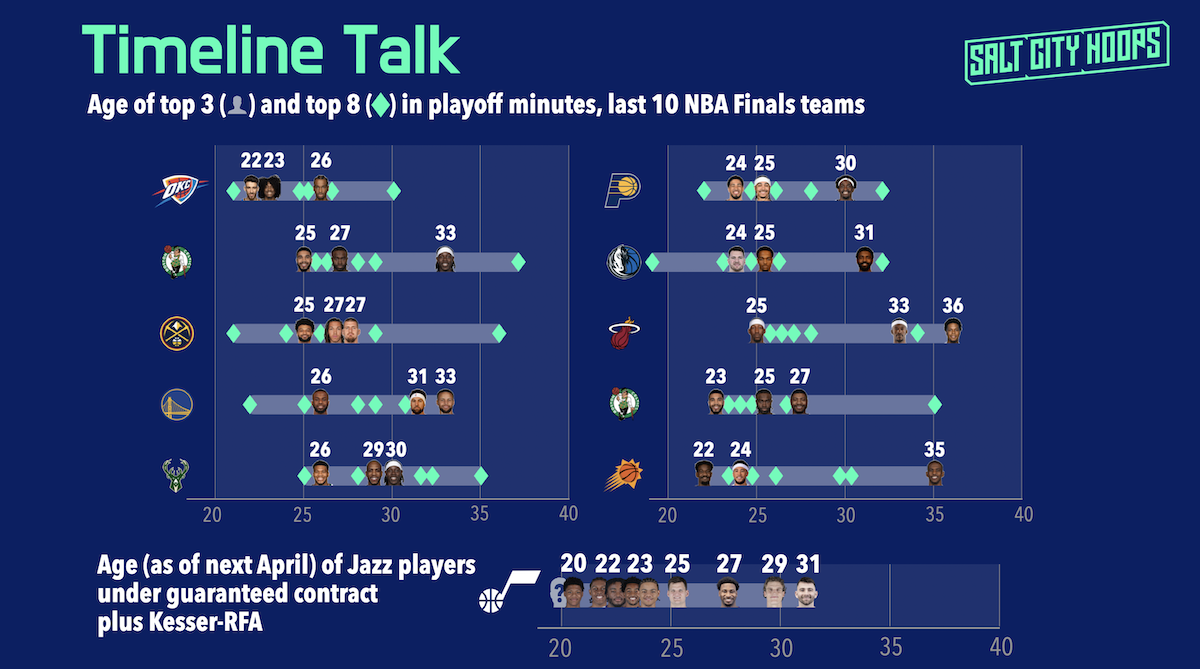
People worry way too much about aligning timelines. Recent history shows that the teams still playing in June usually are ones with a certain amount of age diversity. Utah has at least a nine-year gap between Markkanen and whoever they pick of this year's top four.
If anything, the Jazz still lack a little more veteran presence, at least compared the these 10 teams. Nearly every recent finalist has had rotation contributors in their 30s. Maybe that's Markkanen by the time Utah's truly an inner-circle contender. Maybe they retain Jusuf Nurkic or give John Konchar a bigger role. Maybe they acquire a veteran with the mid-level exception, which they can potentially use partially or in full depending on Kessler's final price tag.
The point is, this is now a team built to win now AND to grow into something different along the way.