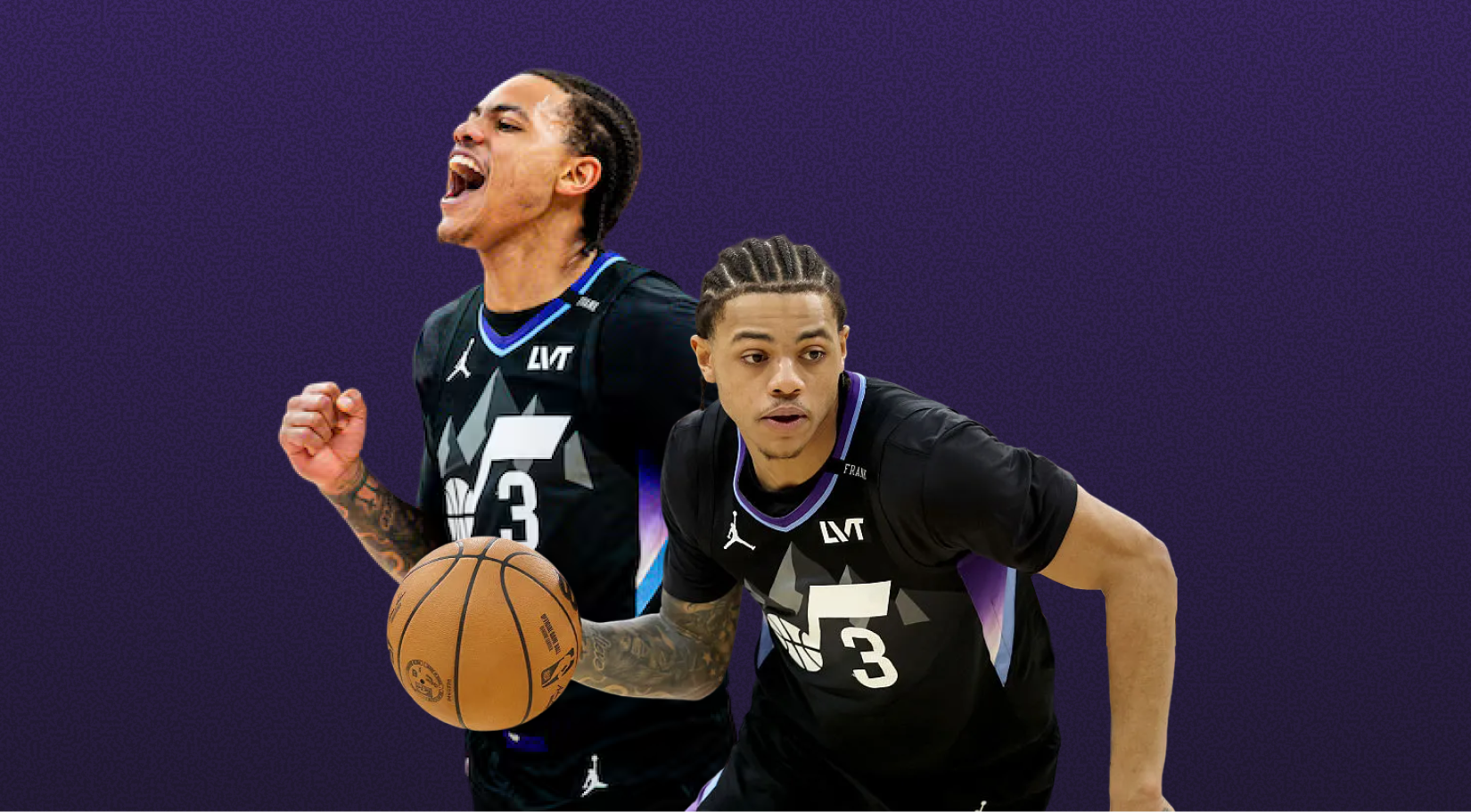

The Utah Jazz will look very different next season. Between their incoming No. 2 pick, Jaren Jackson Jr.'s arrival in earnest, and Walker Kessler's hopeful return, there is some newness to explore. Buried under all that noise is the player who will strongly influence where this rebuild lands: Keyonte George. The 22-year-old guard just finished a breakout third season that made him look like an All-Star level offensive engine — and, on the other end, a genuine defensive problem. That split is what makes him so hard to project, and it raises the question Utah's next few years turn on: how far can a guard built like this carry a team?
The breakout
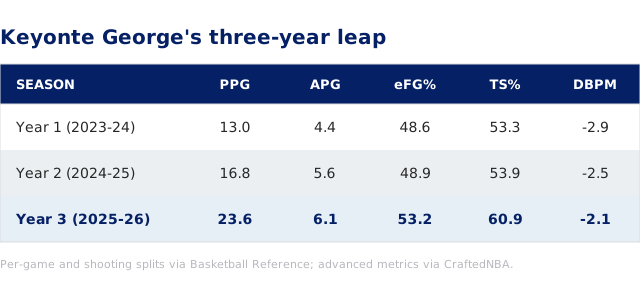
George put up All-Star caliber numbers: 23.6 points, 6.1 assists per game, on an efficient 53.2 effective field goal percentage (eFG%). Luka Doncic is the only player to match those three stats by his third season.[fn]Via Stathead[/fn]
George's rim accuracy went from the 32nd and 49th percentile his first two years to the 95th percentile this season (72%).[fn]Shot-location accuracy and the percentile ranks cited here and in the rim-finishing comparisons below are from Cleaning the Glass[/fn] His midrange and 3-point numbers ticked up modestly (eFG% from the 32nd to 54th percentile), but the rim is where he closed the gap with the tier of guards above him. For example, Jalen Brunson finished at 64 percent at the rim this year (56th percentile), Donovan Mitchell at 66 percent (60th) and Jamal Murray at 67 percent (65th). George is now finishing at a higher percentage than three All-Stars, which is the headline nobody would have guessed a year ago.
Keyonte’s usage and assist rate are All-Star tier. His 27.9 percent usage rate (USG%) and 28.4 percent assist rate (AST%) are right in line with Brunson (30.4/31.3) and Murray (27.9/31.1). Keyonte’s 6.1 assists would be good for 19th in the league if qualified by games played.
These are remarkable numbers for a third-year guard who had real questions after his second season.
What makes Keyonte even more valuable is his role on the team. None of Ace Bailey, Lauri Markkanen or Jackson are plus passers. Kessler showed flashes of increased passing in his limited appearances last season, but he’s not an offensive hub. On paper, the next Jazz core is lacking in the passing department, and Keyonte’s point guard skills will be critical. And with the rising tide of talent, it’s not unreasonable to expect something closer to 7 assists.
If a rookie like Darryn Peterson or AJ Dybantsa can shoulder some of the playmaking load, Keyonte is an excellent off-ball player, who shot a blistering 42.4 percent on catch-and-shoot 3s.[fn]Catch-and-shoot shooting data via NBA.com stats tracking[/fn]
At only 22 years old, George still has plenty of time to expand an already high-level offensive game. For comparison, Brunson's age-22 season was a 50.8 eFG%, low-usage role. He didn't unlock the All-Star version until age 24 to 25. George is several years ahead of that timeline as a primary creator.
Now let’s talk about the other side of the ball…
The defensive tax
In his rookie season, George was in the bottom 1% of the league for defensive box plus/minus (DBPM) at -2.9. He made a small jump in his second season to -2.5, and then again in his third season to -2.1. So from awful to still quite bad. The direction is encouraging, but the metrics still read a significant negative impact.
For some context, Utah’s team defense has stunk the last three seasons. Some defensive stats bias team performance, and Keyonte will surely benefit with a paint anchor in Kessler, a roaming JJJ and maybe even a defensive backcourt mate.
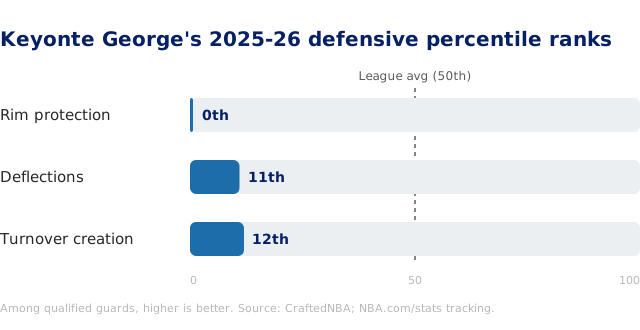
But the individual defensive stats are not flattering. George offers no rim deterrence with only 0.3 blocks per game. He’s in the 11th percentile in deflection rate and 12th percentile at forcing turnovers.[fn]Deflection and turnover-creation rates from NBA.com stats tracking; percentile ranks via CraftedNBA[/fn] His 6-foot-6 wingspan and 185-pound frame limit how much he can contribute. These physical limitations are not a death knell — Steph Curry is a pesky, smart defender with a similar profile, for example.
George does have quick feet to help stay attached on the first step and with better defensive teammates can play tighter on the perimeter. He could add strength to absorb more contact. He can improve off-ball processing on help rotations, weak-side awareness and tagging the roller. There’s certainly room for that DBPM to make a more sizable jump in his fourth season.
But even in optimistic cases, Keyonte will likely come with a defensive tax. The question is how much can his offensive impact offset the defense, and can the defense become passable enough to survive the deepest levels of the playoff gauntlet.
The ceiling
Those questions suddenly matter a great deal, because George will be eligible to sign an extension as early as next month. The Jazz are already at the point where they have to imagine his value in the context of a contending team, and make a decision about his future.
There are plenty of examples of other star guards in the archetype of great offense and negative overall defense to compare him to.
In his last healthy season, Trae Young posted a strong 3.3 offensive box plus/minus (OBPM) but a dismal -2.7 DBPM. Young has taken a team to the conference finals, but was recently traded for pennies on the dollar, signaling how teams value such players. Without him, the Atlanta Hawks saw a surge in performance. In a playoff scenario, as Salt City Hoops’ Mark Pereira described, by Game 2 a team will find 75 ways to make your life hell if you can’t defend. We’ve seen this illustrated time and time again, most recently with Cleveland’s James Harden.
In contrast, consider Jalen Brunson, who this season had an OBPM of 4.0 and DBPM of -0.9. Brunson is undersized, but has a low center of gravity and high defensive IQ. While still not a plus defender, his defense is good enough to lead his team to the NBA Finals, sweeping that same Harden-led Cleveland team in the conference finals to get there.
Making the jump from sieve to passable is rare, but not impossible. In their rookie seasons, Damian Lillard had a DBPM of -1.9 and Jamal Murray a -1.4, but both improved to more neutral numbers in subsequent seasons and have led deep playoff runs.
What kind of jump George can make will go a long way in determining Utah’s ceiling — as well as what the Jazz can afford to pay him on his second contract.
Fortunately, the pump is primed. After making an offensive leap following a focused offseason, George should have confidence that similar focus could be directed toward defensive improvement this summer. He could work on his strength to avoid being bullied by larger players. He’ll be surrounded by the best defensive teammates he’s had. The team has aspirations for a playoff spot for the first time in his career. We have no idea what his defense looks like in that new context.
And I’m sure it’s not lost on George what his defensive reputation is and how it can block or unlock his full potential. The offensive pieces are already in place. I’m excited to see how he puts everything together next season.