
The point of a rebuild, broadly speaking, is to turn winning pieces into assets so that at the right moment you can turn assets back into winning pieces.
The Utah Jazz started down that path 46 months ago with with the first of several trades involving their 2021-22 core. The Jazz had canvassed the league that summer and had some options with Royce O'Neale. They had an offer on the table to trade the 3-and-D forward for a younger rotation-caliber wing if they wanted to attempt another retool of their supporting cast, or they could get a guaranteed first-round pick. It was the least valuable of three teams' selections in the 2023 draft, but because teams aren't allowed to be without a first-rounder in consecutive future seasons, a pick that's certain to convey has real value for asset-strapped teams like that era's Jazz.
O'Neale's departure after five Jazz seasons felt imminent, and the return they chose would be a clear hint of Utah's intention that summer. Would it be a win-now rotation tweak, or a prelude to a larger reset?
As we know now, the Jazz opted for the asset-generating option, signaling clearly where they were headed. They had already traded one rotation mainstay when they shifted the salary of injured Joe Ingles that February. Those two deals proved to be the opening salvo of a string of rebuilding trades — first to liquidate the pieces of their playoff roster and then to reassemble a version they hope propels them back into relevance now.
Here is what that string of now 25 transactions looks like:
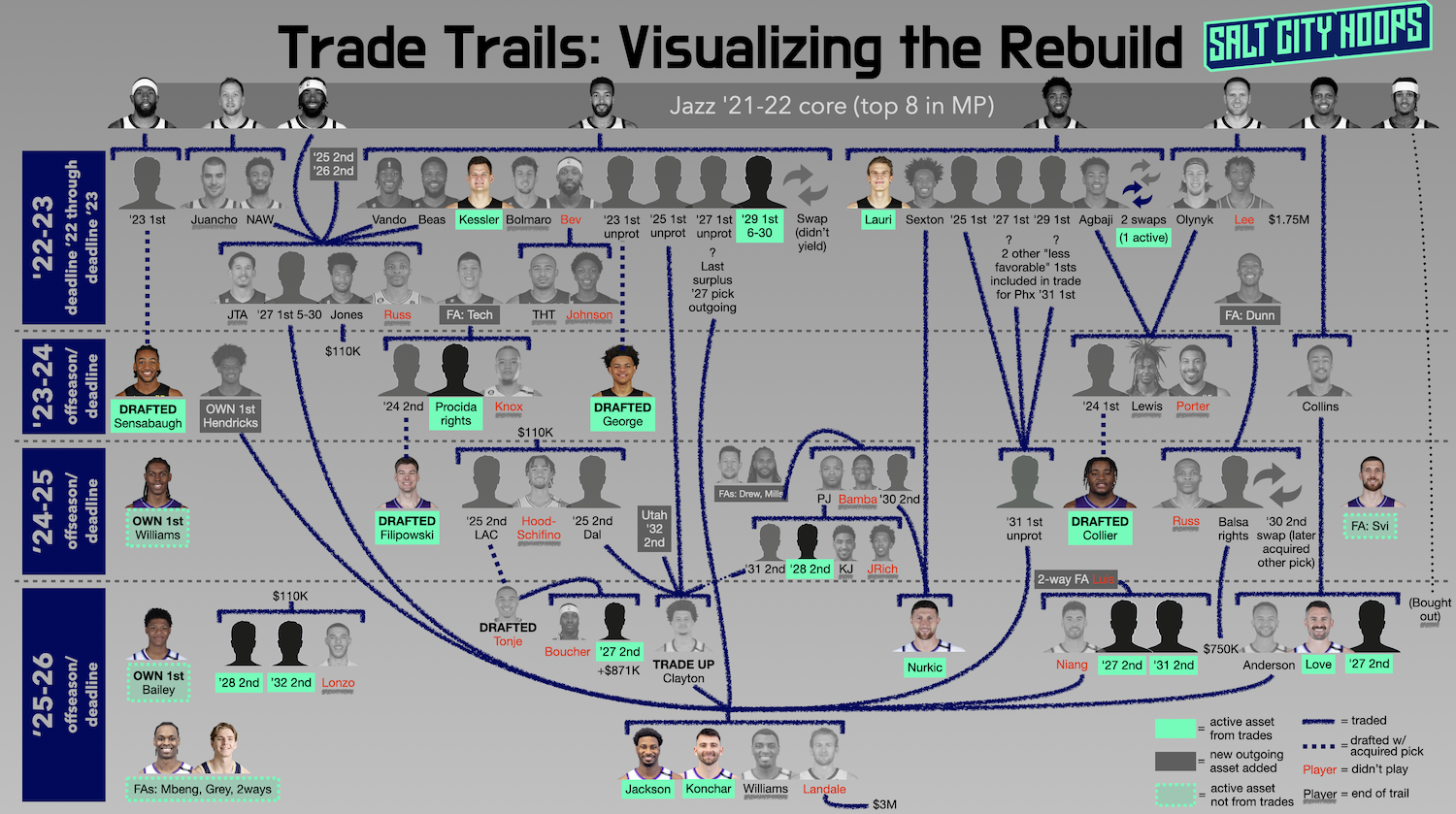
Ten of Utah's current players landed here as a direct or indirect return of Utah's trades involving 2021-22 rotation players.They also now have one surplus first-round pick remaining[fn]Conditionally — more on that soon.[/fn], seven extra seconds and a $6.26 million surplus in cash received vs. sent out[fn]It could be more; details on cash in trades is reported inconsistently.[/fn].
It all started with the assets generated when they dealt seven of their top eight minute-getters from that 2021-22 team. And what's interesting is how many of those initial seven trades produced assets that are still active in Utah's arsenal.
- From the Rudy Gobert trade, Utah still has Walker Kessler (or at least his RFA rights), Keyonte George, one surplus first-rounder, and a big portion of the Jaren Jackson Jr. (and John Konchar) trade was made up of assets from this deal.
- From the Donovan Mitchell trade, Utah still has Lauri Markkanen, Jusuf Nurkic, Isaiah Collier (with an assist from the Bojan Bogdanovic deal), one active swap, and another big chunk of the Jackson deal.
- From the Mike Conley Jr. and Joe Ingles deals, Utah generated another piece of the Jackson trade.
- From the O'Neale deal, Utah still has Brice Sensabaugh.
- From the Rudy Gay trade, Utah still has Kevin Love, a second-rounder, and got some salary filler for the Jackson trade.
- From all other subsequent deals, Utah has six more seconds, Kyle Filipowski, the draft rights to Gabriele Procida and some other minor assets that on paper contributed to the Jackson deal.
That's why it can be fun to focus on what Utah did in the aggregate. If we peel away all of the "pass-through" assets and just focus on what new stuff the Jazz introduced into deals and what active assets they still have from all these trades, you get a clearer picture of the net impact of those 25 transactions.
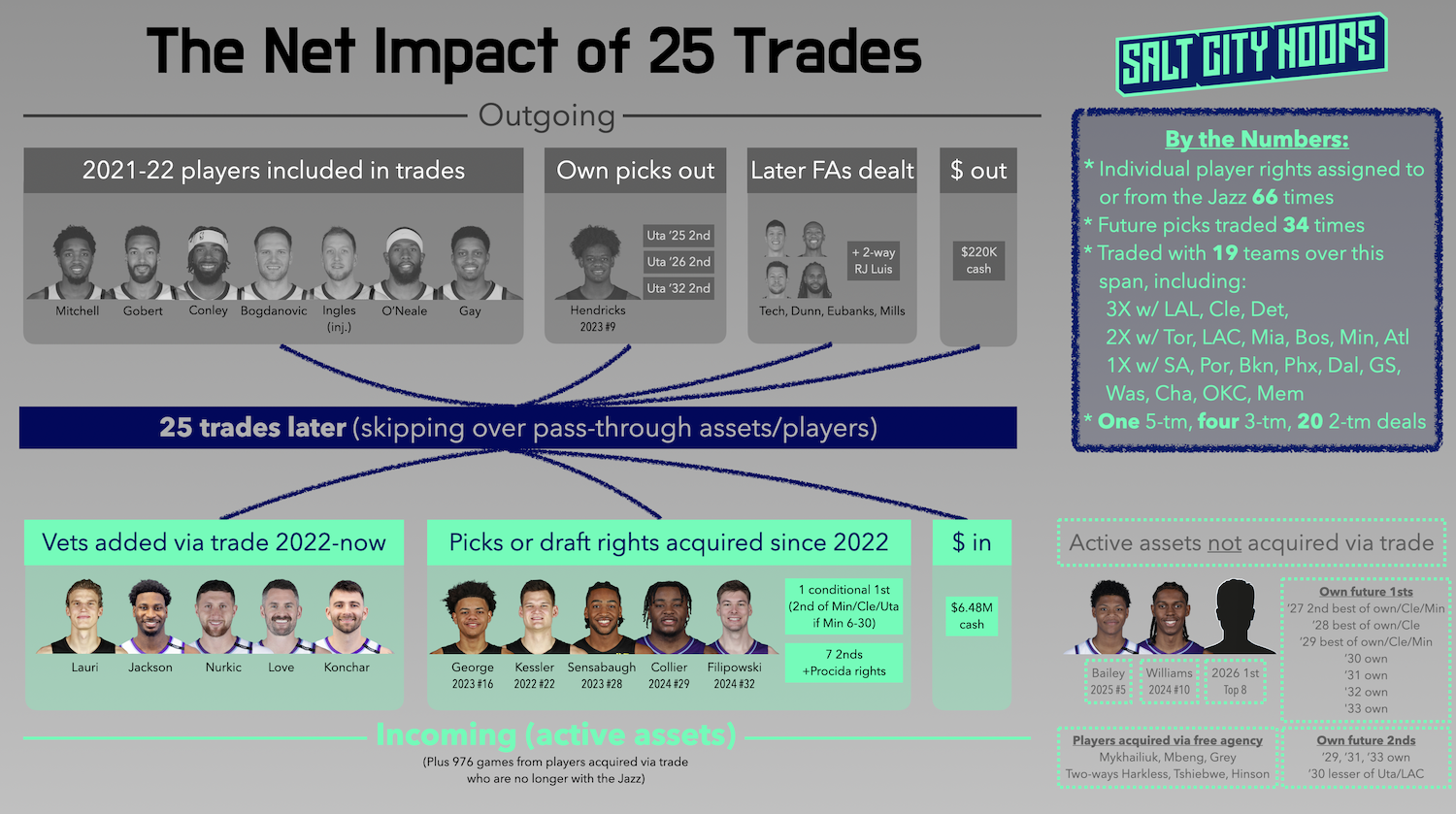
Of course, calling those interstitial Jazzmen "pass-through" pieces is a little cold and ungrateful since there are 10 acquired players who wore Jazz colors for a time before eventually getting rolled into other deals. Guys like Collin Sexton (189 games played) was more than just a placeholder; he was a big part of the Jazz's identity for three years. Kelly Olynyk played 118 games, Ochai Agbaji 110, John Collins 108 and six others[fn]Beas 55, Vando 52, NAW 51, Clayton 45, Anderson 20, Jones 19.[/fn] also contributed on the floor for a time. Utah also got 209 games from acquired players who were eventually waived or set loose as free agents[fn]THT 116, JTA 22, KJ 19, Juancho 17, Bolmaro 14, Lewis 12 and Vince 6.[/fn]. That's 976 games from what we're somewhat unceremoniously describing as "pass-through" guys. That basketball value should count for something, too.
But broadly speaking, what this graph represents is a net in-out those 25 deals. Ignoring assets from the initlal return that they parlayed forward into other deals, we're instead comparing the sum total of fresh assets with what they ultimately wound up with.
Since early 2022, they have put the following on the trade table: two all-league talents, five effective but aging contributors, one draft prospect, future 2nds and some journeyman FA signees.
What they netted out with as of today is a collection of two near all-league guys, a borderline star in George, starter-caliber Kessler, three other interesting draftees, three more vets, one additional first, seven seconds, Procida's rights and surplus cash.
Given the frustration and lack of mutual trust that had been setting in after multiple playoff disappointments, the old version of Utah's core had probably run its course. Now, they have a younger core, and one that's led by All-Star forwards, with tantalizing prospects that could further accelerate Utah's ascent.
Markkanen and Jackson have both come in as high as 17th in voting for 15 All-NBA spots. That's not quite as high as the Mitchell-Gobert tandem; Mitchell grew into a first-team All-NBA selection[fn]Last season.[/fn], and Gobert at his peak was second team[fn]In 2016-17 with the Jazz.[/fn]. But these two current Jazz stars are young and dynamic and seem interested in being part of long-term success in Utah. So does George, whose 24-4-6 counting stats are on par with some All-Star guards. That Lauri-JJJ-Key star trio could be the next generation of Don-Rudy-Mike, plus Utah came away with extra young talent and still has an extra first-rounder.
(Side note about the one surplus pick: the graphic intentionaly oversimplifies the pick situation a bit. The Jazz made later deals with Phoenix and Memphis using unspecificied draft capital in the years they had multiple picks, but we won't actually know until 2027 and 2029 precisely which ones will have completed those deals. Functionally, they will have one first-round pick in each upcoming offseason[fn]Subject to some swapping, essentially.[/fn], plus an extra conditional 2029 selection if Minnesota's not in the top 5. That pick could also be upgraded if Minny has a lesser pick than both Utah and Cleveland that year. For the sake of a cleaner graphic I'm acting as though we know which picks the Jazz will have sent out.)
Truthfully, the verdict as to whether the rebuild succeeded at raising the Jazz's ceiling probably rests largely on a couple of players who weren't trade acquisitions at all. If Markkanen and JJJ remain at their current level[fn]Sometimes All-Stars and almost All-NBA.[/fn], then it might be the trajectories of Ace Bailey and the Jazz's upcoming 2026 draftee that create Utah's best-case scenario. While not technically acquired via trade, they (and Cody Williams) were taken with assets that were certainly enhanced by Utah's decision to enter a multi-year rebuild.
In the aggregate, then, Utah's roster architects have done what they set out to do: they turned a bunch of playoff-caliber rotation guys into assets, and then turned those assets back into what they hope will be a younger, still-developing, playoff-worthy roster as early as next season.
You could nitpick the return of individual deals in a vacuum, but the interconnectedness of all of this shows why a bias for action pays off in the long term. For example, the Jazz could have bristled at having to include second-rounders in a 2023 trade with LA and Minnesota. But if they had walked away over that, they wouldn't have secured the Lakers' 2027 pick, which means it's possible the Jackson deal doesn't happen. (And frankly, it would have been hard to roster those extra second rounders anyway.)
The Jazz have clearly decided they're more comfortable looking back at a deals where they made extra concessions to close the transaction, as opposed to looking back at a crucial deal they didn't make because they got too precious about low-value assets.
That's exactly why we should evaluate the sum total oftheir business rather than get caught up in the minutiae of 25 deals. The goal is to move the roster back to contention, not to ace all the "trade grades" columns.
What the Jazz hope they did in the sum total was replace a bunch of playoff-caliber dudes who were sick of each other and probably had reached their ceiling with a new generation of playoff-caliber dudes who can win now and keep growing together. The fun part now is finding out if it worked.