
Every week during the regular season begins here at SCH with the Salt City Seven, a septet of recurring features that let us relive the biggest moments, key performances and hot issues in Jazzland from various angles. Check in every week for the quotes, stats, plays and performances that tell the stories from the last 168 hours in the world of the Jazz.

Well, that's it: 328 regular season games after hitting they hit the reset button, the Utah Jazz's latest rebuild appears to be over.
Four years after a 2022 teardown, Utah is finally in a position where it has identified the best pieces from those rebuilding trades, added another star to the mix via trade, and acquired a scintillating talent in the draft. Their 22-60 record helps increase the likelihood of adding one more blue-chip piece, but the prevailing sentiment is that the Jazz now have what they need to compete.
So when the buzzer sounded on a Sunday loss in Los Angeles, there was a certain amount of relief among Jazz nation: the next time we see this team, they'll be playing games that matter.
The big question now is how quickly the Jazz can be playoff relevant after a 4-season postseason hiatus.
Here's the good news: the biggest single-season turnaround in NBA history actually came from a team run by current Jazz executive Danny Ainge. The 2006-07 Celtics went 24-58, then the very next year, they won a league-best 66 games, captured the 1-seed, and won a title. That 42-game improvement stands as the best year-over-year improvement in league annals.
So how did they do it? Honestly, their situation was somewhat similar to the Jazz's current one. Like the Jazz with Lauri Markkanen and Keyonte George, they already had a big scoring wing as their star (Paul Pierce) and a promising young guard (Rajon Rondo). Then they made trades to acquire an all-defense big man (Kevin Garnett) and an elite-shooting All-Star (Ray Allen).
Is it a perfect metaphor for the Jazz? No. For starters, Garnett was more than just a defensive stud; he had literally already been league MVP once, something Jaren Jackson Jr. hasn't really sniffed. They Jazz also don't really have a built-in Allen equivalent, unless you think Ace Bailey is going to take off overnight. (For the record, the Celtics got Allen by offering up the fifth overall pick that summer.)
Here are all of the other teams since 2000 to make a single-season jump from under 25 wins (or the equivalent in shortened seasons) into the playoffs:
- The more recent overnight success story is Detroit's. The Pistons went from 14-68 in 2023-24 to 44-38 and the sixth seed just 12 months later. They made some nice depth moves, but mostly their turnaround was because of Cade Cunningham's All-NBA leap. They lost a competitive 6-game series to New York.
- The 2020-21 Hawks got the 5th seed and make a conference finals run a year after winning the equivalent of 24.5 games. They drafted Onyeka Okongwu and signed Bogdan Bogdanovic, but a lot of their jump was due to internal improvement. They also made a coaching change after a disappointing 14-20 start.
- The 2012-13 Hornets (then the Bobcats) went 21-61, then got swept in the first round as a 7th seed. If they secure a playoff spot via this year's play-in, they'll make an ever bigger jump from last year's 19-63.
- The 2003-04 Bulls went 23-59, and then the next year were a #3 seed after winning 47 games. They got Tyson Chandler healthy, got 15.1 ppg out of rookie Ben Gordon, but ultimately got bounced in round 1.
- The 2002-03 Nuggets went just 17-65, but then drafted Carmelo Anthony, signed Andre Miller, and remade their bench. They won 43 games, grabbed the eighth seed, and lost 4-1 in the first round.
- The 2007-08 Heat went 15-67 and the very next year were a 5th seed and lost in a 7-game first-round series. They got there by moving on from Shaq O'Neal and rethinking their supporting cast, but mostly it was because Dwyane Wade bounced back after missing a third of a season to have his best year as a pro: a scoring title, a top-3 MVP finish, and the first of two All-NBA 1st team appearances.
- The Bucks went 15-67 in Giannis Antetokounmpo's rookie year, but then in 2014-15 jumped to .500 and a sixth seed. It was mostly the organic growth of Giannis and third-year Khris Middleton.
- The Thunder made their first playoff appearance in the OKC area by capturing 50 wins and a #7 seed just one year after going 23-59. They drafted James Harden that summer, and also saw big improvement from second-year Russ Westbrook and third-year Kevin Durant, who made his first All-Star team and finished second in MVP voting.
That's it. Of 416 discrete playoff teams this century, only those nine (or 2.2% of the total) got there after failing to reach a 25-win pace the year before.
But the Jazz certainly have a lot of lot in common with these outliers. Pretty much all of those teams had some combination of key players coming back from injury, big leaps from recent draftees, and star acquisitions. The Jazz could have all three of those elements working in their favor.
Either way, just the fact that they will be reaching for that makes it feel like the final buzzer of the 2025-26 puts Jazz basketball on the cusp of a new era.

"Rebuilds are hard, that's not a secret. But I think that a group of people that go through hard things together and come out the other side, there is some real strength in that, because to get where we want to go, it's going to get hard again. It's just going to be a different kind of hard.."
- Will Hardy, on keeping a culture strong through a rebuild
Hardy has fielded so many questions recently about his mindset as the Jazz prepare to shift back into a competitive mode, and he is not at all interested in dodging the premise. This answer came in response to Andy Larsen's question about protecting the culture during four consecutive losing seasons.
"The culture is the people," Hardy continued. "Culture is not a spreadsheet, it's not a power point presentation, it's not bullet points... It's being lived out by the people every day,"
Hardy mentioned that the culture would continue to evolve as the Jazz head into their next phase. "I'm so excited about where we're going."

Rather than cover all seven games over the last two weeks, here are some stats that were particularly superlative.... plus some macro season review stats.
19th
It's kind of hilarious that the Jazz went 14 years without a single player triple-double, and then suddenly have had six in the span of a couple of months. John Konchar had back-to-back ones, and when Bez Mbeng joined him with his own against Memphis, they became the first teammates ever to record triple doubles in the same game off the bench. They were the 19th teammate duo in league history to notch triple doubles in the same game, and it's the only time two Jazzmen have done it.
50
Giving up a 50-point quarter is pretty silly, but that's what the Jazz did in the third quarter against the Pels on Tuesday. It was the Pelicans' highest-scoring quarter ever, and it was part of a 95-point half too. That's the most any team has scored in any half this season. The defense was just a sieve, especially on leakouts, backdoor cuts, and threes out front.
43
Utah had 43 assists vs. Memphis, tied for 5th most this NBA season, and the most by a Jazz team since 1988.
42
Utah ended the season having used 42 different starting lineups, meaning that they've now had 88 distinct starting fives in their last 164 games. The most frequent starter was Bailey, with 61 starts, but only one quintet opened more than five games: George, Bailey, Svi Mykhailiuk, Markkanan and Jusuf Nurkic, with 16 games.
57.7%
While the Jazz avoided a third straight season of 30th-ranked defense by finishing 0.7 points per 100 better than Washington, their 57.7% defensive eFG% outside of garbage time did rank last in the league. Their defense will surely need to improve in a hurry if they're going to compete next season — in particular, they let teams play in transition more frequently than anybody.
+34.7
Utah only had two lineups with 100+ possessions and a positive net rating differential, and both of them had Markkanen, George and Mykhailiuk in them. When those three played with Brice Sensabaugh and Nurkic, they were +5.1 on 102 possessions. The same trio with Kyle Filipowski and Walker Kessler turned in a +34.7 net rating in a supersized configuration, albeit on just 101 possessions.
2,429
The Jazz eclipsed their franchise record in assists for a season, with 2,429 total helpers — 22 more than in the 1987-88 campaign. That's 29.6 per game.

Let's be honest: the 82-game marathon is over and you don't want to read some dense X-and-O description right now any more than I want to offer one up.
So instead, let's just watch Bailey run by people and dunk.
That little shimmy is getting ridiculous. The ease with which he can just cook defenders, even without a screen, is special. The one is Houston technically featured a screen, but Bailey dribbles away from it before his guy really even ices or inches toward the pick at all. In other words, all three of these are Ace starting from a standstill and just completely leaving his guy in the rearview mirror without even needing a pick.
But as with other stuff we've highlighted around his expanding game, a lot of what makes this work is some very specific set-up he does with his lower body: look at how wide his feet are! That posture gives him the option to explode in either direction, but preserving the power and explosiveness with a stance that wide is harder than it looks. Try standing still with both of your feet way outside your shoulders and then try to spring into action in either direction. For most normal humans, it's just not a very natural place from which to launch into a sprint, but it works for him because of his elite athleticism and body control.
The Ace experience is just a ton of fun.

We have two weeks to cover here, so here's recognition for Utah's final seven games.
Jazz 147, Grizzlies 101: John Konchar. There were so many career nights and historical things in this one that it feels like a complicated one to choose... and yet it kind of wasn't. Because Konchar getting back-to-back triple doubles and a +41 really in the end simplified it for me. The other candidate that makes it slightly more complex is Mbeng with his own triple double night, and a meatier one on the surface: 27-11-11. My guess is that if anyone got the real game ball, it was him. But Konchar's felt more impressive and meaningful, partially because I think he has a better chance of contributing next season, which does kind of matter to the Game Ball department. It's also super impressive to get a triple double when you don't have the ball a bunch. After those two, Kennedy Chandler had 26-5-10, Blake Hinson dropped his first 30 game, and Oscar Tshiebwe ripped a personal-best 22 boards.
Strong in defeat:
- Jazz 113, Cavs 122: Kyle Filipowski. The Jazz had four players with 18+ points, and each of them also had 4-5 assists. But it was Filipowski who was kind of at the center of everything early on. He also had the most efficient night out of these four (7-for-12) and had the most complete line (20-10-5, three steals and a block). Williams was probably my runner-up, with 26-6-4 in a bounceback game after a clunker. Sensabaugh cooked in the early fourth, and Bailey got to 19 after a cold stretch.
- Jazz 117, Nuggets 130: Kyle Filipowski. He and Sensabaugh were close, but to these eyes 25-12-3 was just a hair better than Brice's 28-6-4, plus Flip was +8 in a game Utah lost by 13. (Sensabaugh was also +4, and had to play de facto point guard... so flip a coin.)
- Jazz 105, Rockets 140: Cody Williams. Williams' 27-11-4 night was partially aided by garbage time, but in some of these blowouts it's hard to penalize for that when the game was never really super duper in doubt. Cody needed only 16 shots to rack up his second-highest point total of the season, and the Jazz even put him in a bunch of pick-and-roll. Bailey (22 points, 6 boards) and Sensabaugh (20 with 5 assists) were runners-up.
- Jazz 111, Thunder 146: Brice Sensabaugh. Sensabaugh was the only Jazz player who remotely had it going in OKC: 34 points on just 19 shots, plus he dished five assists. Filipowski made it to 20-14-6 despite an off shooting night, but not a lot else went right for Utah, who trailed by 43 at one point.
- Jazz 137, Pelicans 156: John Konchar. Someday we'll reach the point where triple-doubles don't just automatically make you the game MVP, but given how starved the francnhise was of triple-doubles for 14 years, we're not there yet. Chandler's career-high 31 (plus 7 boards and 8 helpers) and Mbeng's 26 were surprising and fun, but no need to overthink this one.
- Jazz 107, Lakers 131: Oscar Tshiebwe. Big O's 29 and 17 felt especially big in a largely ceremonial fourth quarter, when he had 14 points that included six straight putbacks. Mbeng was again notable with 14 points, 9 assists and 5 steals, but all the other big scorers were under a point-per-shot efficiency.
So where does that leave us for the season tally?
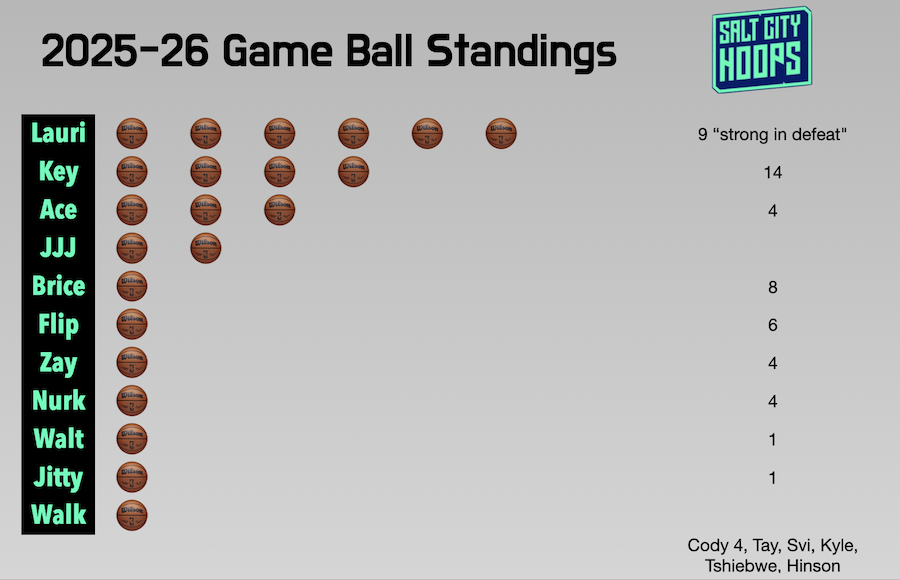

The next Jazz game that counts is more than six months away, so here are some other dates to keep in mind:
Monday 4/20: Draft order drawing. This hasn't been officially announced, but typically the NBA does its random drawing to break draft order ties on the first business day following the play-in. Since Utah and Sacramento finished with identical records, they will split the ping pong combinations and have identical 45.2% odds of getting a top four pick, but this tiebreaker will determine who goes first in the event that neither team gets blessed by the ping pong balls. The winner of this particular draw will be guaranteed no worse than a top-8 pick. The drawing often gets referred to[fn]Including by me
One of the fun (I hope) things I've been tracking is how many Jazz players set or tied career highs this season, including after the All-Star break when the Jazz went more fully into youth mode. Here's an update after 82 games: