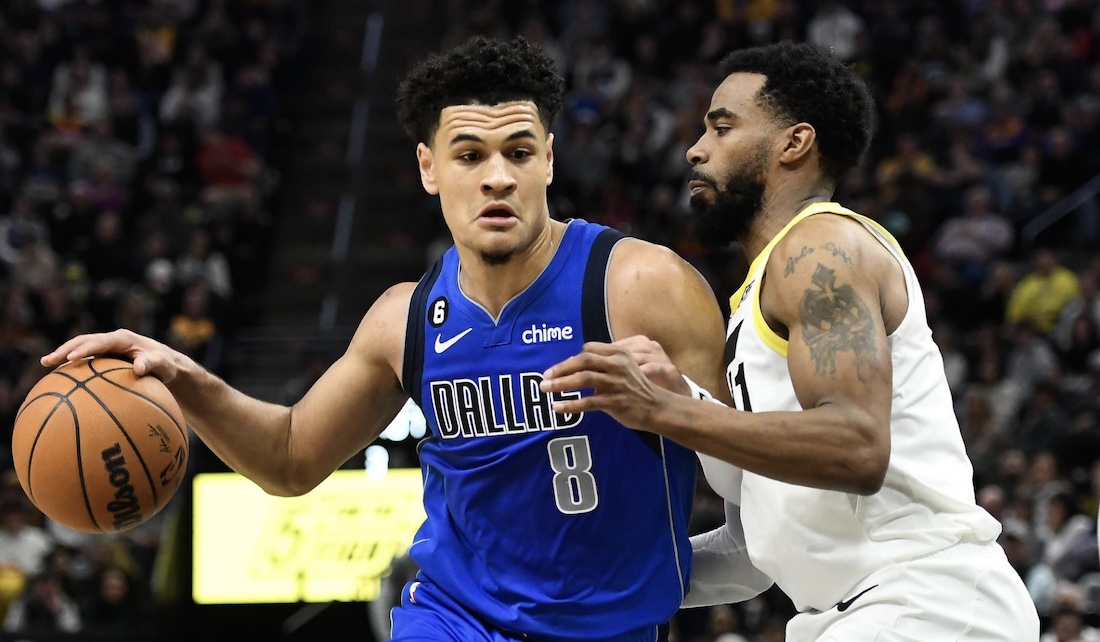
The Utah Jazz finalized a rare late-August trade on Saturday, executing a 3-player swap that brings veteran wing Josh Green to Salt Lake City. There are certainly basketball reasons to take a look at the 25-year-old perimeter defender, but this is a trade that may have been primarily about unlocking options for later.
The Jazz sent former lottery pick Cody Williams to Minnesota in the deal, along with veteran John Konchar. They also received a reported $4 million in cash back from Minnesota, presumably in lieu of draft assets and to help cover the difference in salaries. The Timberwolves needed to reduce salary to accommodate the signing of Jonathan Kuminga, and in fact will waive and stretch Konchar[fn]Through the end of August, teams can elect to stretch out the remaining salary owed to a waived player. That created the urgency to get this deal done[/fn] to create more wiggle room under the second-apron hard cap.
Green has been a rotational piece and sometimes starter in six seasons with Dallas and Charlotte. He's a plus defender on the wing with a 6-foot-10 wingspan. On offense, the Australian guard is a low-usage player who basically only takes catch-and-shoot threes and paint attempts.
His offensive limitations mean he's probably not a core piece of a playoff rotation. To wit, his career minutes average drops from 21.0 in the regular season to 13.4 in his 39 postseason appearances. But the players he replaces on Utah's roster aren't exactly indispensable to a winning rotation either. Williams still sports a negative Box Plus-Minus, and Konchar topped out as Memphis' 10th man.
So making sense of this trade requires looking beyond the basketball aspect.
Green's $14.7 million salary gives the Jazz something they didn't really have before this trade: a mid-sized piece for salary matching. Their only 8-figure salaries belonged to pretty essential players, like star forwards Jaren Jackson Jr. and Lauri Markkanen, both making over $46 million. Prize rookie Darryn Peterson ($13.2 million) is untouchable at this point. Jusuf Nurkic will make $11.5 million, but is likely too important as Utah's only starter-caliber true center.
Even the largest 7-figure salaries belong to two young players the Jazz would surely prefer not to part with in trades: Keyonte George and Ace Bailey.
If those six are off the table, it was going to be extremely difficult for Utah to pursue players making even $25 million. Acquiring that much salary without disturbing the core would have required a 3-for-1 or even 4-for-1 deal, and it's extremely hard to make lopsided deals like that in-season because of roster rules. The most Utah could have brought back on a 2-for-1 deal was $21.3 million.
(Very briefly, teams under the apron can use what are called expanded trade exceptions to acquire more salary than they send out. It's a sliding scale, but in this salary range, the Jazz can receive back in a trade the total of outgoing salary plus $9,096,000.)
When working with salary matching rules, a $14.7 million deal is a lot more useful than two $6 million ones. Because of this trade, the Jazz will have the option of pairing Green with a single other small salary to bring back $26 to 30 million.
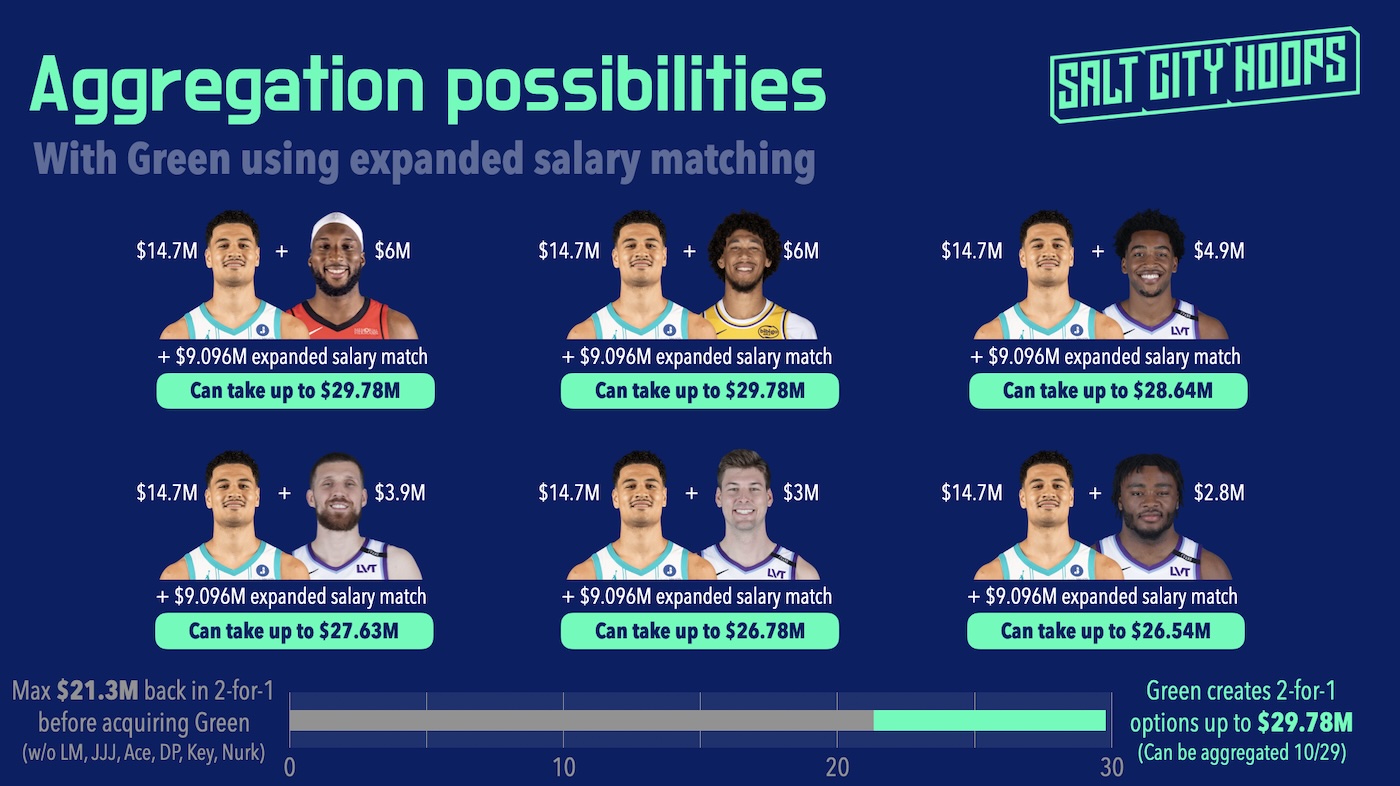
That's a long way of saying that this deal will ultimately be graded differently if it becomes the precursor to acquiring a player they couldn't have gotten otherwise.
There are only 21 players in the league set to make an amount that exceeds the $21.3M the Jazz could have brought back for a Williams-Konchar package but within the $29.78M shown above. So if they did this with a specific target in mind, he's someone on that finite list. The best centers in that price range are Jarrett Allen, Isaiah Hartenstein and Myles Turner. Power forwards seem less likely given the presence of Jackson and Markkanen, but RJ Barrett and Jabari Smith Jr. are both in that window. Big wings like Jaden McDaniels and Trey Murphy could be targets now, as could guards like Devin Vassell, Dyson Daniels or Fred VanVleet[fn]Others in that price range: Draymond Green, Coby White, Josh Giddey, De'Andre Hunter, Keegan Murray, Nic Claxton, Naz Reid, Cameron Johnson, Miles Bridges, Christian Braun, Norm Powell.[/fn].
Of course, those are just the salaries that fit a 2-for-1 configuration. There are other structures that could work The Jazz could propose a 3-for-2 deal (or even a 4-for-3 like the package that landed them Jackson), or they could send some salary elsewhere in a multi-team deal. The ultimate target doesn't have to be one of those 21 guys in the $21.3M-29.8M range. The bottom line is that having a salary like Green's opens up more options.
Green can have his salary aggregated with others in a trade starting October 29, through the February 11 trade deadline.
In the meantime, Green is also a real, live basketball player. He shot 42% on threes last season, and had the best net rating of Charlotte's nine top minute getters. The Hornets' defense was 8.3 points better per 100 possessions when Green was on the floor vs. when he sat.
Broadly speaking, Green probably represents a near-term upgrade for the Jazz. He might not be a top-8 guy on a contender, but neither are the outgoing players at this point, and the Aussie has at least held a steady rotation role on competitive teams and played meaningful playoff minutes.
The Jazz didn't get draft assets in exchange for facilitating Minnesota's other business, but that's partly because the Wolves are essentially out of stuff to trade. They technically have one tradable 2nd, but it's only theirs if it's 51-60[fn]In 2030.[/fn], and no tradable 1sts. Instead, Minnesota is believed to have sent $4 million to Utah. Second rounders often move for a price of $1.5 to 3 million, so you could view this as Minnesota trading the equivalent cash value of a couple of seconds... or, if you prefer, cash to cover the $2.7M dollars in salary plus a second.
For what it's worth, $4M would be the third highest amount of cash to be surrendered in a trade since the start of the 2025-26 salary cap year. The only teams to receive more were the Bucks and Hornets, $4.35M each.
Of course, part of the cost of the maneuver involved giving up on a former lottery pick, and this writer is among those who still maintained that Williams could turn into a winning player someday. But the Jazz want to start winning now, and progress just hadn't come quickly enough for Cody. Utah has already shown a willingness throughout their rebuild to move on from even their first-round draft projects. They traded Ochai Agbaji for another bite at the apple[fn]Which yielded Isaiah Collier.[/fn], and included both Taylor Hendricks and Walter Clayton in their offer for Jackson.
Konchar is an energetic wing who Will Hardy had lauded as a winner, but his salary always made him a prime candidate for a trade. He'll be a free agent now, but the Jazz can't re-acquire him this season.
Ultimately, the way we view this trade in five years may have a lot less to do with Green, Williams and Konchar — three guys probably in a similar tier at present — than with whatever might happen down the line. If the Jazz use this as the first step to red paperclip their way to a difference-making player, that's far more interesting and consequential.