

The defining factor behind the Jazz's disappointing start has been the health of the team's best big men. Jaren Jackson got hurt just minutes into his fourth game, Lauri Markkanen has been shut down for a month or more due to a broken hand, and Jusuf Nurkic still hasn't played at all this season.
But it's not the only reason the Jazz have been stuck on a single win for three weeks now. They've battled ball security issues, have played foul-happy defense, and overall offensive playmaking is still maturing. The underlying thread behind all of these issues is that the Jazz just haven't looked as deep as they had hoped.
One of the questions this scribe was obsessed with over the summer is who would fulfill the "7th best player on a playoff-level team" role for the Jazz. The new triumvirate of Markkanen, Jackson and Keyonte George looks like it could become a winning core. Ace Bailey and Darryn Peterson will play a ton of minutes and could grow into stars. Nurkic is a starter-caliber veteran who should unlock some unique things when he's ready to lace up.
But that's six dudes. Most playoff-worthy squads have at least seven or eight impact guys surrounded by role players and specialists. The front office undoubtedly looked at some bench upgrade options, but a lot of difference-making rotation pieces signed elsewhere. Guys like Quentin Grimes, Ayo Dosunmu and Peyton Watson who did move as free agents all got deals starting around or above the full mid-level exception, and also joined readymade contenders. Even if Utah did offer similar money to any of them, they might have just liked the situation better in L.A., Minnesota and Cleveland, respectively. Other difference-making free agent reserves like Tari Eason, Collin Gillespie and Robert Williams III stayed put.
Utah instead signed Josh Okogie and Jaxson Hayes and traded for Josh Green. All three have experience contributing on playoff teams. But the real hope was that they'd get more out of the depth pieces they've been developing internally: Isaiah Collier, Brice Sensabaugh, Kyle Filipowski and Svi Mykhailiuk.
So far, none of those four has even matched his 2025-26 production, let alone looked ready to step into a bigger, more impactful role.
Getting even a couple of them on more solid footing could be a way for Utah to turn its season around. Even without Jackson, the Jazz net rating when their lineup is made up of any five of Markkanen, George, the lottery youngsters, the veteran acquisitions and Mo Bamba is +4.7. That's the net rating of a 50-win team! Their net rating with all lineups that include even one of Collier, Sensabaugh, Filipowski or Mykhailiuk is -18.1.
That's why their depth situation just doesn't feel great. To fix it, they need to get those four back on track, magnify what they're getting from the veteran acquisitions... or look elsewhere for bench help.
The returning bench players
By the end of Sensabaugh's third season and Collier's and Filipowski's second, all three appeared to have tapped into some things that worked. They were all around average for overall scoring efficiency and were averaging double figures, albeit for a lottery team. Mykhailiuk had become a knockdown shooter and veteran connector piece, with a great on-off differential and elite true shooting for a wing.
If a couple of those four had been able to merely carry over their 2025-26 performance to this year, Utah's early season might feel different right now. Instead...
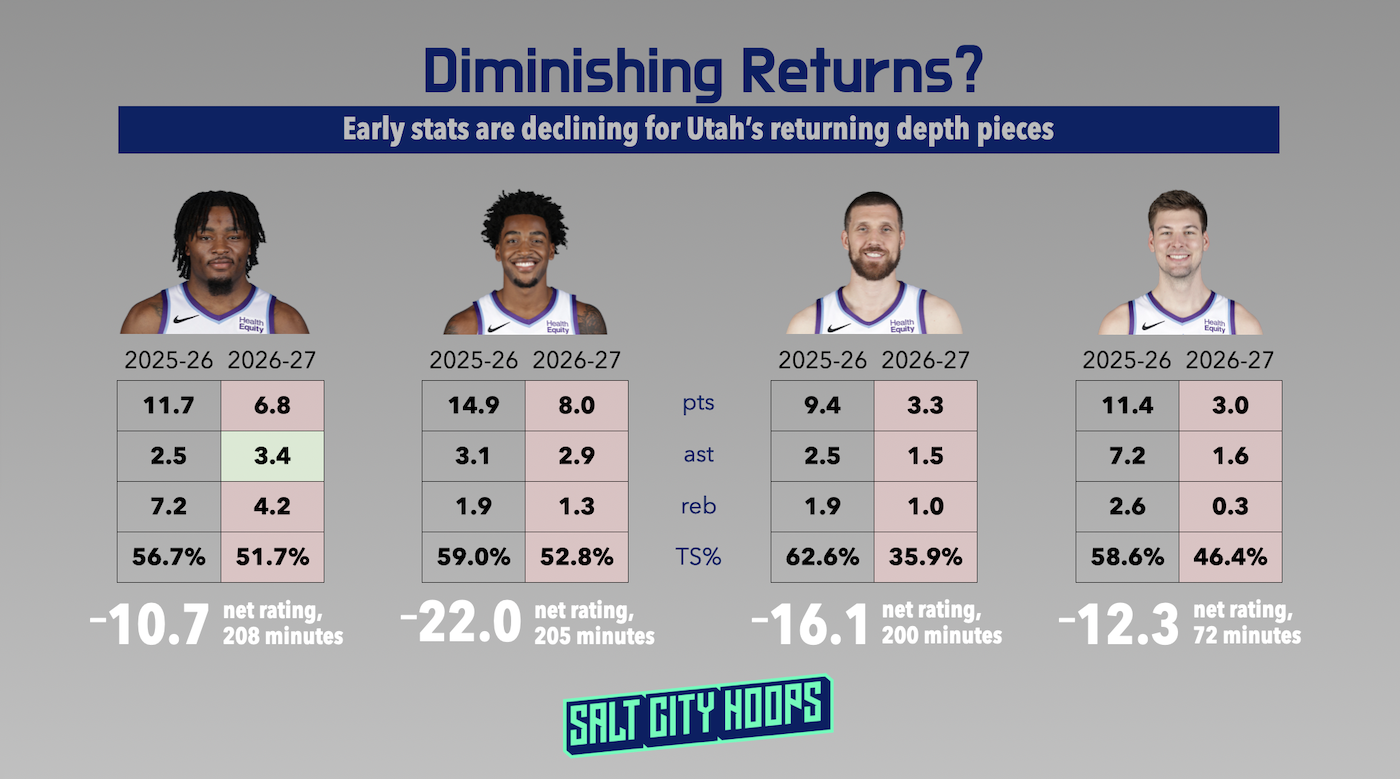
More than the stat declines, the discouraging part is that each guy is back to wrestling with weaknesses and issues where he had seemed to be making progress.
In the same game when Markkanen and Jackson first got hurt, Sensabaugh got pulled after a third-quarter stretch where he had scored eight straight Jazz points. If it felt odd that the Jazz pulled him in a situation where they could use the scoring punch, one need only watch the other end of the floor to understand why.
Sure, he scored all eight Jazz points during this 3:34 stint, but was also one of the chief reasons the Grizzlies outscored them 13-8.
A similar thing happened on Wednesday. Sensabaugh made some buckets and impressed with some early stops, so he earned the right to close against Orlando. He wound up as the top bench scorer with an efficient 19. But also, in the last five minutes of the game he: forgot to rotate behind a trap, threw the ball out of bounds[fn]They gave this turnover to Ace.[/fn] and gambled for a steal to leave Utah guarding 4-on-5. Utah lost by 24 during his 22 minutes.
The scoring prowess is very real. So are the tradeoffs that come with it.
Collier's weaknesses require the Jazz to play a completely different style as soon as he checks into games. The way to force defenses to honor a non-shooter[fn]This week's random 3-point explosion aside.[/fn] is to have the ball in his hands, so the Jazz play through Collier a ton in his minutes. For a while he had figured out how to use all the space defenses give him as basically a launching zone, flinging himself downhill where his speed and strength can do the most damage.
When that's working for Zay, he feels like an ideal change-of-pace guard option — like a pitcher who comes into the middle innings and just throws nothing but lethal fastballs. The problem is that when it doesn't work, the offensive decision-making can start to feel really linear. When every play is just Collier driving, it alters the team's offensive rhythm, especially when his attacks aren't yielding as much.
His efficiency as a driver is down (slightly lower FG% on drives, with fewer assists and more turnovers), but more than that it's the fact that the Jazz offense completely changes in these minutes.
Meanwhile, Filipowski has had about as rough a start as you can imagine. Offseason back rehab and an abbreviated training camp probably cost him some rhythm early on, but we're past the point where we can attribute his 46.4% true shooting entirely to that now. His rim effectiveness has dropped, and his percentage in floater range — where most of his shots come from — is a dreadful 27.3%. His turnovers are up and his defense remains an issue whether he's at the four[fn]Can't always stay in front of people.[/fn] or the five[fn]His rim protection numbers are not great.[/fn].
All three of these guys have NBA skills. They could all still turn out to be totally viable NBA players! But at this point in their respective careers, the tradeoffs make it hard for them to be high-leverage rotation pieces for a winner. They were also the 28th, 29th and 32nd picks in the draft, so it's not even a major indictment to say that... You could probably engineer a role for each as a 8th, 9th or 10th man with limited responsibilities, but when injuries suddenly force them to play the fifth most minutes on the team (as Sensabaugh has this week) or have the whole offense revolve around them (as it does when Collier plays), you feel their liabilities more.
The Jazz didn't draft Mykhailiuk, but did bring him back from the fringes by focusing on his value as a connector, which is considerable. He executes game plans, helps break pressure with his dribbling and passing, and rarely commits sins of omission on defense.
But man, he cannot buy a shot right now. He was a career 37% outside shooter coming into this season, and is now at 21.6% for the year. He's made just 20% of his open (4-for-17) and wide open (2-for-13) threes. His overall true shooting figure of .359 appears to be a typo.
It's unclear what it would even take to get any of these four back to their 2025-26 levels. Right now, their minutes are not winning minutes for the Jazz. Which is partly why we're seeing a lot more of the Joshes and Bamba.
Magnifying the vet depth acquisitions
The Jazz have gotten some encouraging contributions from Green, Okogie, Hayes and Bamba.
If you believe in net rating as a decent proxy for who's adding value, Green comes off looking very helpful. The offense is 6.4 points better per 100 possessions when Green plays versus when he sits, and the defense is 9.0 points better. Nobody has a bigger positive differential than Green's overall +15.5[fn]Ace is close at +12.9, for what it's worth.[/fn].
His positive impact on the team is only inconvenient because he also happens to be a walking trade exception. His salary range makes it likely his name will come up in discussions the Jazz have between now and the February trade deadline. But for now, he's here, and he's helping. He can't shoot right now either (.446 TS%), but it hurts less because of his team-low 9.4% usage. He's basically on the court to hound the ball on defense, swing the ball on offense. If he drives against a bad closeout, he drives to pass. It would be cool if his catch-and-shoot three figure came up from 26%, but the Jazz just kind of make more sense on both ends when he's out there.
Okogie is more of an energy guy than a true stopper, but his physicality does help the defense. His issue isn't just that he's limited on offense, it's that he knows it, so he does a lot of extra thinking when he gets the ball.
Honestly, a catch-and-shoot three would be preferable there, even if it misses. He spends a lot of time jab-stepping and pump-faking, and that hesitation sometimes gives opponents time to erase whatever advantage the Jazz's prior actions had created.
So far the Jazz have been better on defense with Okogie on, but much worse on offense. Some of that might be about combinations, but Okogie can help by trusting himself when he's open. He remains a good corner shooter.
Okogie and Green have now moved into sixth and seventh on the team in total minutes, behind only the five most frequent starters.
Hayes has filled in as the starting center with some success, even acquitting himself nicely in matchups against bigs like Victor Wembanyama and Rudy Gobert. In an ideal world he's a bench piece and not the starter by necessity. (He also appeared to tweak a knee on Friday night, so we'll see what his status is moving forward.) Bamba has endeared himself to Jazz fans, but the reality is they also rescued him from the fringes. He protects the rim and rebounds well. Like Okogie, the team defends better but scores less with him on the floor.
Of this foursome, only Green has high-minute difference maker on his résumé, having been a part-time starter for the contending Mavs, with minute averages in the mid-20s. Okogie and Hayes have mostly been in 15-19mpg roles for good teams, and Bamba has been on the edge of rotations. All four generally seem to know how to execute game plans, though, which is why Will Hardy is increasingly trusting them over the alternatives. That will probably continue to some degre unless there are reinforcements...
Outside options?
It would be very un-Jazzlike to react to the start with a panic move. Anything the Jazz do to remedy their current situation will be something they might have done anyway.
Nobody in the current crop of available free agents screams "7th best guy on a good team," and calling up a random G League talent probably isn't the way to add legitimate middle-of-the-rotation depth. That said, there are some rotation-caliber talents currently playing elsewhere that the Jazz could check in with. Aaron Holiday is a defense-first guard who came off NBA benches for eight years, and his contract with an Italian team has an NBA out clause. Other veteran role players currently overseas include Cole Anthony (currently lighting up the Australian league with 24.5 ppg), Jonas Valanciunas (who wanted to get back to Lithuania earlier) and Jazz alum Kelly Olynyk.
The trade market typically doesn't pick up in earnest until December when recent signees are tradeable, but there has already been one November trade where Oklahoma City picked up Nique Clifford for their deep bench.
If Utah does make a move in the coming weeks, it could create more trade deadline options for later. Players acquired by December 16 can have their salaries aggregated in deadline moves, so a case could be made for doing something early. If they use the Walker Kessler trade exception or trade a small salary for a bigger one in the next month, they will have a way of of laddering up to a bigger salary if a more significant upgrade is available in February.
This deserves to be its own topic of discussion[fn]Hint, hint. More on this soon at SCH.[/fn], but the quick version is this: if Utah can find someone with a salary in the teens who could shore up their bench for a couple of months even if he doesn't change their long-term reality, that might be a more realistic swing than sending out multiple picks in a panicked reaction to the disappointing start.
-----
So many of the Jazz's offensive and defensive issues stem back to the same macro truth about their roster: some of the players they're relying on right now are not established, winning rotation pieces.
Getting healthy is a start, but even once Markkanen, Jackson and Nurkic are back, Utah needs more of their minutes to go to rotation-caliber entities. Maybe they can get there by resurrecting Svi, getting more from their late draft prospects, or doubling down on the new vets. Maybe they need to get there by transacting.
Whichever route the Jazz find, it needs to happen before the season is essentially lost.


