Every week during the regular season begins here at SCH with the Salt City Seven, a septet of recurring features that let us relive the biggest moments, key performances and hot issues in Jazzland from various angles. Check in every week for the quotes, stats, plays and performances that tell the stories from the last 168 hours in the world of the Jazz.

The Jazz remain a bottom-five team in terms of 3-point shooting percentage, and haven't managed to reach even a 33% conversion rate in any of their last four games. Their star player, Lauri Markkanen, has made just 28.3% of his attempted triples in the last seven games.
Ironically, though, solving for what's been ailing the Utah offense actually starts inside. Because Utah's (and Markkanen's) perimeter woes stem largely from the fact that there just isn't enough rim pressure at present in Utah's offense.
The Jazz's system is designed to function inside-out, with rim rollers like Walker Kessler drawing a crowd in a way that benefits Utah's shooters. But with Kessler out of the lineup since midway through game five, the Jazz are just struggling to put any significant amount of pressure on the interior defense. For example, the Jazz average fewer restricted-area baskets (12.9) than any team in the NBA.
Fill-in starter Jusuf Nurkic is in the 14th percentile for efficiency on the 37 possessions he has finished directly as the roller, and no other Jazz center has enough such possessions to be ranked on the league's stats site. The lack of fear teams have about Nurkic, Kevin Love or Kyle Filipowski coming downhill means they can largely guard the pick-and-roll action without bringing extra bodies in to help. That same P&R action used to force weak side defenders to have to react, which is why Utah ranked second in the league last year in corner three opportunities. They managed to get off just six corner attempts against Houston on Sunday.
The ability to get into the teeth of the defense directly correlates with an ability to create efficient offense overall. Here's how the team has performed with different personnel at center:
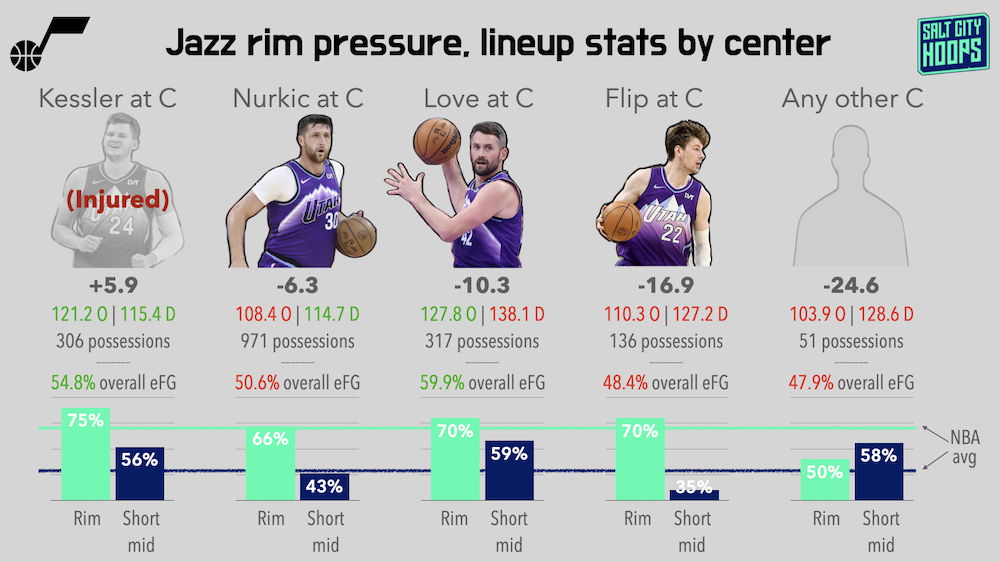
The Jazz were making 51.7% of their corner threes with Kessler at center, because they were often very clean looks. It harder to guard the P&R action 2-on-2 when the screener is a legitimate threat to dunk the ball nearly every time.
Nurk, Love and Flip all do certain things really well, but none of them are even average rim finishers. Nurkic is 25-for-45 at the rim this season, good for the 7th percentile among bigs. Filipowski isn't much better at 13-for-23 (11th percentile), and Love has all of six attempts at the rim, of which he's made three. By playing a 5-out style with Love or Filipowski at center, Utah is able to play outside-in at times and score at the rim by stretching out the defense — but those lineups also can't really guard.
The Jazz have occasionally tried lineups without any of those three at center, and it hasn't gone well either, with an even lower offensive output. They've even started to have Kyle Anderson function as the primary on-ball screener in a lot of the Filipowski minutes so the latter can go back to being a functional PF on offense.
There are other ways to put pressure on the rim, of course, but the Jazz don't have a ton of guys who can just get to the paint with the ball in their hands just because they want to. Keyonte George is the most frequent Jazz driver, but he generally drives down the slot more than going right at the rim. Isaiah Collier drives 8.3 times a game, per tracking stats, and almost half of those wind up in a pass to a teammate, so one answer could be to try to put pressure on the defense that way.
This is probably Utah's reality for now. A rim-rolling center won't just fall out of the winter sky, and that's probably OK given Utah's broader competitive goals at the moment. Just know that rim pressure and outside shooting are extremely connected, and that without that component in their offense, Utah's shooters and ball handlers are going to have to make their own destiny more often.

"Ace (Bailey) still does one thing a day that makes me go like, 'Oh, okay, I didn't know that was an option.'
"We were very high on Ace in the draft, so when he comes to us we're very excited. But then the actual nuance of what is he capable of right now and where could it go in the future, you do have to explore some things."
-Will Hardy on rookie wing Ace Bailey
Bailey's stock is rising game by game, and with good reason. He's Utah's third leading scorer since November 7, his 13.7 points trailing only Markkanen and the red-hot George. His shooting splits over that same stretch are 53-41-82, and he actually has the best net rating of the heavy minute guys in that span (after being upside-down early in that metric).
Hardy and his staff purposely decided to ramp up Bailey's responsibilities a little at a time, but there are moments where the talent just oozes out. For example, they're still not calling for him to run a bunch of iso/P&R by himself — "We haven't gotten to that yet," teases Hardy — but every now and then on a second-side attack, we see the fluidity and skills that made him a top five pick.
The only times he has missed double digits as a starter were in the game he fouled out early and the game he left after a knee-to-knee collision.
His true shooting as a starter is an eye-popping 65% (56% overall). That's an incredibly good sign for a rookie, especially since it's not like he's a last-ditch option on offense; his 19% usage means he's carrying his fair share of the possession load when he's in.
"He's learning really, really fast, and I'm excited with what I'm seeing."

Let's stick with Bailey for a minute, because one thing SCH listeners have heard and read since before the season is how important it would be to gauge the Markkanen-Bailey interaction. The answer to that question could really determine how close the Jazz are to beginning the ascent.
Bailey is figuring out his spots as he plays with and off of Markkanen. First, there are easy ones where he quite simply waits for the ball to find him while defenses mob his All-Star teammate:
But something like this is a bit more sophisticated:
This one is almost set up like the wing pindowns they run for Lauri himself, except that instead of him screening for Bailey, he runs to set a ball screen and Bailey fills his spot on the wing. They do this because the Rockets realized they had bad matchups and pre-switched Josh Okogie onto Markkanen. So now the advantage is that Bailey is being guarded by a little dude, and by coming up into that little crack in the defense, he's for sure going to be able to a) shoot over his 6-foot-2 defender, or b) find a driving lane.
One more, and this is where the vision starts to get really exciting:
Again, Markkanen and Bailey start on the same side of the floor. They're playing against a 2-3 zone, and Lauri cuts to force Kevin Durant to hand him off to the big. This gives Bailey enough daylight to catch cleanly, and then he just goes to work. He attacks the aggressive closeout but keeps his dribble live so that he can legally hang on a pivot after faking Durant into worrying about the spin back to the middle.
This is where the long-term vision is headed: not just open Bailey catch-and-shoots because Markkanen is doubled, but two parallel threats who both have the ability to create advantages and then punish the defense. We're seeing it action now because Markkanen is selfless enough to let himself be used essentially as a decoy so the youngster can get these reps.

21-0
Monday's game in San Francisco was decided wholly by a 21-0 run in the early second quarter. The Jazz missed some shots in that stretch they usually make, but Hardy also pointed out that 13 of GSW's 21 straight points came off of three transition threes and two putbacks.
20+
The Jazz have had four games this season in which three of their players reached 20 in the same game, including Friday's win over Sacramento. George had 31, Markkanen 28 and Brice Sensabaugh tied his season high with 20. Perhaps unsurprisingly, they are 4-0 when that happens.
.714
On Sunday vs. Houston, the Jazz had one of those odd games in which transition play actually brought their offensive efficiency down. They managed to score just .714 points per transition play.
17/61
Dating back to the end of the Indiana game, Markkanen has now made just 17 of his last 61 threes. Of course, he's still averaging 27.9 on over-60 true shooting, thanks in large part to a career year for rim finishing.
28.8
George's 28.8-ppg stretch over six games with 50-40-85 shooting splits was interrupted by a Sunday game in which he was clearly affected by illness. It's a shame that his first career 6-game streak with 20+ had to end that way.

It was a 1-2 week, which means the Game Ball department didn't get the holiday weekend off after all...
Jazz 128, Kings 119: Brice Sensabaugh. George (31-5-6) and Markkanen (28-7-2) were the game MVPs, although Sensabaugh was the bigger story, getting both walk-off interview honors and the first player mentioned by Hardy in the postgame. Giving it to Sensabaugh makes some sense as it would be emblematic of the Jazz's 46-28 bench point advantage, which was a huge ingredient in the win.
Strong in defeat:
- Jazz 117, Warriors 134: Keyonte George. Key's by a mile, both because of his stats (28-6-7) and the fact that he was the only starter with a positive plus-minus in a blowout. Kyle Anderson played well with 6-for-7 shooting and an all-around night (12-6-6) and Bailey tied his career high, but George was easily the Jazz's best in this one.
- Jazz 101, Rockets 129: Jusuf Nurkic. Bailey was the high scorer with 19, and Markkanen willed his way to 18 (on 12 shots) despite the three not going down. But Nurk was centrally involved in the Jazz's best stretch, and might have come away with a triple double had he come back in the fourth. As it stands, he finished with 14, 6 and 9 (on 6-for-7 shooting), and scored or assisted 17 of the Jazz's 21 first-quarter points. Since that was the only portion of the game when the result was even slightly in doubt, we'll go with the Bosnian Beast.

The Jazz continue their brutal stretch, although this week includes what might be the only game they'll be favored in until the second week of January.
Monday 12/1 vs. Rockets: The Jazz got a taste of Houston's vaunted #2 defense, only managing an O-rating of 99.0 on Sunday. That included holding the Jazz to their second lowest total of3-pointers made this season (9). This will be the Rockets' first back-to-back of the season, so we'll see how their more veteran-laden roster deals with two games in 36 hours at elevation. (The Jazz are 2-1 on the second night of B2Bs.)
Thursday 12/4 @ Nets: The 3-16 Nets are a total mess, with the second worst defense and net rating in the league this year. Leading scorer Michael Porter Jr. (24.3 ppg) has missed the last two with those recurring back problems, and Cam Thomas (21.4) has been out for nearly a month. No other Net averages more than 13.6 a game, so depending on the status of those two, this could be an adventure. BYU product Egor Demin has seen more run lately, including a breakout 23-9-5 game his last time out.
Friday 12/5 @ Knicks: The Knicks have an elite offense (#3) and an OK defense (#12), which adds up to the best net rating in the East. They've won four straight and are 11-3 since the start of November. This will be Jordan Clarkson's first game against the Jazz since January 2019, as the 6-year Jazzman is now averaging double figures off the New York bench. Jalen Brunson is averaging a career-best 29, while Karl-Anthony Towns is adding 22 and 12.
Sunday 12/7 vs. Thunder: What was that we just said about Houston's #2 defense? OKC is the team ahead of them, and the gap between those two is the same as the gap between #2 Houston and #23 Chicago. In other words, these Thunder are not messing around. They're 20-1, and since the last time they Jazz saw them (a 32-point loss), they have welcomed back 2025 All-Star Jalen Williams to put him alongside second-leading NBA scorer Shai Gilgeous-Alexander. They are, quite simply, a winning machine.

This came in late enough in the week that I won't have time to fully react to it, so instead I'll just leave this here:
(OK, that's a lie, anybody who's been reading me for a while knows I can't just leave it there... I've already weighed in on this topic, and my opinion hasn't changed much at all since then. Specifically: the Jazz are way, way, way closer to competing if they have Markkanen and 11 firsts than if they have 15 firsts and no Markkanen. We'll dissect this more as trade season nears.)