Every week during the regular season begins here at SCH with the Salt City Seven, a septet of recurring features that let us relive the biggest moments, key performances and hot issues in Jazzland from various angles. Check in every week for the quotes, stats, plays and performances that tell the stories from the last 168 hours in the world of the Jazz.

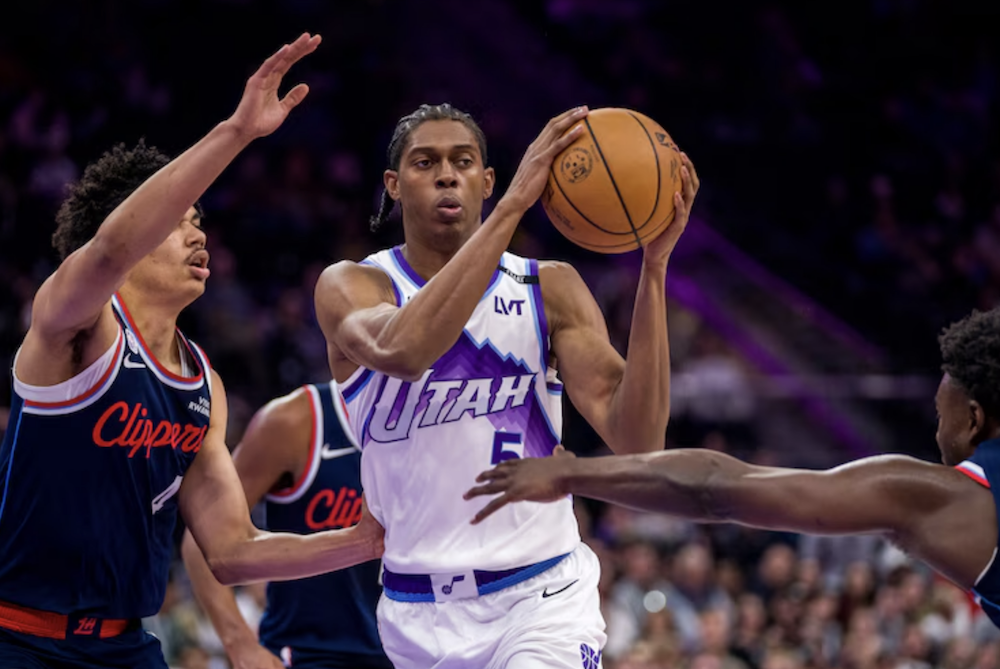
It was a 78-point week for Keyonte George in three appearances, after just making his way back from a 2-week absence. Even after a less efficient game in Milwaukee, he finished the week averaging 26.0 points on 60% true shooting — which, remarkably, is basically in line with his season figures.
George is a 24-ppg scorer this year, with 61% true shooting, which is pretty impressive stuff from a 22-year-old in just his third NBA season.
Plenty of young NBA guards have had high-scoring seasons, but the combination of volume and efficiency puts him in pretty elite company. Only seven guards have completed seasons averaging 20 or more with at least 60% true shooting in their first three years in the league, and most of them have gone on to All-Star or even All-NBA level stardom.
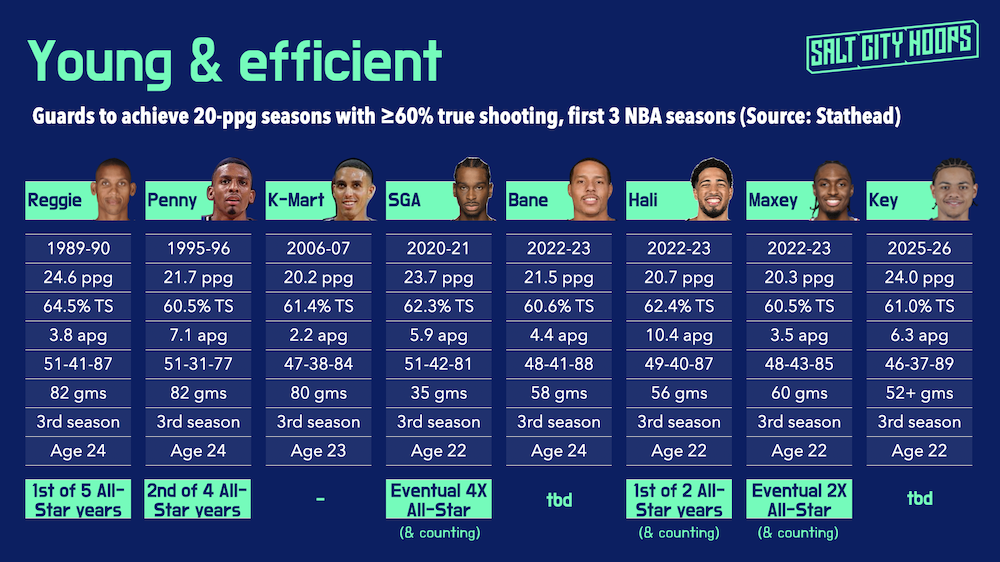
Until this decade, not a single guard had ever achieved those statistical marks by his age-22 season. The three who finally did have all been All-Stars.
George is less of a 3-point threat than almost all of these guys[fn]Penny Hardaway played well before the 3-point explosion.[/fn], but that almost makes his leap even more impressive. Key is doing what he's doing because his effectiveness at the rim has gone up nine percentage points, and in short midrange by eight.
He's in the 82nd percentile this season as a play-finisher out of pick-and-roll situations, with nearly a point per possession on such plays. His responsibility in the offense has grown as Utah finally moved away from veteran ball handlers, and his efficiency is up everywhere as a result.
That's another interesting stylistic distinction when looking at the list above. Tyrese Maxey, Desmond Bane, Kevin Martin and Reggie Miller weren't at that point in their careers the primary creators on their teams. Maxey and Miller were secondary ball handlers, and Bane and Martin did a lot of their work off ball at that point. In that sense, what George is doing this season is probably most comparable to the third-year performances of Penny Hardaway, Shai Gilgeous-Alexander and Tyrese Haliburton. All three of them scored efficienty while also more or less directing the orchestra. (And SGA only played 35 games that year.)
This doesn't mean George is automatically on an SGA/Hali/Penny type trajectory, but it's still encouraging to see him pick up right where he left off before an ankle turn in February paused his breakout season.
Haliburton has always been in a different tier as a natural table-setter, and SGA is a much better defender than George. The Jazz guard needs to engage more consistently on that end. It's a little too easy to find plays where he just kind of stops mid-play.
That end of the floor will likely determine whether he tops out as a dynamic scoring guard or someone who can co-lead a contender. Right now, the defense gets 9.7 points per possession worse when he's on the court[fn]Per Cleaning the Glass.[/fn], essentially giving back the +6.3 impact he has on the offensive side of the floor. Obsessing over on/off numbers isn't totally fair when the Jazz aren't exactly fielding 48 minutes worth of winning lineups, but it's something to monitor.
The larger point here is that Key appeared very much back this week, and that what he's doing this season is almost unprecdented for a guard his age.

"We're trying to simplify the actions that (Ace Bailey) is in so that he can get really good at making the same reads over and over again. The temptation with a guy like Ace is to put him in 10 different spots during the game, but... we're trying to keep it relatively consistent for Ace. Obviously we want to slow drip some things in there and let him scratch a few itches."
- Will Hardy, via team writer Eric Spyropoulos
We took a look at some specific Bailey sets last week, and even noted how often he's being given opportunities to create in the same or very similar setups. Turns out, that's by design.
Hardy explains in this video that where they're seeing a lot of growth right now for Bailey is in making reads off of handoffs. In certain situations, he's finding space to fire off threes in the little seam that's created when defenders prepare to switch. At other moments, he's learning where he has an advantage to attack.That's exactly what we broke down in last week's Playbook section, so it's interesting to hear Hardy talk about that being one specific action they're trying to make a featured part of the rookie's development plan.
"Ace is a really, really exciting player for us because of his ability to impact both sides of the ball," the coach added.

12-2
That was a rough close for the Jazz in Philly. They were up six with under five minutes to play before their offense came off the rails to the tune of 1-for-9 with one turnover. That means an Isaiah Collier drive was their only score on the final 10 possessions: an ORtg of 20 over the game's final 4:30.
63
Bailey (63) is sneaking up on Lauri Markkanen (70) as Utah's season dunk leader. The fact that Markkanen has at least another week or so of downtime before his next re-evaluation date gives the rookie a chance to try to catch up. He added three dunks this past week, all of which came during his career night in Washington.
32
I try to focus these stats on the Jazz side of the ledger, but the whole story of the game in Milwaukee was this number, the spread between Giannis Antetokounmpo's on-court plus-minus (+23) and how the Bucks did without him (-9).
6-9
The Jazz have now completed their slate of away games against Eastern Conference teams, and did so with a 6-9 record. Surprise wins in Boston, Cleveland and Miami drove their record to .400. The other wins came against the tanking Nets, Pacers and Wizards.
30.4%
It had to feel nice for Brice Sensabaugh to see some shots go down in Milwaukee (3-for-6 from three), because he's down to 30.4% from the perimeter since the All-Star break. The team as a whole is shooting 30.9% over that span. Only Sacramento and Portland are converting fewer of their outside attempts since All-Star.

Cody Williams has helped his stock this season as much as just about any of Utah's non-George youngsters.
Some of that is admittedly because of a low baseline: he spent most of his rookei campaign looking both timid and physically overwhelmed. But this year, he's a more active and willing participant in the flow of the game, and it's allowing his basketball IQ to show. All along, he got positive reviews from Will Hardy for his understanding and spatial awareness. It just didn't translate as much last season.
The most notable way his smarts are showing up this year is his off-ball cutting. He's always watching for the half second when his man will turn to watch the action, and then sneaking toward the paint.
Those are clearly all defensive mistakes, but it still takes some serious mental readiness to exploit them. I have no idea why on that last one the Bucks would top-lock a guy who's made two (TWO!) above-the-break threes all year, but they did and he correctly darts in, having put a smaller defender on his back.
Here's a play that shows more of his off-ball movement:
Williams' cut from the strong corner to the weak side makes his man the preferred helper. His guy makes a pretty smart decision to realize that mid-action and stay in to help as John Konchar slips the pick. But that decision now means it's Will Riley's job to drop down and zone-cover the weakside. He doesn't, and Konchar notices immediately, firing the pass to Cody within a few tenths of a second after catching.
That right corner is the one place where Williams' outside shooting is passable at 36%. From all other angles he shoots 17% on threes.
But this type of smart off-ball movement is becoming his calling card. He's looking like an NBA player now — one with plenty of areas to improve, but he's just miles ahead of where he was a year ago.

We already gave out the hardware for Jazz-Nuggets last week, which means we have one win and two losses for which we need to memorialize the top performers.
Jazz 122, Wizards 112: Ace Bailey. Bailey's career nigh of 32 was without a doubt the story of the night, made even cooler by the fact that he did it against Tre Johnson, whom the Jazz surely at least discussed as an alternative at #5 in last year's draft. But Collier, whose 27 were also a career max, came really close to challenging with a slightly more complete line (11 assists), and Kyle Filipowski had a big 9-point fourth quarter on the way to 20 & 14. Wiilliams was also really good.
Strong in defeat:
- Jazz 102, Sixers 106: Keyonte George. George was spectacular in this one: 30 points, including a 15-point third that Utah used to capture its first lead. He hit five threes, had to guard up in size (primarily assigned to Quentin Grimes) and grabbed four boards. Collier had 18 and 5, plus went 8-for-8 from the stripe.
- Jazz 99, Bucks 113: Cody Williams. George was the lead scorer but not as efficient, and Sensabaugh's 17 came in a quick 19 minutes. So this came down to Filipowski and Williams, and I just thought it was worth rewarding Williams' all-around night. The two sophomores actually had eerily similar shooting lines and high-level stats, but let's recognize Cody's first career double-double (13 & 11) plus the fact that he was so centrally involved: only George threw more passes than Williams' 48, during a team-high 37 minutes.

It's a 4-game week for the Jazz, starting with a quick stop at home for a couple of contests.
Monday 3/9 vs. Warriors: The Dubs' hopes of bypassing the play-in are all but gone after losing six of nine. This latest funk has them six games behind #6 Denver in the loss column, and their big deadline acquisition (Kristaps Porzingis) has played all of 40 total minutes. Steph Curry hasn't played since January, so the offense is being led by the likes of Brandin Podziemski, De'Anthony Melton and Gui Santos. They're 3-0 against the Jazz this season, and this one comes on the front end of a back-to-back[fn]They host Chicago on Tuesday.[/fn]
Wednesday 3/11 vs. Knicks: The Knicks started their current 5-game trip by thwacking the Nuggets in Denver despite 38 from Nikola Jokic, but then they had a wire-to-wire loss to the LeBron-less Lakers. They have a same-town back-to-back with the Clippers on Monday before traveling to Utah. This game will mark Jordan Clarkson's return after a 6-year stint with the Jazz, although the beloved guard is playing a fairly minor role (18.1 mpg). The Knicks are 19-6 (a 62-win pace) with their preferred starting five.
Friday 3/13 at Blazers: All-Star Deni Avdija made it back on Sunday after missing six games with back soreness. His rust (6-for-16 from the field) didn't keep them from soundly beating the hapless Pacers, and they play just once more before hosting the Jazz on Friday. They're the second worst 3-point shooting team in the Association, but have more drives per game than anybody outside Miami. They'll be looking for a series sweep of the Jazz, and more importantly can make up some ground in the tight 8-through-10 race.
Sunday 3/15 at Kings: The league-worst Kings are surprisingly 3-4 since snapping their 16-game skid. A renaissance triple-double from Russell Westbrook helped them beat the similarly rudderless Bulls on Sunday, but they have five rotation-caliber players out long-term. DeMar DeRozan had played in every game of the season until he was a late scratch Sunday due to illness. The Jazz are 2-1 against Sacramento this season.

After his career-high night in Washington on Thursday, Bailey is now the youngest Jazz player to reach both 25+ points AND 30+. He still has more than a year and a half to become the youngest in franchise history to hit 35+ or 40+, and nearly two years to become the youngest player to net 45+.
- Youngest Jazz player to score 20+: CJ Miles, 20 points vs. GSW at 19 years, 32 days old[fn]Followed by 10 Ace Bailey games.[/fn]
- Youngest Jazz player to score 25+: Bailey, 25 points vs. SAS at 19 years, 162 days old
- Youngest Jazz player to score 30+: Bailey, 32 points @ Was at 19 years, 204 days old
- Youngest Jazz player to score 35+: Donovan Mitchell, 41 points vs. NOP at 21 years, 85 days old
- Youngest Jazz player to score 40+: Mitchell, 41 points vs. NOP at 21 years, 85 days old
- Youngest Jazz player to score 45+: Mitchell, 46 points vs. Mil at 22 years, 176 days old
- Youngest Jazz player to score 50+: Adrian Dantley, 50 points vs. LAL at 24 years, 272 days old