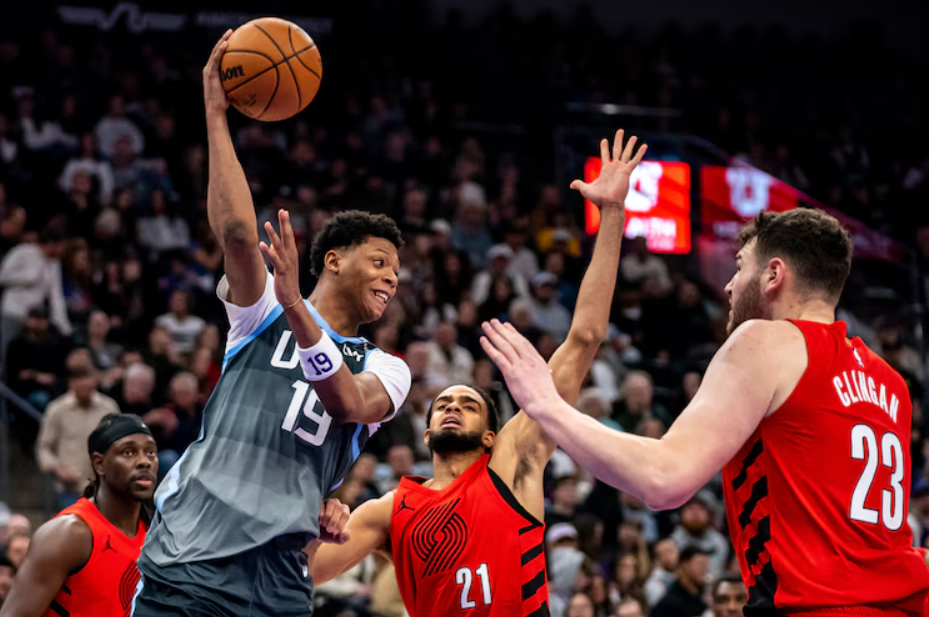
Every week during the regular season begins here at SCH with the Salt City Seven, a septet of recurring features that let us relive the biggest moments, key performances and hot issues in Jazzland from various angles. Check in every week for the quotes, stats, plays and performances that tell the stories from the last 168 hours in the world of the Jazz.

Last week we used this space to posit that the Jazz need to know how many of their young rotation players are going to be ready to contribute to winning next year. Apropos of that line of thought, it's notable how much of Utah's playmaking burden has been shifted to guy who are in that evaluation bucket.
Obviously some of this is because Keyonte George has played all of 13 minutes in the month of February, and Lauri Markkanen has missed the last two games. It was especially clear in Friday's game, where four of Utah's most frequent starters sat. But the shift back into fact-finding mode has been noticeable.
Ace Bailey averaged 3.3 drives per game through January, but is driving with the ball in his hands 6.1 times per contest in February. For him, a lot of it is second action stuff so they can let him cook with an advantage. The Jazz like to run a little fluff on one side of the court, then reverse the ball quickly to Bailey who catches behind a screen and goes to work. But regardless of how they're doing it, the rookie is seeing an uptick in his decision-making and the number of times he's shooting after dribbling.
He also gets some Markkanen actions run for him, like the stagger-DHO play (double screen coming off the wing, ending with a dribble handoff from the big) that makes up so much of the Finn's diet. And they're having him run more side pick-and-roll, where the decision-making is a little more binary. The point is, he's no longer just a spot shooter and cutter.
A ton of the offense is also running through Isaiah Collier right now. The blocky guard uses straight-line drives (with or without a pick) to break the paint, which means the play-calling has gotten a little more straightforward. When teams show help, he's been resorting to midrange leaners to create space, and it's become a nice little tool. His 47% in the short midrange (4 to 14 feet) is above average for a guard. The 0.94 points that shot yields on average is in line with what the Jazz's halfcourt offense produces overall (0.96), and given all of the other possibilities that his drives open up, that's not a bad last resort.
The playmaking will open up even more if teams ever feel compelled to honor Collier at the 3-point line, but he's finding other ways to punish their inattention. When teams simply don't guard him, he's getting better at attacking the empty space they're leaving him, usually in a way that forces other defenders to react to him. (Like this play.) That's smart. It's similar to when teams ignore Draymond Green on the perimeter, so he immediately sprints into a DHO with Steph Curry, and now there's no helper or scheme in place as basketball's best shooter comes around a pick. Both are examples of turning a supposed liability into an advantage.
(Collier also needs to solidify his defense, but that's not the topic today, and he's hardly alone in that: four of the 11 worst defensive EPMs in the NBA belong to Jazz players.)
The other Jazzman who's seen an obvious increase in creation responsibilities of late is Kyle Filipowski. Toward the end of the last season, the Jazz reoriented a lot of their offense around his court vision and ability to create from the elbows or from DHOs. They're doing it again now as other creators toggle in and out. The game in Memphis stuck out because of the four assists, but even beyond assist totals, the frequency with which Filipowski triggers some kind of action in the offense is higher lately.
Whenever Flip plays, he produces solidly. (In his last six games as a starter, he has averaged 16 and 12.) Because of his vision, skills and decent enough shooting, he gives the offense some real juice. The offensive stats don't look great in the Flip-at-center lineups, but some of that is because the vast majority of those minutes (1,117 of the 1,364 possessions where Flip has been the center) have been shared with a non-shooting guard like Collier or Cody Williams. The question of whether Filipowski is viable at both frontcourt spots is going to really matter to his role moving forward, since Utah just acquired another All-Star at the 4/5. (With fresh news of Jusuf Nurkic's season-ending surgery, Flip will certainly get chances to prove people wrong about his ability to play the 5.)
Brice Sensabaugh's creation load feels similar to before. Williams is still more of an opportunistic cutter than a creation hub.
The overall point, though, is that the Jazz are doing what they should with these late-season games. They're giving playmaking reps to guys whose exact roles for next season are still undetermined.

"We've got to continue to be a cohesive unit. We're playing some lineups we haven't seen much of this year... We're still trying to find a little bit of that cohesion from a communication standpoint."
- Will Hardy, after the loss in Memphis
The arrivals of Blake Hinson (two-way signing) along with John Konchar and Vince Williams Jr. (part of the Jaren Jackson Jr. trade) have the Jazz have the Jazz back at square one in terms of collectively understanding sets and schemes. For that matter, even prior two-way players Elijah Harkless and Oscar Tshiebwe were playing just their eighth and fourth Jazz games of the season, respectively.
Hardy sounded pretty understanding of that, and actually lauded the Jazz for (mostly) executing pretty well until some second-half turnover woes kicked in.
The new guys are also intriguing enough to be worth a little on-the-fly calibration. Hinson in particular has had a really solid first couple of NBA outings. "He keeps the game really simple," Hardy said, "and that gives him the ability to play with a lot of different people and a lot of different groups."
Hinson scored 11 in his NBA debut, and followed that up with 13 in Memphis.

16
That was the quantity of second-half turnovers in Memphis on Friday, 11 of which were of the live-ball variety. After finishing last in turnover rating the past two seasons, Utah is on pace to finish 26th this season.
34.5%
Collier is up to 34.5% on pullup threes, which is a bit of a paradox since his catch-and-shoot figure is still down at 26.5%.
#2
The Jazz take the second most "short mid" shots in the NBA, roughly 27.3% of their shot diet, per Cleaning the Glass. They're also the 7th most efficient team at that particular shot type.
41.7%
We talked about Bailey's off-the-bounce creation above, but here's another exciting data point: he's up to 41.7% on pull-up threes. That's incredibly encouraging. Only eight NBA players shoot better on at least as many as his 48 attempts.
+1.3
That's Nurkic's on/off differential. He'll finish his first Jazz season as an overall winning player, and Hardy has raved about his buy-in, his screen setting and of course his passing. He'll be an unrestricted free agent this summer, but the Jazz will have his "Bird" rights if they and the Bosnian Beast want to continue the partnership.
24
Only three Jazz players (and none of them undrafted like Hinson) have had more points across their first two NBA games than Hinson has had since making his league debut just before All-Star. Darrell Griffith scored 32 in his first two games back in 1980-81, Duck Williams totaled 30 in '79-80, and Deron Williams had 28 in 2005-06.

We should probably talk more about Filipowski than we do, and after his do-it-all night in Memphis (20-6-4-2-2) is a good time to turn the volume up.
It's just really useful to have a 7-footer who's capable of bringing the ball up at all, let alone then make a legit enough dribble move that the defender is forced to leave a guy who shoots 54% from the right corner:
Especially with all of the improvised lineups, the Jazz are really leaning more on Flip's ability to see the floor. They did something similar last spring as an organizing principle when so much of their other creation juice was sitting. He's the benefactor on this next play, but also the guy who initially sets it up:
This almost looks like simplifying "pistol" action. Teams use pistol for a lot of quick-hitting offense, and the most basic version is a dribble pitch from a guard to a wing who then flows right into a ball screen from a trailing big. But by having Flip play the role of the guard and the screening big here, the Jazz get the same benefit but without the congestion of two added bodies. That whole side of the floor is otherwise empty, so it's now essentially a 2-on-2 game.
Utah primiarly runs DHOs for their shooters' benefit, but Flip rolls perfectly into an empty piece of real estate. Bailey probably delivers the pass a tad early, before he's really forced Flip's guy to make a decision, but it doesn't matter because Flip just kind of bullies him anyway.
And that's the thing, there are certain defenders against whom Flip can simply go to work. He doesn't even need a pick to go self-create this:
And look, all three of those are against the same defender, who happens to be a featherweight rookie in his second NBA game. This kind of stuff won't be there against just anybody. But the Jazz definitely leaned into Flip's ability to make decisions with the ball in his hands, and they are likely to do more of that if other creation engines keep missing games.

Only one game to dole out credit for this week:
Strong in defeat:
- Jazz 114, Grizzlies 123: Kyle Filipowski. He did a little of everything: 20 points, 6 boards, 4 assists, 2 blocks and 2 steals. And as shown above, he was centrally involved in a ton of Jazz actions — even after getting whacked in the face early on. Collier was the other big numbers guy (24 with 5 assists, 4 steals) although was slightly less efficient and did a lot of his scoring in a futile late run. Bailey had 20 for his seventh straight game in double figures. Hinson looked every bit like an NBA player while collecting 13.

After the Jazz finish this little 2-game trip, they get a baseball-style homestand against a team that's trying like all hell to get out of the bottom 5.
Monday 2/23 at Rockets: Houston has been a bit wobbly of late. They're 4-4 this month, with the wins coming against the SGA-less Thunder and three sub-.500 teams. So much of their offensive identity revolves around offensive rebounding, which has been harder to generate during Steven Adams' absence. (They're still #1 in the league in that stat, but by a less crazy margin.) Still, they have pair of Western Conference All-Stars, and they are top 10 on both offense and defense.
Thursday 2/26 vs. Pelicans: The Pels are actually playing .500 ball over their last dozen games, and Zion Williamson has appeared in 32 straight games. They also could be getting Dejounte Murray back from a year-long Achilles rehab, their coach casually announced the other day. Trey Murphy has missed a couple, but Saddiq Bey has been filling in nicely, and in fact is averaging 22-7-3 over the past month.
Saturday 2/28 vs. Pelicans: These two games are among the seven total New Orleans will play against other teams in the league's bottom seven. But because the Pels don't own their pick, they have no motivation as an organization to do anything other than sprint through the tape. They surrendered their 2026 pick unconditionally for the chance to draft Derik Queen 13th overall last summer. In their defense, Queen has looked solid as a rookie, with 12-7-4 averages. Fellow lotto rookie Jeremiah Fears (who the Jazz at least had on their radar at #5) is also averaging 13.2.

The coolest stuff about this past week was all of the Jackson love in his return to Memphis (albeit in street clothes). The full tribute video makes it impossible to be unexcited about the quality of human the Jazz just acquired, and then this story/letter takes the cake: