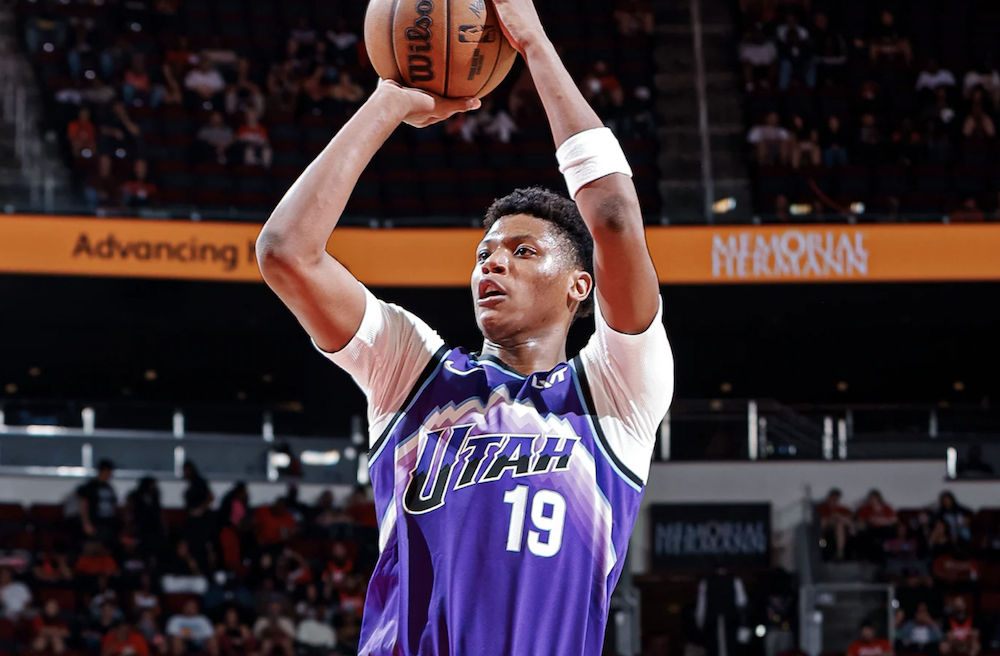
Every week during the regular season begins here at SCH with the Salt City Seven, a septet of recurring features that let us relive the biggest moments, key performances and hot issues in Jazzland from various angles. Check in every week for the quotes, stats, plays and performances that tell the stories from the last 168 hours in the world of the Jazz.

The Jazz are set to accelerate their ascent next season after acquiring an All-Star at the trade deadline. But the exact angle of their upward trajectory depends just as much on how many of Utah's current young reserves can be winning rotation pieces starting this fall.
Even before Jaren Jackson Jr.'s nascent Jazz career was put on hold due a growth in his knee, one of Utah's most important objectives this spring was going to be forecasting what they can reasonably expect from a largely unproven bench corps. Now, with Jackson being officially shelved for Utah's final 26 games, it could be argued that this is the single biggest remaining priority of their season.
The Jazz can pencil in a pretty impressive starting lineup for opening night in October, headlined by All-Stars Jackson and Lauri Markkanen. Around those two, they have the option of retaining defensive anchor Walker Kessler, they have an ascending guard in Keyonte George, and they have a precocious and bouncy teenager in Ace Bailey. In a perfect world, they'd love to spend their last trimester in sort of an extended training camp for that group, but alas, Jackson and Kessler aren't healthy anyway.
Beyond those five, they have a lot of unknowns.
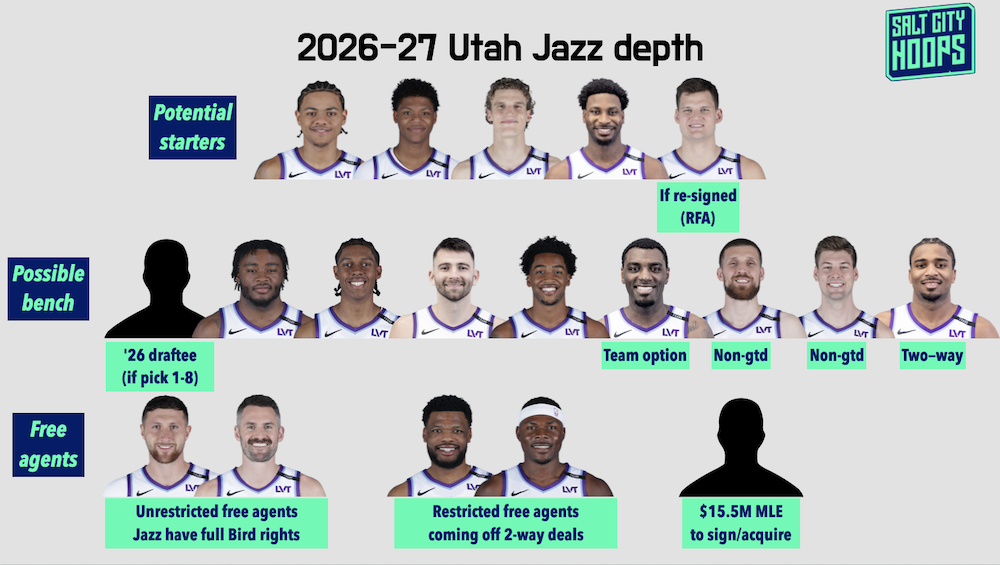
For the Jazz to really be cooking with gas next season, they need 3-4 guys on that middle row to be "rotation player on a good team" level. Or if not, they need to be prepared to use the $15.5 million mid-level exception and other tools to fortify their rotation with winning players. That means the pressure is going to be different for young Jazz reserves who until this month had the luxury of gradually plugging along in their respective development programs. Roster builders need to know specifically and imminently: who can help them win right away?
Nobody has really answered that definitively to date. Isaiah Collier, Cody Williams and Brice Sensabaugh have each improved, but all currently have negative on/off differentials. Kyle Filipowski is slightly positive, but his net rating is far better when he's at the four, a position where the Jazz just acquired an All-Star. John Konchar and Vince Williams Jr. were on the edge of the rotation for sub-.500 Memphis. Svi Mykhailiuk has turned into a steadying presence for the Jazz, but even he has never been a rotation regular on a .500+ team.
Frankly, even Bailey has some stuff left to prove if he's going to be part of a playoff-level starting five. He's a clear piece of Utah's future, and has surged lately with 16 and 5 averages in his last 13 games. But the offense and defense both improve when he sits, per Cleaning the Glass. That's perfectly fine for this season when the competitive ambitions are lower, but he can also use these last couple dozen games to show he's capable of being a winning player in the fall.
Because of Bailey's ceiling, he's likely to play a major role in next year's rotation either way. Same goes for whatever youngster the Jazz draft if they keep their top-8 protected pick. Extremely few rookies contribute meaningfully to winning in year one, but they'll want that player to be involved in the rotation. That makes it all the more vital that a few of their other bench guys are ready to have a steadying impact.
How much those guys can realistically impact a playoff-aspiring 2026-27 squad is likely the most pivotal future question left the Jazz can start to answer with this season's final 26 games.
(Digression alert:) Which is why it's completely crazy for the NBA to fine the Jazz for wanting to reallocate opportunities in support of those assessments. The Jazz are out of the playoff picture, and are under no obligation to pretend that winning any single game is more important to them than thoroughly evaluating what they need ahead of next season, a year in which they can actually compete.
I've already kvetched about the fine, but that's the truly frustrating part about this: even if the Jazz didn't own their pick at all in the upcoming draft, they'd still be closing some games with their young guys because that's what smart teams do when they're out of the playoff picture. The NBA intelligentsia sees Markkanen checking out of a game and cries, "Tankers!" but in reality, the Jazz already know what they need to know about Markkanen as it relates to their 2026-27 ambitions. They know much less about what they can budget for from Sensabaugh, from Filipowski, etc.
(Digression over.)
Back to the original point, expect the Jazz to spend much their remaining season gathering more info about Collier, Cody Williams, Sensabaugh, Filipowski, Konchar, Vince Williams Jr. and Mykhailiuk. All seven have NBA-level skills, but none of them are no-brainers to have careers as difference-makers on playoff teams.
- Collier's NBA skill is his ability to crack the defense at will and then make simple if-A-then-B reads. If he's not in an NBA rotation in five years, it will be because modern guards have to have some minimal level of shooting, and because the defense can still be rough.
- Cody's in the league because of his defensive understanding and peskiness. If he doesn't make it as a high-level rotation guy, it will be because it's hard for NBA teams to succeed with players who participate minimally on the offensive end.
- Sensabaugh is a silky-smooth scorer in a league where every team could use more shooting and creation on the wing. But league-average efficiency (.585 true shooting this year, .584 career) might not ensure him minutes on a contender if he doesn't start doing some of the other stuff more consistently.
- Filipowski is smart and skilled, with good vision for 6-foot-11 guy. He hasn't had great results at center, though, so to be viable long-term he needs to be able to guard fours and knock down shots (33% on catch-and-shoot 3s).
- Konchar's best version is a plus defender and a smart role player. At 6'5", he's a bit pigeonholed on defense, so his value is somewhat more lineup-dependent.
- Vince carved out a rotation role by playing great defense, and by having one really solid outside shooting year. But he's a sub-30% shooter since then, and as with Collier, non-shooting guards are going out of style to some degree.
- Mykhailiuk has shown value as a connector, emergency playmaker and a decent enough shooter to be a pressure relief valve for other guys. He's just an OK athlete, but probably the closest thing in this group to an established rotation guy.
Again, Utah doesn't need to hit on ALL of these guys for 2026-27 to be more competitive. Even if just a few are ready to contribute to a winning outfit, things could get interesting fast.

"(Recent defensive improvement) is a combination of a lot of things: the attention to detail was very good, the communication was good, the physicality was good. You know, we also added a guy to our roster who has been Defensive Player of the Year.
"That first group — (Jusuf Nurkic), Jaren and Lauri — we have a lot of size. And then we start subbing and two of them are on the court for the majority of the game. Those guys have done a good job of protecting the paint as a group, but ... everybody has to do their job in this league to guard."
- Will Hardy, after the win in Miami, speaking to what has changed about the defense.
Of Utah's five best games of the year in defensive rating, three have been the games Jackson played in. His individual DRtg in three Jazz games has been 95.0, 96.4 and 78.4.
Of course, Miami and Orlando are middling offenses, and the Kings are cellar-dwellers. But there's a chance we have no idea just how much Triple-J could rescue Utah's defensive identity overnight. That's especially true when he and Kessler are taking turns sending opponents' shots and drives back.
Over the last four seasons (starting with his DPOY year), Jackson has allowed opponents to shoot just 52.4% at the rim when he's challenging. That's an insane number to sustain over a 4-year stretch. Oh and by the way: Kessler's career figure over that same span is 52.6%. Only Chet Holmgren and Isaiah Stewart have as low a rim FG% allowed with at least 200 contests this season. Two guys in the entire league, and the Jazz could have two in the same starting frontcourt come October.
With both of those paint protectors sidelined, the Jazz will almost assuredly finish this season 30th in defense for the third straight season. But Utah's secret weapon next season could be based on an overnight defensive transformation led by those two.

-15
The Jazz erased a 15-point deficit to defeat Miami on Monday, tying the largest disadvantage they've overcome in a win this year. They also came from 15 down in their January home win against the Wolves.
92.1
The best version of Sacramento is... not a good basketball team. The version that visited Utah last week was even more steps removed from a quality squad, so take this next stat with a grain of salt: Utah's 92.1 defensive rating was 10.8 points better than their next best defensive outing.
#10
Sensabaugh's 28-point night on Thursday moved him into 10th all time for Jazz games with four threes or more.
11
Blake Hinson also made some weird Jazz history that night: his 11 points were the most ever by an undrafted Jazz player in a league debut game.
9+
Collier's streak of six straight games with 9+ assists matches the longest of his career. The only Jazz players to have streaks at least as long are Rickey Green, John Stockton and Deron Williams, who last did it in 2011. Stockton once had 61 in a row.

To further illustrate the point above about youth minutes being a worthy end unto themselves, let's look at an ingredient in Monday's win that was extremely important: Bailey's off-the-bounce creation.
Look, if Markkanen plays this fourth quarter, they're just not drawing all these plays up to let the rookie attack with an advantage. They basically made Bailey the guy with the ball in his hands down the stretch of a close game, and the impact of that is huge as you think about where the Jazz view His Airiousness' trajectory taking him.
A lot of Bailey setups are drawn with flair screens so he can go to the outside where his first step and athleticsm are best unleashed. The screener's man doesn't switch correctly, and Bailey's guy pauses with his momentum going toward Bailey, so the rook just cooks him. It worked so well that they run a same flare setup on the next play. This time the screener's man is there for the switch, so Bailey just takes him one direction and then spins back into the gap he created.
Watch his footwork closely on that move. At game speed it just looks like an athlete making an athletic play, but he actually executes a perfect drop step that completely neutralizes the defender. A drop step is when you spin toward the basket but seal your position by bringing your leg around the defender's. Once Bailey gets that leg in front, there's almost no way for his defender to challenge without fouling. It's subtle but extremely effective. The fact that Bailey executes that as a live read is just a clue at how much he's thinking the game, even on what looks like a pretty straightforward drive.
They go back to Bailey later on another flare cut. He takes one bounce, covers a ton of ground on a jump-stop, and finishes despite five Heat players being within arm's length.
Utah turning over its offense to Bailey down the stretch of a road game against a likely playoff team is awesome experience for him. This is one of the games Utah was fined for not closing with Jackson and Markkanen, but they're clearly putting Bailey in a chance to succeed here with smart play-calling, and him having these opportunities will be huge as he continues down his NBA path.

The Jazz went into the break fresh off a 2-1 week, which means we have some work to do in the Game Ball department:
Jazz 115, Heat 111: Jaren Jackson Jr. Let's get the All-Star on the board, shall we? Sensabaugh hit the go-ahead three and then sealed the game with free throws, but Jackson was more potent overall, including with 17 points in the first half. His final numbers were 22 points (for the second straight game), five boards, three assists and two steals. And once again that was without playing at all in the fourth quarter. He had the best +/- by a mile at +15.
Jazz 121, Kings 93: Jaren Jackson Jr. This has to be Trip again, right? His third straight 20+ game since joining the Jazz started with a 12-point first quarter, and that's really all the Jazz needed to put the Kings in the rear view mirror. He was efficient with 8-for-13 shooting, with seven of those buckets coming off the dribble drive. Final line was 23 points, 4 rebounds, +27 (game high) in 22 minutes. Markkanen and Sensabaugh each added 19, Collier had 14 assists.
Strong in defeat:
- Jazz 119, Blazers 135: Brice Sensabaugh. Brice was cooking all night, finishing with 28 points on 19 shots. There was a moment when I might have considered Collier given that he did more of the other stuff (15 points, 9 assists, three steals), but Sensabaugh wound up sort of demanding this through sheer volume (and to be fair, he also had four rebounds). Mykhailiuk also had a fun little explosion with 14 late points after Williams Jr. was ejected.

The Jazz will ease back into things after All-Star with just a single game before having the rest of the weekend off.
Friday 2/20 at Grizzlies: This would have been a fun reunion game, but Jackson's injury puts a damper on that storyline. It will still be a homecoming for John Konchar and Vince Williams Jr., as well as a potential revenge game for former Jazzmen Taylor Hendricks, Walt Clayton Jr. and Kyle Anderson. The Grizzlies are winless since the trade deadline, and have lost 10 of 12 overall. Ja Morant last played on January 21, but the Grizzlies have roughly the same success rate without him (13-20) as they do with him (7-13). Zach Edey is also out long-term, and Cedric Coward hurt his knee right before the break.

Bailey's entire Rising Stars media session is up on the Jazz's YouTube, and as usual the 19-year-old was full of joy and fun answers. A few highlights:
- He shared that Anderson and Georges Niang were his go-to vets when the season started. Now that they have moved on, he is spending more time with Nurkic, Kevin Love and Jackson. Interesting that he singled out Jackson just 10 days after the trade.
- Relatedly, he talked about the surprise of going through his team's first in-season trade. "Anything can happen.... Wow."
- He also had some nice things to say about his chemistry with Collier. "That my dog, man."
- Hardest NBA guys to guard? Luka, SGA and Wemby. But his "welcome to the NBA" moment was guarding Devin Booker.
- Would he ever take part in the dunk contest? "I wish," he said, while also noting that it comes with a lot of pressure.
- While attempting to answer a question about his best dunk, he said, "I've made so many dunks, I don't even remember." The number is 55. "That's a lot of dunks."
- "All that fast food is done," he lamented when talking about NBA lessons. In particular he misses McDonald's and Waffle House.