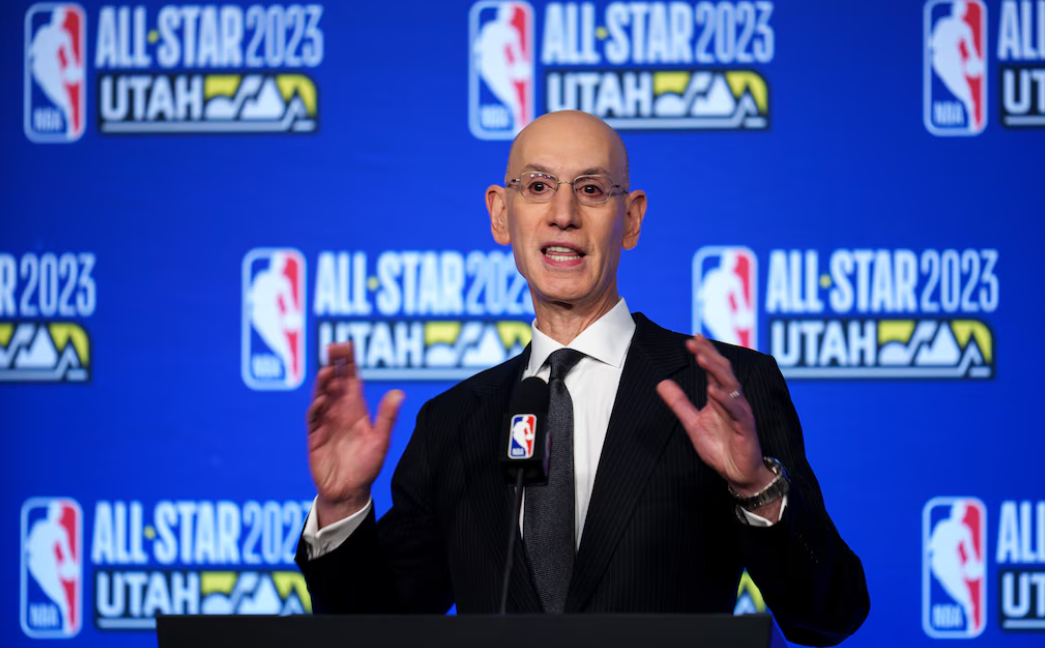

The NBA sent an unprecedented and uncomfortable message to NBA teams on Thursday when it levied a $500,000 fine against the Utah Jazz. League commissioner Adam Silver basically told the basketball world: Our league office attorneys will decide whether your rotations make sense or not.
The league has never before issued a fine based solely on playing time allocation or substitution choices, but that's what they did on Thursday. In justifying the massive penalty, the league specifically cited in its release Utah's decision to sit Lauri Markkanen and Jaren Jackson Jr. in the fourth quarter of recent close games. Forget everything else about this situation and consider whether you think it's a good precedent to set that a bunch of guys in custom suits can tell a coach what rotations he is allowed to run.
Forget that Jackson was on a minutes limit so he could get a few games under his belt without exacerbating a growth the Jazz medical staff found in his knee. And that Markkanen was also on a medically-imposed minutes limit, his coach shared after the fine news came out.
Forget that the Jazz won one of the games referenced in the league's release, and is 3-3 over its last six games.
Forget that in the SAME release the NBA suggested that another team avoid fines by having players "play reduced minutes."
Forget that the whole uproar may be the result of OKC's general manager stirring up his peers in his own attempt to land a lottery pick.
Forget that most fans would probably rather see their team's best players play some minutes rather than play no minutes.
Forget that Markkanen's 16th in the league in minutes per game at 34.4, and Jackson has averaged over 30.
Forget that several other teams are shutting down half their rosters at a time.
Those are all pretty salient points here, but put them all to the side for a moment and ponder this more fundamental question: should the league be able to decide when a coach can and cannot sub players in and out of games?
There are myriad reasons a coach/team could choose to play certain players at a particular juncture of a game or season. One is to win games, but that's far from the only thing that goes into the calculus. Even playoff teams sometimes make playing time decisions in pursuit of some long-term payoff at the expense of X% of win probability, such as when a contending team wants to develop and evaluate a young player who isn't really a positve wins-added player. Load management is another reason why coaches — even on contenders — accept the trade-off of a lower win probability on a given night for long-term success. They might want to test certain combinations, see how a particular player performs in a larger role, make an agent happy, reward a player for working hard in practice... whatever.
The league has decided to selectively punish the Jazz because their decision ostensibly impacted their likelihood of winning, but so do decisions made by every single coach in every single NBA game. Denver's net rating is 16.5 worse when Nikola Jokic is not on the floor, so every second that he sits is lowering their likelihood of winning. But of course, he still needs to sit because Denver has to protect his ability to help them win tomorrow and next week and next year, as well as develop other players and test other configurations they might need if, heaven forbid, Jokic got into foul trouble in a playoff game.
Of course, nobody's mad that Jokic isn't playing all 48 minutes. But the NBA explained that it fined the Jazz because Markkanen and Jackson were "otherwise able to continue to play," in their words. If that's the standard, who gets to make the determination when a 33-minute night for Star Player X is acceptable but 29 minutes for Star Player Y is an insult to competitive integrity?
Let's pretend for argument's sake that the Jazz didn't own their pick at all. Would they behave any differently? At some point when a team knows it's not playoff-bound, it's almost irresponsible to chase pyrrhic wins when you could instead be exploring other questions about your personnel and future. The Jazz won in Miami because Brice Sensabaugh hit two clutch threes, Ace Bailey had success creating off the dribble, and Cody Williams played great defense. Irrespective of outcome, are the Jazz not allowed to evaluate how their recent first-round picks can perform when featured in high-leverage situations? Isn't that critically important as they analyze how to be more competitive next season?
Look, nobody's naive to how 2025-26 game outcomes impact the Jazz's future talent profile. But the point is: that's not their only motivation. Closing games with Sensabaugh or Isaiah Collier or Kyle Filipwoski could make the Jazz better next season, when the wins will actually matter to their franchise.
And even to the degree that Utah did this specifically to enhance their lottery odds, Utah's far from alone in this exact behavior. As one national media member pointed out, Toronto had this same practice down the stretch of last season and got fined a grand total of $0. But you don't even have to go back that far! Here are a few examples of sub-.500 teams making, umm, curious closing rotation choices in games that were still winnable, all from the last few weeks:
- Sacramento held a fourth quarter lead against the Clippers. Zach LaVine, DeAndre Hunter, DeMar DeRozan, Russell Westbrook and Malik Monk had all played, but they oddly chose to close the game (an eventual 3-point loss) without any of them.
- Memphis had a chance to win in Golden State on Monday, up 13 going into the fourth. They closed with Jahmai Mashack and Javon Small over their veterans, lost the quarter 29-15, and didn't even call a timeout after GSW's go-ahead bucket with 19 seconds left — or after recovering Mashack's miss.
- Washington was in a back-and-forth contest with Sacramento on 2/1 and chose to pull all of their starters and close instead with a lineup of 10-day signee Skal Labissiere, their two-way guys, and seldom-used Anthony Gill. As with Utah, they won this game against co-tanking Sacramento, in their case because Labissiere, who had been out of the NBA for most of the past five seasons, randomly exploded with a 9-point quarter. (They also had a game where they started to cut into Brooklyn's lead in the third quarter, and then the starters were promptly replaced by a different 10-day signee, two-way guys Sharife Cooper and Jamir Watkins, and Gill.)
- Brooklyn gave two of it starters just 20-21 minute in an overtime game and chose instead to rely on Nolan Traore for 37 minutes in a winnable home game against Boston.
- Sacramento also abruptly sat a healthy Domantas Sabonis as well as LaVine, Monk and Westbrook down the stretch of a game they were winning by six against Memphis.
Each of those situations was at least as dubious as the Jazz's and yet none of them got fined. And that's OK! Because there are dozens of reasons why coaches might have wanted to see some run from Traore over Egor Demin, or Nique Clifford over LaVine, or whatever! But the fact that teams have made eerily similar decisions to the Jazz's to no consequence is why the NBA's consternation rings pretty hollow. The only team fined for the specific behavior of altering late-game rotations was the one who owes a conditionally protected first-round pick to Oklahoma City. Could that be why Thunder GM Sam Presti is riled up about tanking?
It rings even more hollow when in the same memo in which they announced Utah's fine, they suggested that Indiana consider having their own stars "play reduced minutes." WHAT?!?! Do they even hear themselves?! What a beautiful example of the inconsistency that has frustrated the Jazz on this topic, when in consecutive paragraphs the NBA's official message talks out completely different sides of their mouth.
In fact, the NBA fined Utah last year for sitting Markkanen altogether. So Utah adjusted. This more recent approach of playing him reduced minutes is exactly what the NBA is directing Indiana to do to avoid further fines.
You can't convince me that Markkanen and Jackson playing three quarters is worse for the product or for the fans than them playing zero. In Orlando, Markkanen dunked the ball five times, hit some threes, partnered beautifully with his new frontcourt mate, and then got out of the way so that Bailey could have a 3-for-5 quarter and Filipowski could pile up 9 points and 5 boards. Oh the shame! Why are we mad about that?!
The Jazz have a week off now to stew in their anger over the naked hypocrisy of this fine. In the meantime, everybody and their grandmother will float lottery reform proposals that almost certainly carry consequences far worse than the situation they're trying to correct. Then they'll get back on the floor next Friday and try dance around to the league's self-conflicting direction as they try to avoid fines while also honoring their long-term goals.
When they do, the coaching staff had better keep those lawyers on the phone to approve every sub and lineup decision.