Every week during the regular season begins here at SCH with the Salt City Seven, a septet of recurring features that let us relive the biggest moments, key performances and hot issues in Jazzland from various angles. Check in every week for the quotes, stats, plays and performances that tell the stories from the last 168 hours in the world of the Jazz.

With so much intriguing but unproven youth on the Jazz's roster, some fans react to veteran minutes as though they're being asked to eat their vegetables. But the few vets on this roster are getting playing time for specific and obvious reasons. Let's explore those reasons and the vets' impact.
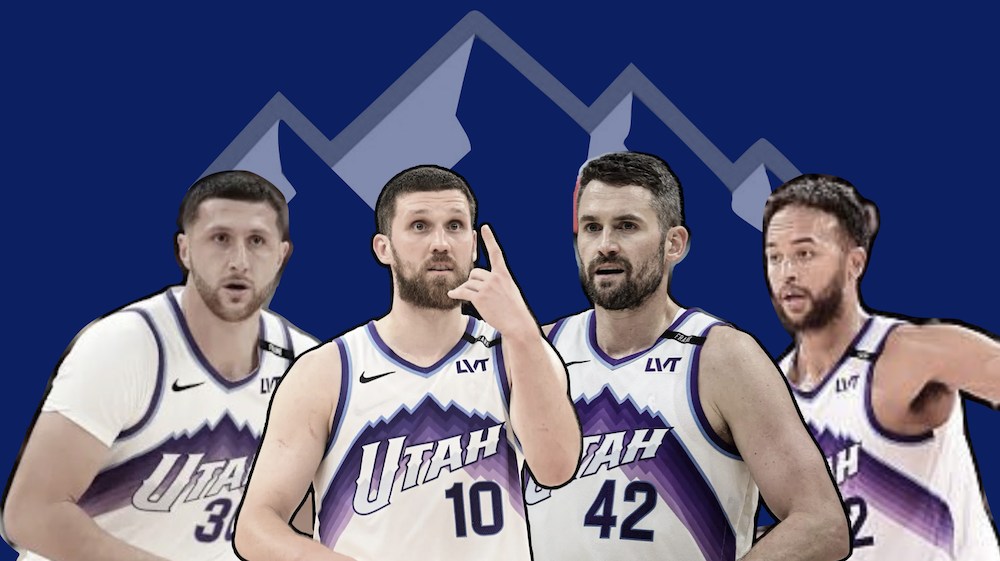
Utah's main roster is comprised of Lauri Markkanen, nine recently drafted youngsters, and five non-star veterans who landed here through Utah's rebuilding transactions. Those five, at 28 to 37 years old, have more established ceilings than the nine kiddos, so fans would naturally prefer to explore the unknowns. But circumstances have demanded perhaps more of these elder statesmen than was originally budgeted.
Svi Mykhailiuk, 28, is playing the most of this group, and is actually third on the team in total minutes. This is surprising, to be sure. Even your trusty scribe thought back in October that the ball-handling wing would be just a placeholder starter. But he's honestly been pretty solid in some crucial ways. He executes well on both ends, doesn't demand a ton of shots, and has .600-plus true shooting when he does fire.
Mostly his extended presence comes down to Utah needing more ball movers and pick-and-roll operators. Certain lineups just lack a ton of creation ability, including the starting group. Neither Markkanen nor Jusuf Nurkic are thought of as initiators, and Ace Bailey isn't quite there yet. So without a second P&R runner, teams could just focus on making Keyonte George's life hell. Other starter options with that group would either lack the creation juice (Taylor Hendricks/Cody Williams), make the Jazz small (Isaiah Collier/Walt Clayton) or put too many minus defenders on the floor at the same time (Brice Sensabaugh/Kyle Filipowski).
Svi probably doesn't stay in the starting lineup forever, but right now he complements the other four well enough. Opponents shoot below their expected FG% with him guarding, and he knows what the Jazz want from him in their sets. Fans don't love all of his shots, but his usage is only 13%.
The 31-year-old Nurkic wasn't supposed to play nearly this much, but Walker Kessler's injury left him as the only real center on the roster. As a result, he's firmly in the top five for minutes. He doesn't really score at the rim anymore and his paint defense doesn't strike fear into anybody. But he rebounds well and has an elite passing profile for a big.
He's primarily on the floor because he's a big body and a good screener. The Jazz want the basketball environment to be organized in a way that makes sense for development, and teaching these guys their place in a P&R offense just isn't going to work with Hendricks (or even Markkanen) regularly functioning as a screening big.
That's the same reason Kevin Love has played 204 minutes for the Jazz at age 37. Even he's not a real center, and the Jazz feel that on defense. But he at least has the know-how to make the offense run like it's supposed to. He's mostly popping off of screens (and shooting 41% on catch-and-shoot threes), which is still helpful in that it's giving guys reps in an offensive setting that's logical. Weird stat: the Jazz halfcourt offense is 20.7 points better per 100 possession with Love on vs. off; no player in the impacts his team more. (Also, no player has as wide a gap in the other direction on defense: the Jazz's overall D is 23.6 points worse.)
Kyle Anderson, 32, is barely playing, so any misgivings about his role are probably exaggerated since he's literally last among regular roster players in minutes. And his minutes are also somewhat related to the absences in the big man rotation. The Jazz are really focused on developing Filipowski at the 4, so when Love rests on back-to-backs, pay attention to how the Jazz are actually utilizing Slow-Mo; he's functionally the center in those lineups. More than half of his time in the floor (140 of his 217 possessions played) has been in lineups with no Kessler, Nurkic or Love. Watch his role, he's basically the third center now.
(Georges Niang hasn't debuted yet, but there will probably be some minutes for him at some point, too.)
The other reason those four are playing is because so many of Utah's 22-and-under players still struggle at times to understand the game plan and their role in it. It's not a bad thing for young guys to have to satisfy certain conditions before they're granted playing time. The benefit of having vets who know what they're doing is that the coaching staff can point to those guys and say to the youngsters, "Just play that hard and execute like him and you'll get in."
These guys practice and play together enough. They know if, say, Mykhailiuk outplays one of the youngsters in scrimmage and then the young guy gets the minutes anyway. The reward system needs to be more tuned to the inputs, at least as far as execution and effort go.
Unless the Jazz alter their roster, it's fairly likely we'll continue to see these vets contributing. Mykhailiuk's handling, Nurkic's screening, Love's popping and Anderson's chameleon-like versatility are helping the Jazz create a meaningful basketball ecosystem for the other 10 dudes, and giving the youth a bit of a model for how to earn trust and minutes.

"It would mean a lot to see this rebuild through. For me, the journey of getting better and better as a team and then finally breaking through means a lot to me. I would love to be a part of the next great Jazz team."
-Lauri Markkanen, in a piece by Tony Jones of The Athletic
This is exactly what you want to hear you're the Utah Jazz. This is the lone All-Star on a team full of NBA babies signaling that he's OK being patient while the Jazz figure out their core for the next competitive version. At least for now, this is the opposite of a trade request; he sounds like he prefers to stay even if it means waiting for his first taste of playoff basketball.
It's kind of admirable that Markkanen would prefer to burst onto the postseason stage because he helped carry the Jazz there, rather than as a mercenary for some already-loaded squad.

3-2
Here's a weird little fact about the 2025-26 Jazz: they actually have a winning record on the second night of a back-to-back. In fact, Monday's bounceback win against Houston made them 3-1, but then they didn't play well on their second straight night in Gotham. The Monday game was also Houston's first back-to-back, and it clearly affected their older group. In particular, the rest night for their best rebounder hurt them since second-chance points are a pretty vital ingredient to their offense. (Utah actually beat them 24-20 on second points.)
7.6
Speaking of back-to-backs, the Nets were on one when the Jazz visited Brooklyn, and they also set Cam Thomas and Michael Porter Jr. That made this onea near automatic win; in fact, the combined career averages of the 11 available Nets that night was just 83.9 points per game, meaning their average opponent that night was a career 7.6 scorer.
124.3
New York's 124.3 output in halfcourt offensive was one of the very best of the entire NBA season. The Jazz kept them from running a ton, but it turns out they didn't need to because they were so potent in the halfcourt.
11
Eleven first-quarter threes is just silly, and it's why Utah was never really in it against OKC on Sunday. They've trailed opponents by 35 or more on five occasions this year, including in their two most recent games and in both Thunder trips to Salt Lake City.
23.6%
Identify-wise, it's clear that the Jazz care a ton about denying opponents the paint. Their opponents get less than a third of their attempts and shooting fouls drawn at the rim, the lowest figure in the league. The problem is, once they get there they make 71% of them, the second worst rim defense figure.

The Jazz talk a lot about building the advantage over the course of a play. Sometimes the first action gives a player all the advantage he needs to shoot wide open, attack the basket, or create something for a teammate. Much more often, if you take that advantage into a subsequent action, you can really start to generate something that increases your chance of offensive success.
That's how you wind up with one of the NBA's most prolific catch-and-shoot threats being left wide open.
Watch how much pointing and talking happens on that first play. That's the Jazz figuring out match-ups and deciding what they can exploit. As a result of that quick collective analysis, it looks like they change the play here based on this communication between Nurk and Markkanen on what they're seeing.
Mykhailiuk realizes what they want and bring his guy (a poor defender at this point) into the screening action. That creates the first advantage, and nobody would have been upset — make or miss — if George had taken that first open three that resulted from Svi's little brush screen. But they keep building. George attacks the bad closeout in a way that forces Mykhailiuk's new defender to stunt, and again they have an advantage for a good corner shooter, but again Mykhailiuk decides instead to let his defender get off balance and put the defense into "oh crap" mode. Reed Sheppard completely leaves Key, so Bailey's and then Markkanen's defenders have to scramble away from them, leaving a 50% corner shooter open.
The other cool thing about this play is that Markkanen is clearly supposed to be involved in the first action, but opts out of it because he realizes the Jazz's best advantage comes by setting up the play another way, and then he ultimately benefits anyway.
The second clip on that video works primarly because Brooklyn's in desperation mode and trying to speed the Jazz up late in a 3-possession game. George makes the right pass when they put two on the ball, and Markkanen keeps it just long enough for Clayton's defender to full shift. That leaves nobody in front of the rookie guard, so his drive draws three defenders. Filipowski and George know they're passing the second the receive it. Markkanen gave the ball up to create an advantage, and then got it back after that advantage had been compounded.
Again on that one, Markkanen is humble enough to not make the play about him, but ultimately cashes in.

Based on their performance in this week's two wins, you pretty much have to go one game ball for Markkanen (59 with 16 rebounds over the two wins) and one for George (57 with 18 assists). I distributed them this way:
Jazz 133, Rockets 125: Keyonte George. It felt more appropriate to give George this one, since in addition to his 28-4-8 line he came up with two big defensive plays that sealed the win late. The six TOs were the only reservation, but he was the slightly more efficient of the two. Markkanen was also awesome (29 & 8) and had more responsibility defensively. The bigs also played well: Nurkic with 18, Filipowski with 12-7-3.
Jazz 123, Nets 110: Lauri Markkanen. That leaves this one for Markkanen, which feels appropriate given that it was his ninth 30-point game. Only Adrian Dantley (five times), Karl Malone (once) and Pete Maravich (once) ever had more 30-point games up to this point in the season. Markkanen was also aggressive in this one, yamming all over dudes and taking guys off the dribble. That said, I'd be perfectly fine swapping these two and recognizing George's 29-5-10 night in Brooklyn. It just felt like for these games, they had to split them. Flip had 15-8-5 as a fill-in starter, and Clayton (13-3-3) looked good off the bench.
Strong in defeat:
- Jazz 112, Knicks 146: Lauri Markkanen. Hard to know what to do with this one. On the one hand, the starters allowed the Knicks to surge with a 23-0 start. On the other hand, the top bench performers mostly just used garbage time to salvage their stats: all 11 of Clayton's points came in the fourth, like 11 of Collier's 13. So the simplest thing to do is to reward the best overall performer, and that was Markkanen (18-9-2 and the lowest defensive FG% on the team in MSG).
- Jazz 101, Thunder 131: Walter Clayton Jr. With all due respect to high scorer Filipowski, Clayton and Hendricks both pulled in career highs with their first ever 20-point games. Clayton's was a bit more complete with the nine assists, and he also played more and was more centrally involved in everything in a game with no Markkanen. But both he (8/12) and Hendricks (6/10) were efficient, and Flip's 21 and 10 would make him a fine pick too.

Weirdly, because of in-season tournament makeup games, the Jazz only have one game in the next seven nights.
Friday 12/12 @ Grizzlies: The Grizz are surging, at 7-2 in their last nine despite the fact that Ja Morant played in none of those games. Jaren Jackson Jr. is averaging 4-year lows in points, rebounds, blocks and steals. They've been getting help from a lot of different directions, as seven guys are averaging double figures over this 9-game stretch.

Plenty of fun stuff this week:
- The Jazz had a Jordan Clarkson sighting and a visit from Andrey (his new spelling) Kirilenko, just 48 hours apart.
- I can't think of two guys whose place in all-time Jazz history are more fun to debate, just becaue their contributions and personalities were so unique. I did a bunch of research and thinking about this for a historical project that has not yet seen the light of day. And in my careful calculations, Kirilenko probably deserves to be pretty dang high. He's third in career wins above replacement and fifth in win shares. His 2003-04 season was the single best value over replacement season by a Jazzman not wearing #12 or #32. He is top five in franchise seasons, minutes, steals, blocks, and top 10 in points, rebounds and assists. His Jazz peak wasn't quite as high as Deron Williams or Carlos Boozer from his same era, but he spent four more seasons with the club than either of them (and twice as long as Donovan Mitchell), so the cumulative impact is likely higher. Someday I'll release my history thingy, and fully lay out the case, but AK should honestly be pretty stinkin' high.
- Clarkson also had a special Jazz career. He's no worse than the second best bench scorer in franchise history. He probably has to rank behind most/all of the 16 Jazz All-Stars (exception being Truck Robinson, who was an All-Star and first-team All-NBA as a Jazzman but only spent a season and a half). He's not ahead of Jeff Hornacek, and there's also a tier of the very best Jazz role players I'd put just ahead of him based again on total impact: guys like Darrell Griffith, Thurl Bailey, Derrick Favors, Paul Millsap and even same-era benchmate Joe Ingles. That's 21 guys. After them, there's a group of short-lived almost-stars (Al Jefferson, Bojan Bogdanovic, Jeff Malone) and longer-term role players (Greg Ostertag, Bryon Russell) and that's the group where I think you can articulate a case for JC next to any of them. That means he's probably somewhere between 22 and 28 all-time, depending on how you weigh peaks, longevity, and of course vibes.
- ESPN's Tim Bontemps weighed in on George's third-year leap.
- Here's what Kirilenko said on the Jazz-Thunder broadcast about Bailey: "He's very talented... The movement is amazing, he's shooting well. But again, he needs to learn the game. It's not about scoring the basket. It's about strategically: where you need to be in the right moment of the game, how to cut right, how to be in the right position. Because everything else, he's got it."
- Oh man, that Nurkic suit.